



Ever caught yourself speaking through clenched teeth during a tense moment and thought, “Why do I sound like this?” Yeah, same here. The first time I stumbled across the word dentiloquent, I laughed, paused, and then leaned in. It sounded oddly specific… and honestly, a bit dramatic. But once I dug deeper, dentiloquent turned out to be one of those rare words that feels niche yet weirdly relatable.
So let’s unpack it properly. No stiff linguistics lecture. No dictionary overload. Just a clear, friendly, human explanation of what dentiloquent really means, why it exists, and why people across language, psychology, and communication circles still care about it.
What Does Dentiloquent Mean?
Let’s start simple.
Dentiloquent describes a way of speaking that involves the teeth often talking through clenched or nearly clenched teeth. The word traces back to Latin roots:
dens = tooth
loqui = to speak
Put them together and you get “speaking with the teeth.”
Straightforward, right?
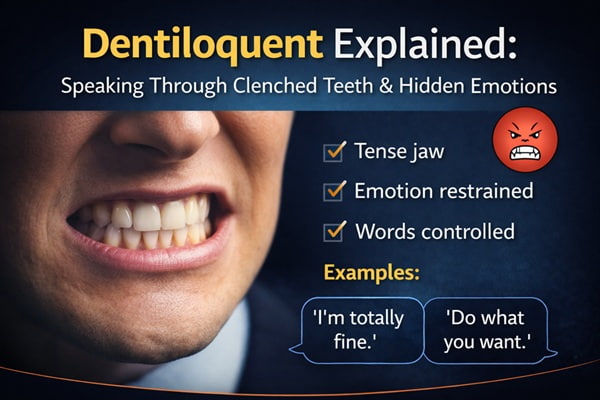
But dentiloquent doesn’t just describe how someone speaks. It often hints at emotion, tension, restraint, or control hiding behind the words.
Ever heard someone say, “I’m totally fine,” while their jaw looked like it could crack a walnut? That’s dentiloquent energy.
Why Dentiloquent Speech Feels So Familiar
Here’s the funny part: even if you’ve never heard the word before, you’ve definitely experienced it.
Think about moments like:
Holding back anger during a meeting
Trying to stay polite when you’re not thrilled
Delivering sarcasm with a tight smile
Speaking calmly while internally screaming
Dentiloquent speech shows up when emotion wants out but social rules say “don’t you dare.”
IMO, that’s why the word sticks. It captures something very human.
Dentiloquent vs Normal Speech
Let’s compare this in real-world terms.
Regular Speech
Relaxed jaw
Natural articulation
Emotion flows freely
Dentiloquent Speech
Tight jaw or clenched teeth
Constrained articulation
Emotion stays filtered
One sounds open. The other sounds… controlled.
And control always tells a story.
Is Dentiloquent a Bad Thing?
Short answer: not at all.
Dentiloquent speech doesn’t equal poor communication. It simply describes a speaking style, not a flaw.
In fact, dentiloquent moments often show:
Emotional intelligence
Social awareness
Self-restraint
Professional control
That said, constant dentiloquent speech can signal stress or suppressed emotion. Balance matters.
Dentiloquent in Everyday Life
You’ll hear dentiloquent speech more often than you think.
At Work
Someone disagrees but stays professional.
“Let’s circle back on that idea.”
Translation? I hate this idea, but I won’t say it out loud.
In Relationships
Conflict meets politeness.
“Do whatever you want.”
Yep. Dentiloquent classic.
In Public Speaking
Nerves tighten everything.
First-time speakers often sound dentiloquent because tension creeps into the jaw.
Dentiloquent vs Similar Speech Terms
This is where things get interesting.
Dentiloquent vs Dentiloquy
Dentiloquent describes the style
Dentiloquy refers to the act or habit of speaking through the teeth
Dentiloquent vs Dentilingual
Dentilingual focuses on tongue-to-teeth articulation
Dentiloquent focuses on tone, tension, and restraint
Dentiloquent feels more emotional. Dentilingual feels more technical.
Why Linguists Even Care About Dentiloquent Speech
Linguists love patterns. Dentiloquent speech reveals a lot about:
Emotional states
Social dynamics
Speech mechanics
Cultural norms
FYI, many languages associate tight-jaw speech with politeness, authority, or suppressed anger. That connection isn’t random.
Speech always carries more than words.
Dentiloquent and Body Language
Speech doesn’t exist alone.
Dentiloquent moments often pair with:
Forced smiles
Minimal lip movement
Rigid posture
Controlled gestures
When the body and voice tighten together, listeners feel it even if they can’t explain why.
That’s communication psychology in action.
Dentiloquent Speech in Media and Film
Once you notice it, you’ll see it everywhere.
Villains often speak dentiloquently right before losing control. Politicians use it during uncomfortable questions. Characters in dramas lean on it to signal tension without shouting.
It’s subtle. It’s powerful. And it works 🙂
Is Dentiloquent Speech Intentional?
Sometimes yes. Sometimes no.
Unintentional Dentiloquent Speech
Stress
Anxiety
Nervousness
Emotional restraint
Intentional Dentiloquent Speech
Sarcasm
Authority
Controlled confrontation
Dramatic effect
Actors and speakers often train this tone deliberately.
Dentiloquent and Emotional Suppression
Let’s be honest for a second.
Dentiloquent speech often appears when emotions stay bottled up. The jaw tightens. The words stay polite. The feelings stay trapped.
Occasional restraint helps social harmony. Constant restraint burns people out.
If you notice dentiloquent speech becoming your default, your body might be asking for a break.
Cultural Perspectives on Dentiloquent Speech
Different cultures interpret dentiloquent speech differently.
Some see it as respectful
Others read it as passive-aggressive
Some associate it with authority
Others link it to emotional suppression
That flexibility explains why the term still matters globally.
Dentiloquent Speech in Professional Communication
Professionals rely on dentiloquent speech more than they admit.
Why?
It keeps conversations civil
It prevents emotional escalation
It maintains authority
But overuse can make someone sound cold or distant. The trick lies in knowing when to relax the jaw.
Can Dentiloquent Speech Affect Clarity?
Yes, sometimes.
Tight jaw movement can:
Muffle pronunciation
Reduce vocal warmth
Limit expressiveness
Speech coaches often work on jaw relaxation for this exact reason.
Clear speech needs physical ease.
How to Recognize Dentiloquent Speech in Yourself
Ask yourself:
Does my jaw feel tense when I speak?
Do my teeth touch often while talking?
Do people say I sound “controlled” or “tight”?
Awareness alone already helps.
Reducing Excessive Dentiloquent Speech
If you want to loosen things up:
Take slow breaths before speaking
Relax your jaw intentionally
Stretch facial muscles
Pause instead of clenching
Small changes make a big difference :/
Why Dentiloquent Remains a Relevant Term
Some words survive because they capture human behavior perfectly. Dentiloquent does exactly that.
It names something we all experience but rarely label.
And naming things helps us understand them.
Also Read : transds Explained: Meaning, Uses & Future of Digital Systems
Key Takeaways About Dentiloquent
Dentiloquent describes speech involving the teeth
It often signals emotional restraint or control
It isn’t bad it’s contextual
Overuse may hint at stress
Awareness improves communication
Simple, but surprisingly deep.
Frequently Asked Questions About Dentiloquent
What does dentiloquent mean in simple terms?
It means speaking through or with the teeth, often with a tight jaw.
Is dentiloquent speech intentional?
Sometimes. It can also happen naturally during stress or restraint.
Is dentiloquent the same as angry speech?
Not exactly. It often hides emotion rather than expressing it openly.
Do professionals use dentiloquent speech?
Yes. Many professionals rely on it to stay composed.
Can dentiloquent speech affect pronunciation?
It can slightly reduce clarity due to jaw tension.
Is dentiloquent a medical condition?
No. It’s a descriptive linguistic term, not a disorder.
Can someone train dentiloquent speech?
Actors and speakers often practice controlled jaw speech intentionally.
Final Thoughts on Dentiloquent
Here’s my honest takeaway.
Dentiloquent sounds fancy, but it describes something deeply human. It’s what happens when emotion meets restraint, when words behave better than feelings.
Once you recognize it, you’ll hear it everywhere in meetings, movies, conversations, and even yourself.
And maybe that awareness helps you choose when to hold back… and when to finally unclench your jaw and speak freely.