




Ever wondered if your birthday is as unique as you are? While every birthday is a cause for celebration, some dates on the calendar are statistically far more exclusive than others. This isn’t just a matter of chance; it’s a fascinating intersection of holidays, modern medicine, and even cultural beliefs.
This article dives deep into the data to reveal the number one rarest birthday in the world. We will also explore the top 10 least common birth dates and unpack the surprising reasons why so few people blow out their candles on these specific days. Get ready to see the calendar in a whole new light.
The #1 Rarest Birthday in the World
Unsurprisingly, the undisputed rarest birthday on the planet is February 29th, also known as Leap Day. Because this date only occurs once every four years, the odds of being born on it are a staggering 1 in 1,461. This statistical anomaly makes being a Leap Day baby, or “leapling,” a membership in a very exclusive club.
Globally, only about 5 million people share this quadrennial birthday. In the United States, data from the Social Security Administration suggests that only around 363,000 people have a February 29th birth date.
Beyond Leap Day: The Top 10 Rarest Birthdays
While February 29th stands alone in its rarity, several other dates are remarkably uncommon, primarily due to their connection to major public holidays. If you were born on one of these days, you share your special day with far fewer people than you might think.
Here are the ten least common birthdays in the United States, excluding Leap Day, ranked by the average number of daily births.
| Rank | Date | Average Daily Births (U.S.) | Holiday Association |
|---|---|---|---|
| 1 | December 25 | 6,574 | Christmas Day |
| 2 | January 1 | 7,792 | New Year’s Day |
| 3 | December 24 | 8,069 | Christmas Eve |
| 4 | July 4 | 8,796 | Independence Day |
| 5 | January 2 | 9,307 | Day after New Year’s |
| 6 | December 26 | 9,543 | Day after Christmas |
| 7 | November 27 | 9,718 | Thanksgiving (varies) |
| 8 | November 23 | 9,883 | Thanksgiving (varies) |
| 9 | November 25 | 9,954 | Thanksgiving (varies) |
| 10 | October 31 | 9,978 | Halloween |
Source: Data compiled from multiple sources analyzing U.S. Social Security Administration and CDC data.
Why Are Holiday Birthdays So Uncommon?
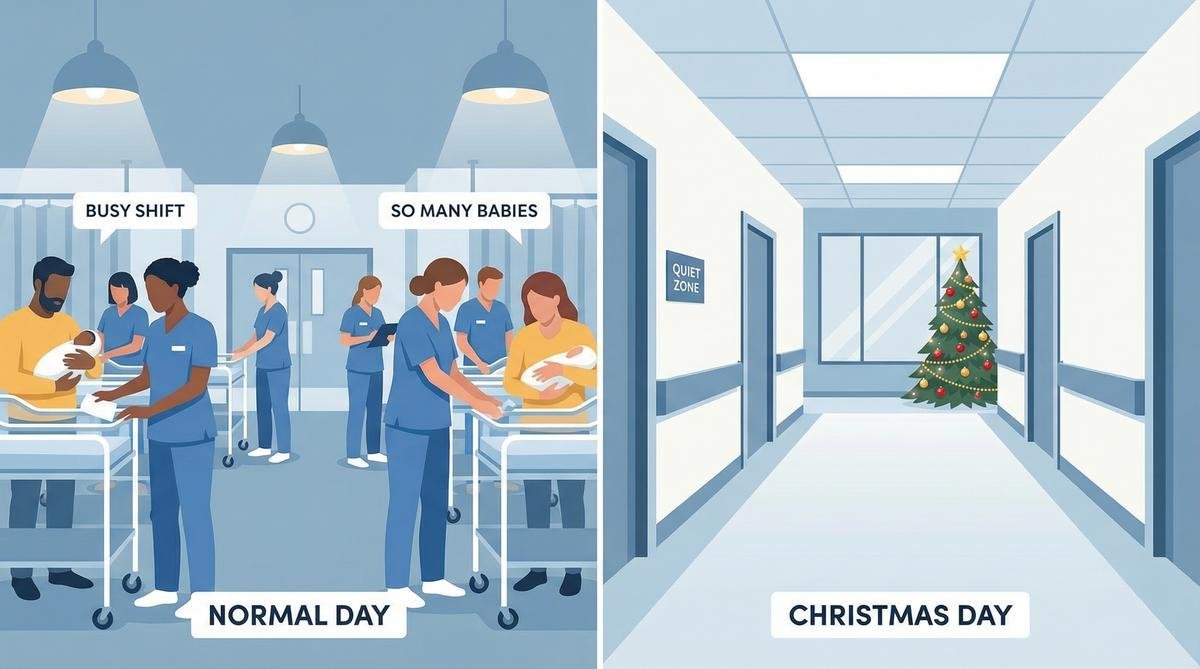
The striking pattern of rare birthdays clustering around major holidays is no coincidence. The primary driver behind this trend is the modern practice of scheduling births. In many countries, particularly the United States, a significant portion of babies are not born on a day dictated purely by nature, but on a date chosen by doctors and parents.
This phenomenon is largely due to two medical procedures: scheduled Cesarean sections (C-sections) and induced labor. Hospitals and medical staff are far less likely to schedule these non-emergency procedures on major public holidays like Christmas or New Year’s Day, when staffing is lower and people wish to be with their families. With about one in three American babies born via C-section, this scheduling practice has a dramatic impact on birth statistics, creating a noticeable dip in births on and around major holidays.
A Global Perspective: Is the Rarest Birthday Universal?
While February 29th is a global phenomenon of rarity, the other least common birthdays can vary from one country to another, influenced by national holidays and cultural norms. The U.S. pattern of holiday-centric rare birthdays is mirrored elsewhere, but with local adjustments.
In the United Kingdom, for example, December 26th (Boxing Day) is often cited as being even rarer for a birthday than Christmas Day. This reflects a similar avoidance of scheduling births on major public holidays. In Australia, while the holiday pattern also holds, their most common birth months differ from the U.S., indicating different seasonal conception trends.
Cultural beliefs also play a role. In some countries, April 1st (April Fools’ Day) is an unusually rare birthday. This is not due to a public holiday but rather a cultural aversion to having a child born on a day associated with pranks and hoaxes, a trend noted in data from England, Wales, and New Zealand.
Life as a “Leapling”: The World of February 29th Babies

What is it actually like to have the world’s rarest birthday? For leaplings, it’s a mix of unique challenges and fun perks. The most common question they face is, “How do you celebrate your birthday in a non-leap year?” Most choose to celebrate on either February 28th or March 1st, with families often establishing a tradition around one or the other.
Beyond the celebration logistics, having a Leap Day birthday is often a point of pride and a fun fact that sets them apart. There is even a dedicated organization, the Honor Society of Leap Year Day Babies, a global club for people born on February 29th. It provides a community for leaplings to share their unique experiences and connect with others who understand the novelty of their birth date.
Frequently Asked Questions (FAQ)
What is the rarest birthday besides February 29?
Christmas Day, December 25th, is the rarest birthday in the United States besides Leap Day. With an average of only 6,574 daily births, it sees roughly 40% fewer births than the peak days of the year.
Why is December 25th a rare birthday?
Fewer babies are born on Christmas Day primarily because doctors and hospitals do not schedule non-emergency C-sections or labor inductions on this major public holiday. Since a large proportion of births are now planned procedures, this has a significant effect on the daily birth count.
What is the most common birthday?
September 9th is the most common birthday in the United States, a result of more conceptions occurring during the winter holiday season nine months prior. On average, more than 12,000 babies are born on this date each year.
What is the rarest birthday month?
February is the rarest month to be born in, largely because it is the shortest month of the year, with only 28 days (or 29 in a leap year). The CDC recorded only 271,000 births in February 2023, compared to 322,000 in August.
Is April 1st a rare birthday?
Yes, in some countries like England and Wales, April 1st (April Fools’ Day) is a rare birthday due to a cultural preference to avoid having a child born on a day associated with jokes and pranks.
How many people are born on February 29?
It is estimated that about 5 million people worldwide have a February 29th birthday, with approximately 363,000 of them residing in the United States, according to the Social Security Administration.