





You just received a rejection letter from your bank. The fee was never disclosed. The appeals process looks impenetrable. Then a colleague mentions a single word: Ombudsmann. Three weeks later, the bank reverses its decision — at no legal cost to you. That is what Ombudsmänner do. They give ordinary people a credible, independent voice against institutions that otherwise hold all the cards.
The word itself confuses many German learners and even native speakers: Is the plural Ombudsmänner or Ombudsleute? Is there an English equivalent? And beyond grammar — who actually are these figures, what authority do they hold, and how do you engage one? This article answers both the linguistic and the practical questions in full, covering the legal landscape across Germany, Austria, and Switzerland.
What Ombudsmänner Means — Etymology and Core Concept
The word entered German from Swedish. Ombud means “representative” or “proxy” in Old Norse-rooted Swedish, and man simply means “person.” Combined: an appointed representative who acts on behalf of citizens when they have no other recourse. Sweden created the world’s first ombudsman institution in 1809 — the Justitieombudsman — as a parliamentary check on executive power. The idea was radical then. Today it is considered a cornerstone of democratic accountability.
German borrowed the term during the mid-twentieth century as consumer protection and civil rights movements expanded the demand for independent oversight. The Duden — the authoritative German dictionary — lists Ombudsmann as an established loanword with full German declension, meaning it follows German grammatical rules despite its foreign origin.
In English, the equivalent is ombudsman (plural: ombudsmen) or the gender-neutral ombudsperson (plural: ombudspersons). Some international bodies use ombuds as a standalone noun.
Plural Forms and Full Declension of Ombudsmann
German learners consistently stumble on this noun because it has two valid plural forms with different registers. Both appear in respected publications — knowing when to use each matters.
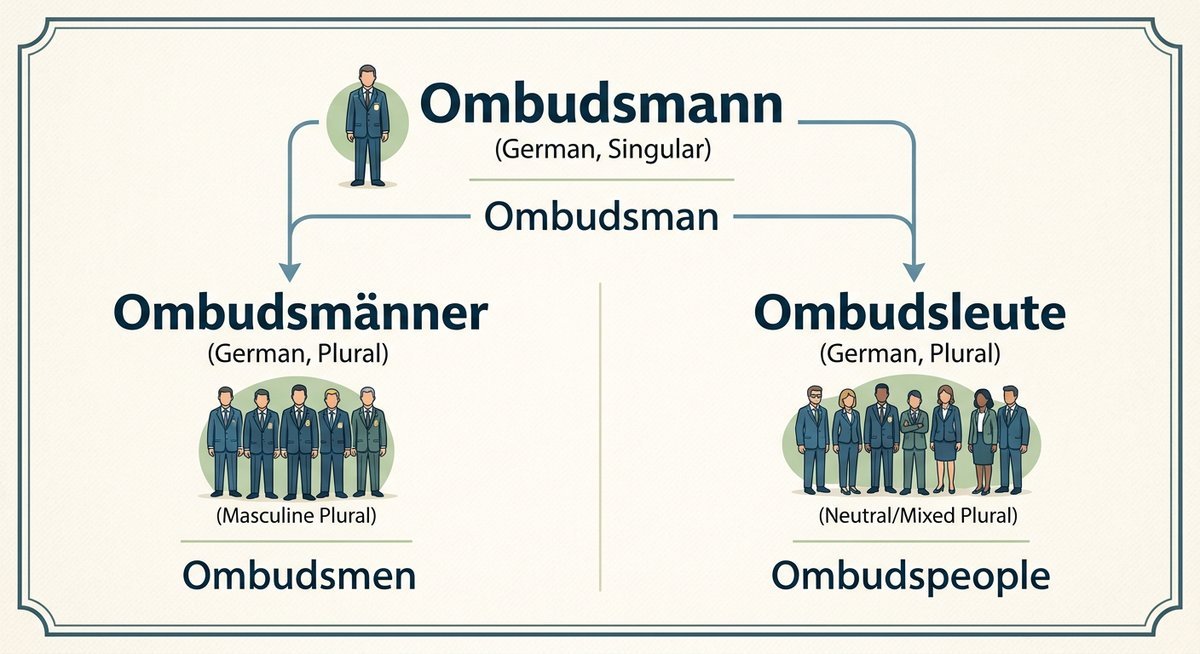
Ombudsmänner follows the strong masculine declension pattern, identical to Mann → Männer. It is the dominant form in legal documents, news reporting, and everyday speech. Ombudsleute follows the Mann → Leute pattern and is increasingly preferred in official communications, gender-neutral legislation, and contemporary bureaucratic texts. Neither form is wrong; context determines the better choice.
| Kasus (Case) | Singular | Plural — Standard | Plural — Inclusive |
|---|---|---|---|
| Nominativ (Subject) | der Ombudsmann | die Ombudsmänner | die Ombudsleute |
| Genitiv (Possessive) | des Ombudsmanns / Ombudsmannes | der Ombudsmänner | der Ombudsleute |
| Dativ (Indirect Object) | dem Ombudsmann / Ombudsmann | den Ombudsmännern | den Ombudsleuten |
| Akkusativ (Direct Object) | den Ombudsmann | die Ombudsmänner | die Ombudsleute |
A practical tip for German learners: when in doubt, Ombudsleute is the safer choice in formal writing produced after 2010. Government ministries and the European Union increasingly standardize around gender-inclusive plural forms in German-language documents.
The Role and Legal Authority of Ombudsmänner
Ombudsmänner are not judges. They cannot issue court orders or arrest anyone. What they hold instead is institutional credibility, procedural independence, and — in several sectors — the power to issue decisions that are legally binding on companies up to specified monetary thresholds. That combination makes them, for many disputes, more effective than a court: faster, free, and less adversarial.
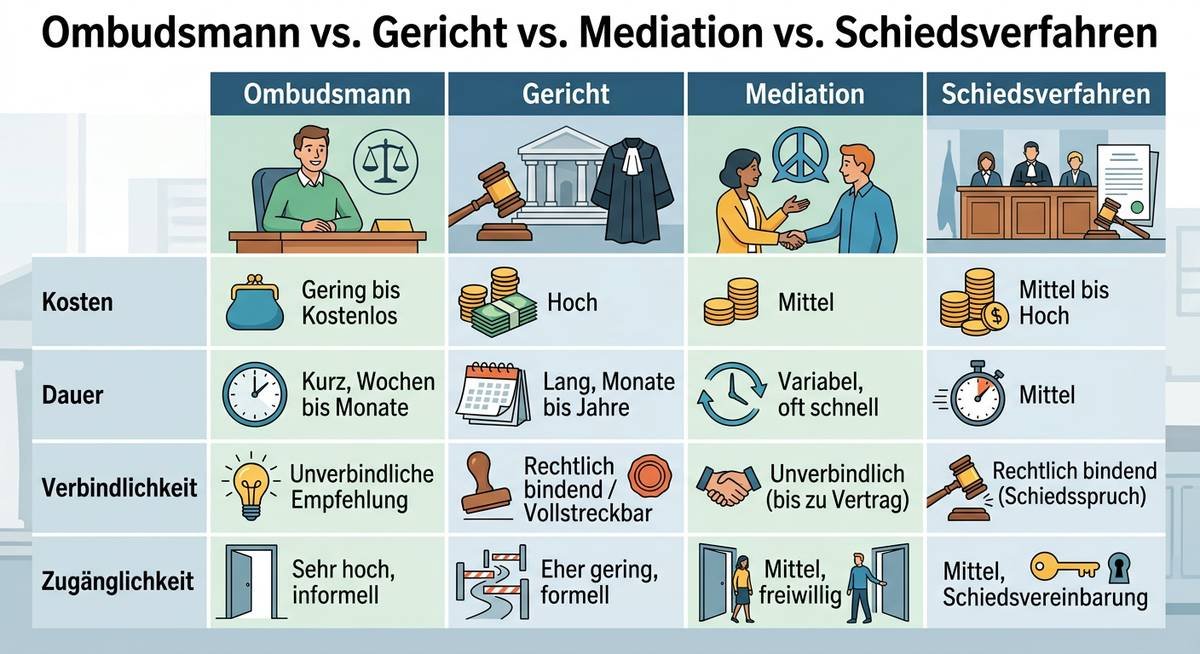
Ombudsmann vs. Court vs. Mediation vs. Arbitration
| Criterion | Ombudsmann | Court (Gericht) | Mediation | Arbitration |
|---|---|---|---|---|
| Cost for complainant | Free | Court fees + legal costs | Mediator fees (shared) | Arbitration fees (shared) |
| Average duration | 6–12 weeks | 12–36 months | 4–10 weeks | 3–12 months |
| Binding decision | Yes (sector-dependent, up to threshold) | Yes | No (agreement-based) | Yes |
| Legal representation required | No | Recommended / required | No | Recommended |
| Preserves business relationship | Often | Rarely | Usually | Sometimes |
| Right to court after | Yes (fully preserved) | Final | Yes | Limited |
One critical point many people overlook: using an Ombudsmann does not forfeit your right to go to court afterward. You can pursue the ombudsman process first and, if unsatisfied, still file a civil lawsuit. This makes the ombudsman route a low-risk first step rather than a gamble.
Legal Framework: Germany, Austria, and Switzerland
The legal basis for Ombudsmänner differs significantly across the three major German-speaking countries. These differences determine binding force, scope of jurisdiction, and which sectors are covered.
Germany
Germany does not have a single national Ombudsmann. Instead, it operates a sector-based system governed primarily by the Verbraucherstreitbeilegungsgesetz (VSBG) of 2016, which transposed the EU Directive on Alternative Dispute Resolution (ADR Directive 2013/11/EU) into German law. The VSBG sets minimum standards for recognized arbitration bodies — including independence requirements, transparency rules, and procedural timelines.
Major institutions include the Ombudsmann der privaten Banken (private banking), the Versicherungsombudsmann e.V. (insurance), the Schlichtungsstelle Energie (energy suppliers), and the Schlichtungsstelle für den öffentlichen Personenverkehr — söp (public transport). The Bundesnetzagentur handles telecommunications disputes. BaFin supervises financial services ombudsman institutions.
Austria
Austria takes a constitutionally grounded approach. The Volksanwaltschaft is enshrined in Articles 148a–148j of the Austrian Federal Constitution (Bundes-Verfassungsgesetz, B-VG). It operates as a three-member collegial body elected by the National Council, with a rotating chairmanship. Its mandate: to investigate maladministration by federal and — since a 2012 constitutional amendment — also provincial authorities.
The Volksanwaltschaft can compel public authorities to provide information, recommend remedies, and report directly to parliament. This constitutional grounding gives it authority that many sector-specific ombudsman bodies lack. Austria also has sector-specific bodies for financial services and telecommunications modeled closely on the German framework.
Switzerland
Switzerland’s ombudsman landscape is more decentralized, reflecting its federal structure. There is no single national ombudsmann for all sectors. The Ombudsman der Banken handles banking disputes and operates under a foundation (Stiftung) model, independent of both government and banking associations. The Ombudsstelle Privatversicherung und Suva covers private insurance, while cantonal ombudsman offices handle administrative complaints at the regional level.
A notable Swiss distinction: the Ombudsstelle Telekommunikation was established in 1997 under the Fernmeldegesetz and handles disputes between telecoms providers and their customers with a binding decision power for amounts up to CHF 2,000. The Swiss model also emphasizes voluntary industry participation — companies can join ombudsman schemes without statutory compulsion, though consumer expectations increasingly push them to do so.
Ombudsmänner by Sector: Who Handles What
Knowing which Ombudsmann applies to your dispute is half the battle. The sector determines the institution, the threshold for binding decisions, and the procedural requirements you must meet before filing.
| Sector | Institution (Germany) | Typical Cases | Binding Up To |
|---|---|---|---|
| Private banking | Ombudsmann der privaten Banken | Unauthorized fees, transfer errors, loan disputes | €10,000 |
| Savings banks (Sparkassen) | Ombudsleute der Sparkassen | Account closures, fee transparency, investment advice | €10,000 |
| Insurance | Versicherungsombudsmann e.V. | Rejected claims, contract disputes, premium hikes | €10,000 |
| Energy | Schlichtungsstelle Energie | Overbilling, meter errors, supply interruptions | Recommendation only |
| Telecommunications | Bundesnetzagentur | Contract traps, broadband failures, roaming fees | Recommendation only |
| Public transport | söp | Delays, refund disputes, accessibility failures | Recommendation only |
| Public administration (AT) | Volksanwaltschaft (Austria) | Government maladministration, civil rights violations | Constitutional mandate |
How to File a Complaint: Step-by-Step
The process is simpler than most people expect. You do not need a lawyer. You do need documentation and patience.
- Exhaust internal channels first. Most Ombudsmann institutions require proof that you contacted the company directly and either received a final rejection or received no response within six to eight weeks. Document this in writing — email is sufficient.
- Identify the correct institution. Use the sector table above. If your dispute crosses sectors (e.g., a bank selling insurance), file with the institution matching the product in dispute.
- Gather your documents. Contract terms, correspondence, account statements, rejection letters. The Ombudsmann needs a clear paper trail.
- Submit online or by post. Most institutions offer an online complaint form. Processing times run six to twelve weeks from the date of complete submission.
- Respond promptly to information requests. The Ombudsmann will contact both parties. Delays on your side extend the process. Keep a copy of everything you send.
- Receive and evaluate the decision. If the decision is binding and in your favor, the institution must comply. If it is a recommendation, the company has a defined response period. If you remain unsatisfied, your right to pursue legal action is fully preserved.
Frequently Asked Questions
What is the correct plural of Ombudsmann in German?
Both Ombudsmänner and Ombudsleute are grammatically correct and listed in the Duden. Ombudsmänner is the traditional form; Ombudsleute is the gender-inclusive alternative increasingly used in official and legislative German texts.
What is the English translation of Ombudsmänner?
The standard English translation is ombudsmen (plural of ombudsman). Gender-neutral alternatives include ombudspersons or simply ombuds, used by several international organizations including the European Union.
Are ombudsman decisions legally binding in Germany?
It depends on the sector and the amount in dispute. The Ombudsmann der privaten Banken and the Versicherungsombudsmann can issue binding decisions against member companies for amounts up to €10,000. Energy and telecommunications ombudsman bodies typically issue non-binding recommendations.
Can I still go to court after contacting an Ombudsmann?
Yes. Using an Ombudsmann does not waive your right to take legal action. The ombudsman process is entirely voluntary for the consumer and leaves all judicial options open.
What is the difference between Ombudsmann and Volksanwaltschaft?
In Germany, ombudsmann bodies are sector-specific (banking, insurance, energy, etc.) and typically handle consumer-business disputes. Austria’s Volksanwaltschaft is a constitutionally mandated institution that investigates maladministration by public authorities across all areas of government — a broader mandate with constitutional enforcement weight.
How long does an ombudsman process take?
Typically six to twelve weeks from the date the Ombudsmann receives a complete complaint file. Complex cases with multiple document requests can extend to six months, though this is uncommon.
Is using an Ombudsmann free?
For consumers and private individuals, yes — universally. The participating companies fund the institutions through membership fees and contributions. You will never be charged for filing a complaint or receiving a decision.
The Bottom Line
Ombudsmänner occupy a precise and valuable niche: accessible, free, faster than courts, and — in key sectors — backed by real binding authority. Whether your dispute involves a German savings bank, an Austrian government office, or a Swiss telecoms provider, an Ombudsmann institution almost certainly exists for your situation. The correct plural, the full declension table, the sector-by-sector breakdown — all of it matters, but none of it matters as much as knowing this tool exists and using it when you need it.
The next time an institution tells you the matter is closed, check whether an Ombudsmann disagrees. They often do.