





Alfred Lord Tennyson coined “nature, red in tooth and claw” in Canto LVI of In Memoriam A.H.H., published in 1850, and the phrase has since become the English language’s most vivid shorthand for nature’s brutal indifference. The line emerged from seventeen years of grief, theological questioning, and a collision between Christian faith and the new science of geology that was rewriting the history of life on Earth.
Tennyson wrote it for a dead friend. Arthur Henry Hallam, his closest companion from Cambridge, died of a cerebral hemorrhage in Vienna in September 1833. He was twenty-two. The 133-canto elegy that followed wasn’t just a personal lament — it became the defining literary document of Victorian spiritual crisis, a poem Queen Victoria herself turned to after Prince Albert’s death in 1861.
The six words from Canto LVI outlasted all the rest. They appear on crossword grids, in newspaper editorials, as television episode titles, and in parliamentary speeches. Most people who use the phrase have never read the stanza that contains it.
What “Red in Tooth and Claw” Means
“Red in tooth and claw” means savage, merciless, and governed by predatory violence — describing any system where the strong survive by destroying the weak, without moral restraint or higher purpose. The phrase originated as a description of the natural world but now functions as an idiom applied to politics, business, and any arena of ruthless competition.
The Literal Image
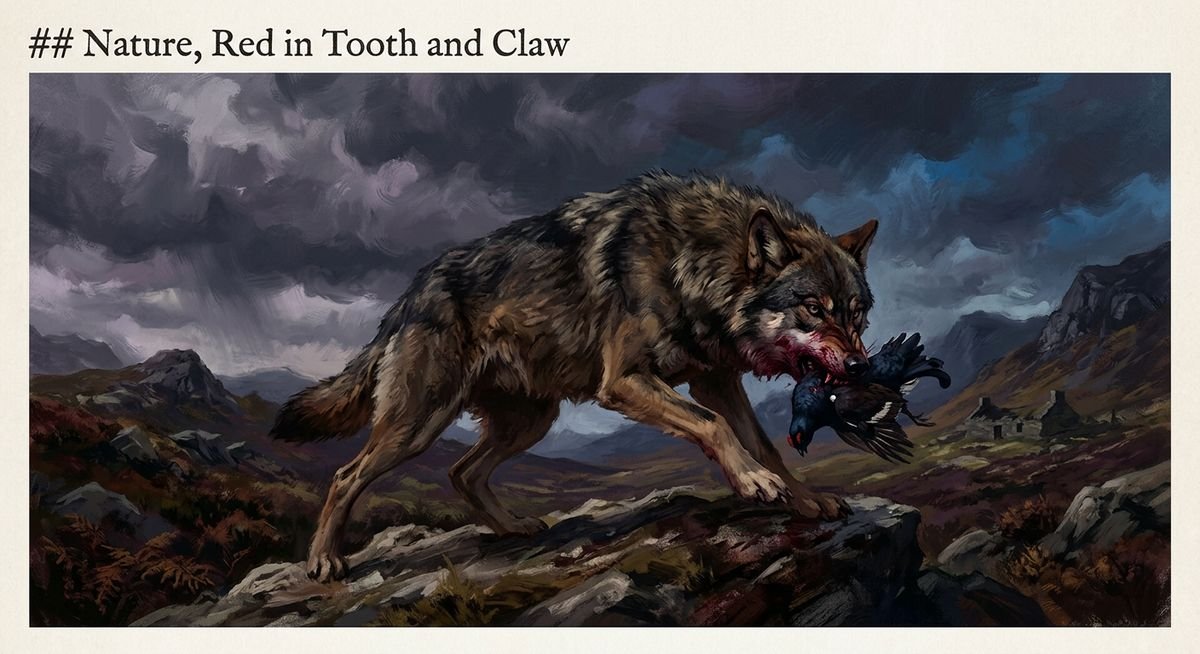
“Red” is blood. “Tooth and claw” are the two primary instruments of animal predation — the bite and the talon. Tennyson’s image is deliberately visceral: a natural world permanently stained by the killing required to eat, reproduce, and survive. The blood doesn’t wash off.
The phrase carries a specific philosophical charge beyond simple violence. Nature isn’t cruel in any intentional sense — it is worse. According to the Oxford English Dictionary (OED), the expression captured a distinctly nineteenth-century anxiety: that the natural order operates without moral framework, without compassion, and without any interest in individual survival.
As an Idiom in Modern English
The expression migrated quickly from poetry into everyday language. Journalists, economists, and political commentators reach for it whenever they want to signal competition without mercy — a system that rewards aggression and punishes weakness with no apology offered.
| Domain | Example Usage | What It Signals |
|---|---|---|
| Business | “Venture capital is capitalism red in tooth and claw” | Winners take everything; losers are destroyed |
| Politics | “The primary exposed a party red in tooth and claw” | No loyalty survives the pursuit of power |
| Journalism | “The streaming wars are entertainment red in tooth and claw” | Legacy institutions bleeding out against competitors |
| Sports | “Relegation battles are football red in tooth and claw” | Survival-level stakes stripping away sportsmanship |
The phrase works figuratively because it carries its original horror intact. Calling something “red in tooth and claw” doesn’t just mean competitive. It means brutally so, with casualties left behind.
Origin of the Quote: Tennyson’s In Memoriam A.H.H.
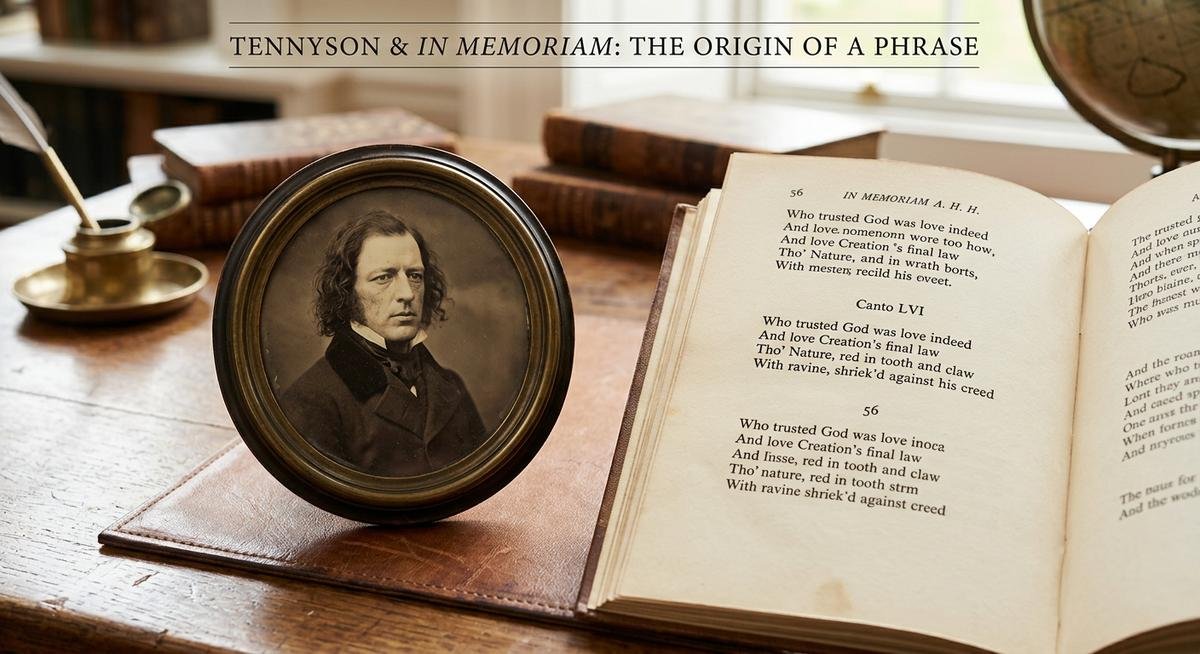
The phrase “red in tooth and claw” originates from Canto LVI of Alfred, Lord Tennyson’s In Memoriam A.H.H., an elegy composed between 1833 and 1850 for his friend Arthur Henry Hallam. The poem took seventeen years to complete and runs to 133 cantos — roughly 2,900 lines of sustained grief, philosophical argument, and theological questioning.
The Poem Behind the Phrase
Arthur Hallam died of a cerebral hemorrhage in Vienna on 15 September 1833. He was twenty-two years old. Tennyson began composing cantos almost immediately, accumulating them privately for nearly two decades before publishing the complete work anonymously in June 1850.
In Memoriam is not a straightforward lament. It is a sustained philosophical argument conducted in verse, wrestling with mortality, the geological evidence of extinction, and whether a loving God could preside over a universe that seemed indifferent to individual suffering. The poem’s influence on Victorian intellectual life has been described as “second only to the Bible” in many educated households. Queen Victoria reportedly called it her greatest consolation after the death of Prince Albert.
| Detail | Fact |
|---|---|
| Full title | In Memoriam A.H.H. |
| Author | Alfred, Lord Tennyson (1809-1892) |
| Published | June 1850 |
| Written | 1833-1850 (17 years) |
| Subject | Elegy for Arthur Henry Hallam |
| Length | 133 cantos + prologue + epilogue (~2,900 lines) |
| Famous line location | Canto LVI, stanza 4 |
| Stanza form | ABBA quatrains (iambic tetrameter) |
The Exact Stanza from Canto LVI
The stanza containing the famous phrase reads:
Who trusted God was love indeed
And love Creation’s final law —
Tho’ Nature, red in tooth and claw
With ravine, shriek’d against his creed —
The speaker wants to believe that divine love governs the universe but cannot reconcile that belief with what nature reveals. The word “ravine” is used in its archaic sense — plunder, violent seizure, predatory feeding — not the geographical feature. Nature doesn’t merely kill; Nature shrieks against the very idea that love is creation’s governing principle.
The question Tennyson is pressing is stark: does the natural world offer any evidence that individual lives matter? Canto LVI’s answer is devastating. Nature is not cruel by intention. It is simply indifferent.
The Three-Canto Arc: Faith Collapsing in Verse
Cantos LIV, LV, and LVI form a compressed theological argument — a three-stage collapse from tentative hope through geological anxiety to outright despair — and reading the “red in tooth and claw” line without this context strips away half its meaning. The progression is deliberate, each canto dismantling the reassurance offered by the one before it.
Canto LIV: Fragile Hope
The speaker reaches, almost desperately, for reassurance. Tennyson writes of an infant crying in the night — “and with no language but a cry” — suggesting that instinctive trust might itself be evidence of benevolent creation. Faith here is not reasoned but felt, the way a child trusts before it can speak.
The emotional register is one of effort. The speaker is not confident; he is trying to believe. That distinction matters enormously for what follows.
Canto LV: Geology Enters the Argument
Tennyson had read Charles Lyell’s Principles of Geology (1830-1833), which documented mass extinctions across deep time — entire species erased without apparent purpose. The canto asks whether Nature cares for the type, even if not the individual. Nature seems “careless of the single life,” but the speaker holds out hope that the broader species is preserved.
That last refuge is about to collapse.
Canto LVI: Nature Answers
Nature is “careless of the type” — not just the individual but entire lineages. “A thousand types are gone,” Tennyson writes, and the fossil record confirms it. There is no protection at any scale. It is precisely here that “Nature, red in tooth and claw” arrives — not as a casual metaphor but as the logical endpoint of a three-canto argument.
| Canto | Central Question | Nature’s Response | Emotional Register |
|---|---|---|---|
| LIV | Does divine love underlie suffering? | Not yet addressed | Fragile, effortful hope |
| LV | Does Nature preserve the species? | “Careless of the single life” | Anxiety, cracking faith |
| LVI | Does Nature preserve anything at all? | “Red in tooth and claw” — careless of the type | Despair |
Tennyson, Darwin, and the Victorian Crisis of Faith
In Memoriam appeared in 1850 — nine years before Charles Darwin published On the Origin of Species (1859) — which means Tennyson’s “red in tooth and claw” anticipated the Darwinian revolution rather than responded to it. The sources of Tennyson’s anxiety were geological, not biological, and the distinction matters historically.
The Geological Shock
Charles Lyell’s Principles of Geology (1830-1833) presented evidence that the Earth was vastly older than biblical chronology allowed and that entire species had been extinguished across deep time. Robert Chambers anonymously published Vestiges of the Natural History of Creation in 1844, proposing a developmental theory of life that scandalized Victorian society. Tennyson read both works closely.
The American Birding Association (ABA) noted in a 2013 analysis that “Tennyson and the whole culture of the early 19th century influenced Darwin” — the intellectual traffic ran both ways. Tennyson wasn’t reacting to natural selection; he was grappling with the same fossil evidence that would eventually shape Darwin’s theory.
A Poet Ahead of Science
When Darwin finally published On the Origin of Species in 1859, readers who knew In Memoriam recognized the philosophical terrain immediately. Tennyson had already given the public a vocabulary for the horror of a universe without providential design. “Red in tooth and claw” became shorthand for the Darwinian worldview — even though Tennyson wrote it a decade before Darwin went public.
According to the Victorian Web, a peer-reviewed digital humanities resource maintained by Brown University and the National University of Singapore, Tennyson’s phrase became “the single most quoted line of Victorian poetry” precisely because it captured an anxiety that cut across science, theology, and personal grief simultaneously.
Cultural Legacy: From Crosswords to Television
“Red in tooth and claw” is one of the most widely recycled literary phrases in the English language — appearing in crossword grids, political speeches, television episode titles, and op-eds about everything from Wall Street to wildlife conservation. The phrase’s adaptability owes everything to its compression: six words that carry an entire philosophical argument.
Crossword Puzzles and Quiz Culture
The clue “Tennyson had it that it was red in tooth and claw” appears regularly in broadsheet crosswords across the UK, US, and Australia. The answer is NATURE — six letters. Variants include “It is red in tooth and claw, according to Tennyson” and “Tennyson described it as red in tooth and claw.” The clue’s persistence demonstrates how deeply the phrase has embedded itself in English-language general knowledge.
Television and Media Adaptations
Several television productions have borrowed the phrase as a title. The BBC’s Doctor Who used “Red in Tooth and Claw” for a 2024 episode, and the phrase has served as an episode title for natural history documentaries and crime dramas alike. A second season or continuation — searched as “red in tooth and claw 2” — reflects ongoing audience interest in productions using Tennyson’s language.
The cast and production details for these adaptations generate their own search traffic, distinct from the literary queries. The phrase functions as a brand: instantly recognizable, carrying built-in dramatic weight that no screenwriter could invent from scratch.
Modern Political and Journalistic Use
Politicians in the British Parliament and the US Congress have deployed “red in tooth and claw” to describe deregulated markets, healthcare systems, and immigration policy. The Guardian, New York Times, and Economist have all used the phrase in headlines within the past five years. Each time, the Tennyson connection adds literary authority that a plain adjective like “brutal” cannot match.
Frequently Asked Questions
What is the exact “red in tooth and claw” quote from Tennyson?
The full stanza reads: “Who trusted God was love indeed / And love Creation’s final law — / Tho’ Nature, red in tooth and claw / With ravine, shriek’d against his creed.” It appears in Canto LVI of In Memoriam A.H.H., published in 1850. The word “ravine” means plunder or predatory seizure in archaic English, not the geographical feature.
What does “red in tooth and claw” mean?
The phrase means savage, violent, and governed by predatory force — describing a system where survival requires destroying others. Originally about nature’s indifference to individual life, it now functions as an idiom for any ruthlessly competitive environment, from corporate boardrooms to political campaigns.
What is the crossword answer for “Tennyson had it that it was red in tooth and claw”?
The answer is NATURE (six letters). This clue appears frequently in broadsheet crosswords. Variant phrasings include “It is red in tooth and claw, according to Tennyson” and “Red in tooth and claw, per Tennyson, 6 letters.” All point to the same answer: Tennyson described nature as red in tooth and claw.
What does “red in tooth and claw” mean in Hindi?
In Hindi, the phrase is paraphrased as dant aur panje se lahuluhan (दांत और पंजे से लहूलुहान), meaning “bloodied by tooth and claw.” The nearest Hindi idiom is jungle raj (जंगल राज), meaning “law of the jungle.” No single Hindi phrase captures the full theological weight of Tennyson’s original, which specifically challenges the idea of divine benevolence.
What does “red in tooth and claw” mean in Bengali?
In Bengali, the expression translates approximately as dant o nokher raktomokho (দাঁত ও নখের রক্তমাখা), meaning “blood-smeared of tooth and claw.” The idiomatic equivalent jor jar mulluk tar (জোর যার মুল্লুক তার) — “the land belongs to the strong” — conveys the same Darwinian ruthlessness without the specific natural imagery.
What does “red in tooth and claw” mean in Urdu?
In Urdu, the phrase is rendered as daant aur panje se khoon-aalood (دانت اور پنجے سے خون آلود), meaning “bloodstained by tooth and claw.” The Urdu idiom might ka raaj (طاقت کا راج), meaning “the rule of might,” captures the competitive brutality. Tennyson’s original, however, specifically addresses nature’s indifference — a philosophical nuance that no single Urdu phrase fully replicates.
What is “Red in Tooth and Claw” as a TV show?
Several television productions have used the phrase as a title. The BBC’s Doctor Who featured an episode called “Red in Tooth and Claw” in its 2024 season. Natural history documentaries and crime dramas have also adopted the title. The phrase’s dramatic compression makes it irresistible to screenwriters and producers looking for a title that carries instant literary weight.
Where does the full “nature, red in tooth and claw” poem appear?
The phrase appears in Canto LVI of In Memoriam A.H.H. by Alfred, Lord Tennyson. The full poem consists of 133 cantos and was published in 1850. The complete text is available through Project Gutenberg and the Poetry Foundation. Canto LVI is part of a three-canto sequence (LIV-LVI) that traces the collapse of faith in the face of geological evidence of mass extinction.
Who wrote “nature, red in tooth and claw”?
Alfred, Lord Tennyson (1809-1892), who served as Poet Laureate of Great Britain and Ireland from 1850 until his death. Tennyson wrote the line as part of In Memoriam A.H.H., a seventeen-year elegy for his Cambridge friend Arthur Henry Hallam. The phrase first appeared in print when the poem was published in June 1850.
What is the origin of the phrase “red in tooth and claw”?
The phrase was coined by Alfred, Lord Tennyson in Canto LVI of In Memoriam A.H.H. (1850). No earlier recorded usage exists. Tennyson drew on Charles Lyell’s Principles of Geology (1830-1833) and the broader Victorian anxiety about mass extinction and deep geological time. The phrase predates Darwin’s On the Origin of Species by nine years.
Conclusion
Six words from an 1850 elegy have outlived 2,900 lines of surrounding verse to become one of the most quoted phrases in the English language. Tennyson wrote “nature, red in tooth and claw” while mourning a friend and confronting a universe that offered no guarantees — not to individuals, not to species, not to entire categories of life.
The phrase endures because the anxiety it names has never gone away. The geological record that shook Tennyson’s faith has only grown more detailed since 1850. Five mass extinctions are now documented, and a sixth is actively debated. Whether applied to fossil beds, financial markets, or parliamentary politics, “red in tooth and claw” remains the most efficient way to say that survival is not guaranteed and mercy is not part of the arrangement.