



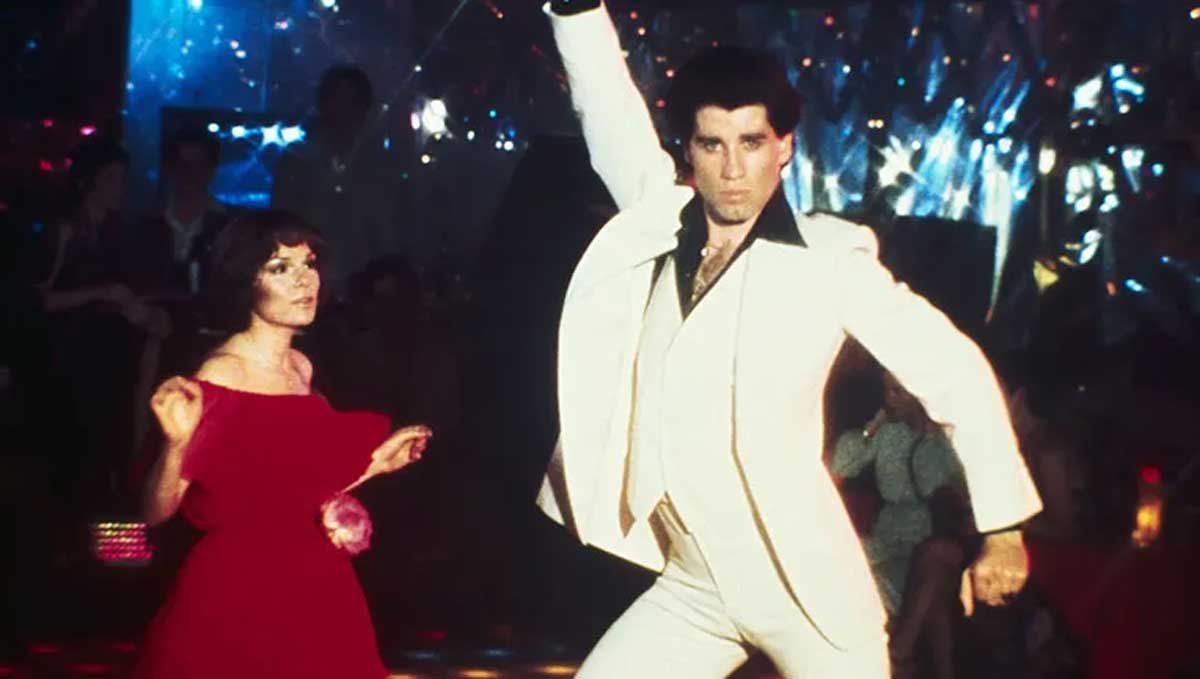
John Travolta’s performance in Saturday Night Fever remains one of the most consequential acting debuts in Hollywood history. Cast at 22 years old — still best known as the lovable dim-bulb Vinnie Barbarino on Welcome Back, Kotter — Travolta transformed a gritty Brooklyn disco drama into a global phenomenon and himself into a legitimate movie star almost overnight.
The role of Tony Manero, a paint-store clerk who lives for Saturday nights on the disco floor, gave Travolta something television never could: a character with real dramatic weight. The white suit. The strut. The Bee Gees pulsing at full volume. Every element locked together so perfectly that the film didn’t just capture a cultural moment — it created one.
The full story involves months of dance training with choreographer Lester Wilson, costume choices that became fashion history, a Bee Gees soundtrack that outsold almost everything before it, an Academy Award nomination that shocked the industry, and the viral afterlife of a 90-second sidewalk strut that the internet simply refuses to let die.
Who Is Tony Manero? Travolta’s Character and Career Breakthrough
Tony Manero is a 19-year-old paint-store clerk from Bay Ridge, Brooklyn — underpaid, underestimated, and utterly alive only on Saturday nights. John Travolta’s portrayal of Manero in Saturday Night Fever transformed a working-class antihero into one of cinema’s most iconic characters, and simultaneously catapulted Travolta from a beloved TV sitcom face to a legitimate Hollywood star.
Tony Manero — The Brooklyn Dreamer
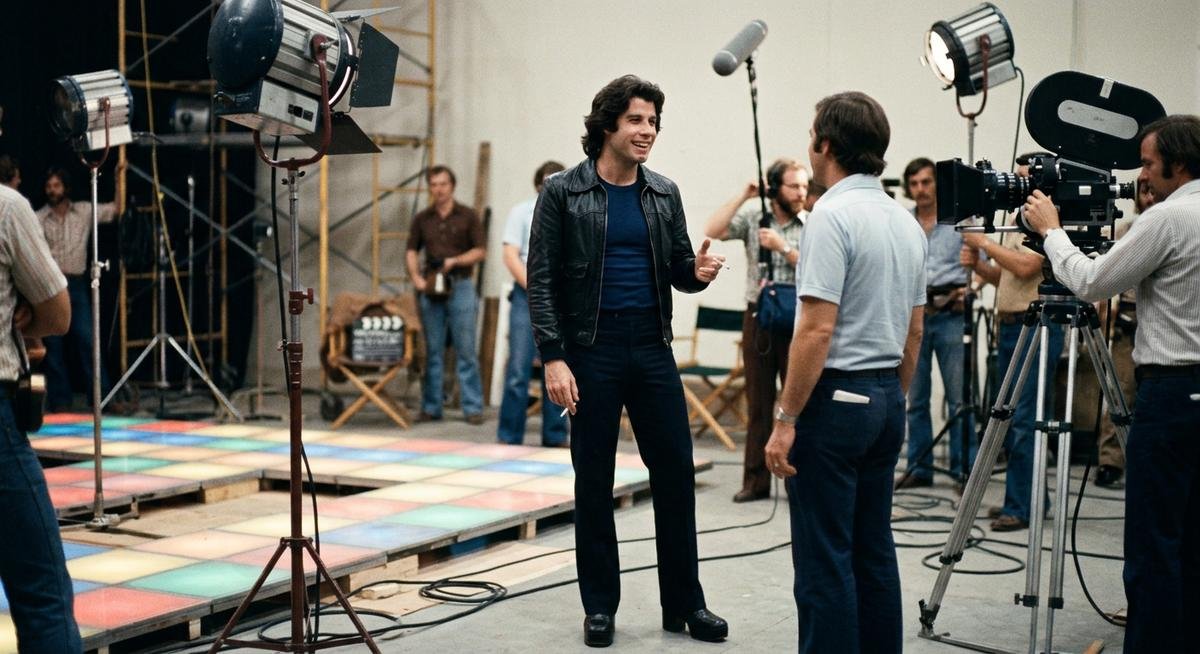
Norman Wexler’s screenplay — adapted from Nik Cohn’s 1976 New York Magazine article “Tribal Rites of the New Saturday Night” — gives Tony Manero a life that feels suffocating in every frame except one. The 2001 Odyssey disco in Bay Ridge is his cathedral, the dance floor his only territory where talent, not circumstance, determines status.
Director John Badham refused to sand down Tony’s edges. The character is vain, sometimes cruel, and casually sexist — a product of his environment as much as a prisoner of it. That emotional complexity is precisely what elevates the performance beyond a showcase for disco moves.
Tony’s arc is one of painful self-awareness. By the film’s end, he recognizes that the disco king identity he’s built is a ceiling, not a crown. It’s a remarkably mature dramatic structure for what many initially dismissed as a dance movie.
How Old Was John Travolta in Saturday Night Fever?
Travolta was 22 years old during principal photography in 1976 and had just turned 23 by the time Saturday Night Fever opened in December 1977. The age alignment with Tony Manero was almost accidental — and almost didn’t happen at all.
At the time of casting, Travolta was best known as Vinnie Barbarino, the swaggering class clown on the ABC sitcom Welcome Back, Kotter. Paramount Pictures was taking a genuine commercial risk: handing a gritty, R-rated dramatic feature to a TV actor whose entire public identity was built on comedic mugging for a studio audience.
The gamble paid off at a scale nobody predicted. Saturday Night Fever grossed over $94 million domestically against a $3.5 million budget, and Travolta earned an Academy Award nomination for Best Actor — one of the youngest nominees in that category at the 50th Academy Awards ceremony in 1978.
| Detail | Facts |
|---|---|
| Travolta’s age during filming | 22 (principal photography, 1976) |
| Travolta’s age at release | 23 (December 1977) |
| Prior claim to fame | Vinnie Barbarino, Welcome Back, Kotter (ABC, 1975–1979) |
| Tony Manero’s age in the film | 19 years old |
| Film’s production budget | $3.5 million |
| Domestic box office gross | Over $94 million |
The Dance Scenes — Training, Choreography, and Disco Moves
John Travolta’s dancing in Saturday Night Fever wasn’t improvised charisma — it was the product of months of disciplined pre-production training that transformed a TV sitcom actor into one of cinema’s most credible physical performers. Choreographer Lester Wilson worked with Travolta daily to master hustle technique and freestyle disco movement, drilling footwork patterns until they looked effortless under the 2001 Odyssey’s colored lights.
Training and Preparation
Travolta arrived at production with a genuine advantage: he had studied dance since childhood, training in ballet, jazz, and tap before his career in acting took hold. That foundation made him a fast student when Wilson began layering in disco-specific technique — the sharp isolations, the weight shifts, the rhythmic precision that separates a trained dancer from someone approximating moves.
The rehearsal schedule was relentless. Travolta reportedly trained for several months before cameras rolled, building the stamina required to perform extended sequences in a single take without losing the explosive, coiled energy Tony Manero needed to project. Physical confidence was the goal — not just correct steps, but the look of a man who owns every square foot of that dance floor.
Breaking Down the Iconic Dance Scenes
The film’s standout sequences unfold on the 2001 Odyssey’s illuminated checkerboard floor, and each one serves a specific dramatic function. Tony’s solo performance to “More Than a Woman” is pure exhibition — a display of technical fluency that establishes him as genuinely exceptional, not just the best dancer in a mediocre room.
The competition finale escalates the stakes, pairing Tony with Stephanie Mangano (Karen Lynn Gorney) in a sequence that blends hustle partnering with freestyle breaks. The specific moves that burned themselves into audience memory are precise and repeatable: the extended index-finger point skyward, the controlled spinning turn, the low floor slide that drops Tony’s center of gravity before he snaps back upright.
| Dance Move | Scene Context | Technical Description |
|---|---|---|
| The Point | Solo and competition sequences | Extended index finger raised diagonally overhead; arm fully extended from shoulder |
| The Spin | Multiple floor sequences | Single-axis controlled rotation, weight centered over the ball of one foot |
| The Floor Slide | Competition finale | Low lateral slide dropping hips toward floor level before sharp upward recovery |
| Hustle Partnering | Competition with Stephanie | Lead-follow Latin hustle framework with disco-era freestyle breaks inserted |
Critics who dismissed disco as shallow spectacle found themselves unable to dismiss what Travolta was actually doing. The movement was athletic, precise, and emotionally legible — you could read Tony’s hunger and joy through the choreography alone.
The Opening Strut — “Stayin’ Alive” and the Birth of a Meme
Before Tony Manero ever sets foot on a dance floor, director John Badham establishes exactly who he is with a single 90-second sequence: Travolta strutting down a Bay Ridge, Brooklyn sidewalk in a black leather jacket, paint can swinging in one hand, two slices of pizza in the other, while the Bee Gees’ “Stayin’ Alive” drives every step.
The shot is deceptively simple — a tracking close-up on Travolta’s feet, then a wider reveal of his full swagger — but the audio-visual lock it creates is permanent. The strut and the song became inseparable the moment audiences first saw them together, and that pairing is arguably the single most imitated image in disco-era cinema.
Decades later, the sequence found a second life entirely on its own terms. The opening strut became one of the internet’s earliest and most durable GIF formats — Travolta’s confident walk looped endlessly across forums, social media threads, and reaction posts. Capital One later licensed the image and likeness for a widely circulated commercial campaign, introducing the strut to audiences who had never seen the film. The “john travolta saturday night fever walk” meme cluster now generates consistent search volume independent of the movie itself — a rare case of a single film shot achieving autonomous viral identity across multiple generations of internet culture.
The White Suit, the Hair, and Every Piece of the Tony Manero Look
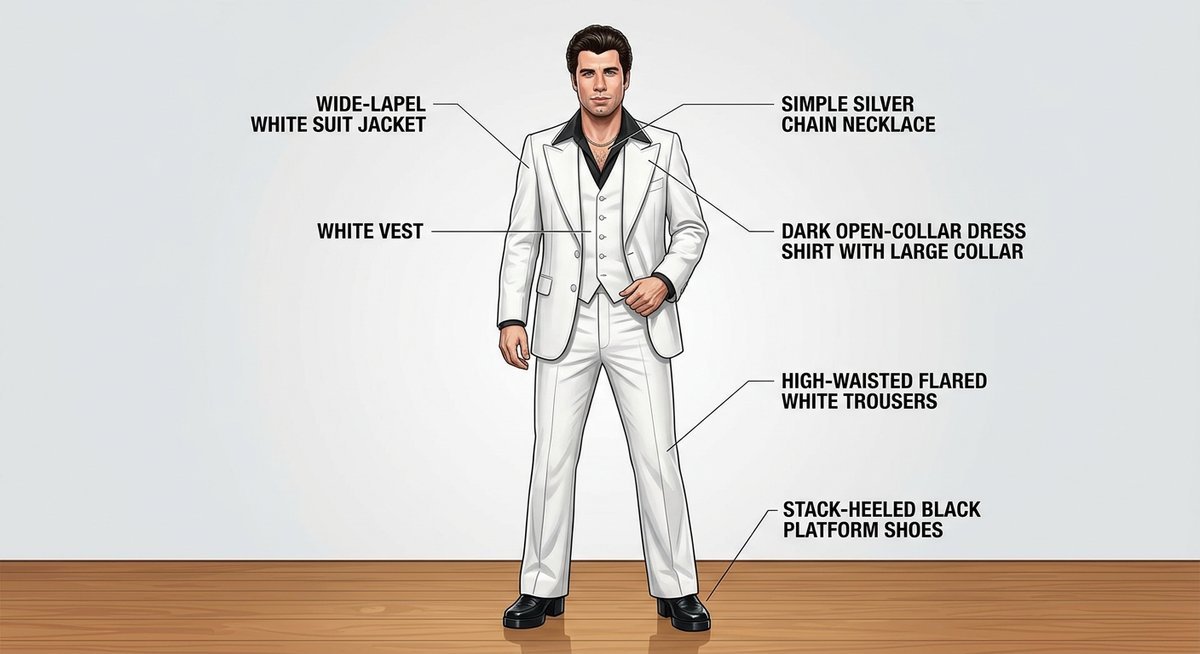
Costume designer Patrizia von Brandenstein created the white three-piece suit, black dress shirt, platform boots, and gold chain necklace that define the Tony Manero look — the single most recognizable costume ensemble in disco-era cinema and one of the most imitated Halloween outfits of the past five decades.
Von Brandenstein made a deliberate visual choice: the suit had to function as a transformation device, separating Tony’s Saturday-night self completely from the drab paint-store clerk he was Monday through Friday.
The Iconic White Suit — Designer, Details, and Symbolism
Von Brandenstein cut the suit with wide peak lapels, high-waisted flared trousers, and a fitted waistcoat — all hallmarks of late-1970s menswear pushed to their most theatrical extreme. The black dress shirt worn underneath was a calculated contrast, making the white suit pop under the club’s strobing lights the way a spotlight finds a performer on a dark stage.
The suit’s whiteness wasn’t accidental symbolism — it was blunt. Tony is the king of the floor, and the color announces that status before he takes a single step. Von Brandenstein has noted in interviews that the goal was to make Travolta look like he belonged to the disco the way a matador belongs to the ring.
The Full Outfit — Leather Jacket, Boots, Necklace, and Hair
Away from the club, Tony’s uniform is equally deliberate. The black leather jacket he wears during the opening strut is classic outer-borough armor — tough, cheap, and cool in the specific way only 1970s Brooklyn could produce. Platform boots complete the street look, adding both height and a rolling swagger to Travolta’s already precise gait.
The gold chain necklace sitting against that black shirt is a small but loaded detail. In Bay Ridge working-class culture, gold chains were a marker of identity — something you saved for, something you wore with pride. It’s not costume jewelry. On Tony, it reads as biography.
Then there’s the hair. Travolta’s voluminous, feathered, blow-dried style became as iconic as the suit itself — a precise construction of 1970s disco-era male grooming that required maintenance and vanity in equal measure. Tony spends real time in front of the mirror, and the hair proves it.
| Wardrobe Element | Scene Context | Cultural Symbolism |
|---|---|---|
| White three-piece suit | 2001 Odyssey dance floor | Transformation, disco royalty, escape from working-class routine |
| Black dress shirt | Under the suit at the club | Visual contrast; amplifies the suit’s brightness under stage lighting |
| Black leather jacket | Opening strut, street scenes | Brooklyn street identity, toughness, working-class cool |
| Platform boots | Throughout the film | Height, swagger, 1970s disco-era fashion signifier |
| Gold chain necklace | Club and street scenes | Outer-borough pride, working-class aspiration |
| Feathered, blow-dried hair | Throughout the film | Disco-era male grooming; vanity as self-expression |
Taken together, the complete Tony Manero look became the definitive Halloween costume template for 1970s disco dress-up — a shorthand so powerful that five decades later, the white suit alone is enough to identify the character without a single word of explanation.
The Bee Gees Soundtrack — “Stayin’ Alive” and the Songs That Defined an Era
The Bee Gees wrote and recorded “Stayin’ Alive,” “Night Fever,” “How Deep Is Your Love,” and “More Than a Woman” specifically for Saturday Night Fever, producing a double-LP soundtrack that sold over 40 million copies worldwide and became one of the best-selling albums in recorded music history.
Barry, Robin, and Maurice Gibb delivered the bulk of the tracklist, but the album also featured contributions from Yvonne Elliman, Tavares, and MFSB — giving it genuine breadth beyond a one-act showcase. The music and Travolta’s performance became inseparable from the moment of first release.
The Soundtrack Track List and the Bee Gees’ Contribution
The core Bee Gees contributions — “Stayin’ Alive,” “Night Fever,” “How Deep Is Your Love,” “More Than a Woman,” and “Jive Talkin'” — dominated radio in a way few soundtracks ever have. The full soundtrack remains available on major streaming platforms. “Night Fever” and “How Deep Is Your Love” both reached number one on the Billboard Hot 100. The album also included tracks from Yvonne Elliman, Tavares, and MFSB, giving the double-LP genuine breadth rather than a one-artist showcase.
| Track | Artist | Chart Peak (US) |
|---|---|---|
| Stayin’ Alive | Bee Gees | #1 |
| Night Fever | Bee Gees | #1 |
| How Deep Is Your Love | Bee Gees | #1 |
| More Than a Woman | Tavares | #32 |
| If I Can’t Have You | Yvonne Elliman | #1 |
How “Stayin’ Alive” Became the Film’s Signature Sound
Director John Badham made a precise creative choice opening on Travolta’s strut with “Stayin’ Alive” already playing — no buildup, no title card, just the song and the swagger locked together in the first frame. That audio-visual pairing burned itself into cultural memory so completely that hearing the opening bass line still conjures Travolta’s white-suited silhouette for millions of people who have never seen the full film.
“Stayin’ Alive” runs at approximately 103 BPM — a tempo that, decades later, the American Heart Association identified as ideal for maintaining proper chest compression rhythm during CPR training. The song has since been used in medical education programs as a pacing tool, a genuinely surprising second life for a disco anthem built around a Brooklyn kid’s Saturday night.
The Oscar Nomination, the Cast, and the Film’s Awards Legacy
John Travolta received a Best Actor nomination at the 50th Academy Awards in 1978 for his performance as Tony Manero — making him one of the youngest nominees in that category at the time, at just 23 years old. He lost to Richard Dreyfuss for The Goodbye Girl. The nomination alone, however, permanently repositioned Travolta from television personality to legitimate dramatic actor.
John Travolta’s Oscar Nomination — What Happened and Why It Mattered
The nomination was genuinely controversial inside the industry. Saturday Night Fever carried an R rating, featured sexual assault, suicide, and raw working-class despair — not the kind of material that typically earned Academy recognition in 1978. Many insiders expected the film to be dismissed as a disco cash-grab. The nomination signaled that voters saw something more serious in Travolta’s performance than the marketing suggested.
Travolta’s loss to Dreyfuss didn’t diminish the achievement. The nomination arrived alongside his concurrent Grease success, creating a remarkable double moment in a single calendar year that no TV actor had previously managed. The Oscar nod gave Travolta a critical credibility that would follow — and occasionally rescue — his career for decades.
The Saturday Night Fever Cast — Who Starred Alongside Travolta
The supporting cast was essential to grounding Travolta’s performance in something believable. Karen Lynn Gorney played Stephanie Mangano, Tony’s dance partner and the film’s emotional counterweight — an ambitious woman actively escaping Brooklyn while Tony is still trapped in it. Their tension drives the film’s second half.
Donna Pescow delivered a quietly devastating performance as Annette, the neighborhood girl in love with Tony who he repeatedly dismisses. Barry Miller played Bobby C, whose storyline provides the film’s most tragic turn. Joseph Cali and Paul Pape rounded out Tony’s crew as Joey and Double J, two friends whose limited horizons sharpen Tony’s own restlessness by contrast.
Director John Badham and screenwriter Norman Wexler built an ensemble that refused to let the disco spectacle swallow the drama. Every supporting character functioned as a mirror for Tony — showing him, and the audience, exactly what staying in Bay Ridge would cost.
| Actor | Character | Role in Tony’s Story |
|---|---|---|
| Karen Lynn Gorney | Stephanie Mangano | Dance partner; represents escape and aspiration |
| Donna Pescow | Annette | Unrequited love; symbol of staying behind |
| Barry Miller | Bobby C | Tragic arc; the film’s emotional gut-punch |
| Joseph Cali | Joey | Core crew member; reflects neighborhood stagnation |
| Paul Pape | Double J | Core crew member; comic and dramatic foil |
The Viral Afterlife — Memes, the Capital One Commercial, and Pop Culture Legacy
The opening strut from Saturday Night Fever became one of the internet’s most enduring GIF formats — looped across Tumblr, Twitter/X, Reddit, and TikTok as a universal shorthand for confidence, swagger, and walking into a room like you own it. Travolta later reprised the Tony Manero persona in a Capital One commercial that introduced the character to Gen Z viewers who had never seen the original film.
The walk meme’s durability is remarkable. The original 90-second sequence — Travolta carrying a paint can and two pizza slices through Bay Ridge, Brooklyn to the beat of “Stayin’ Alive” — has been remixed, parodied, and repurposed across every major social media platform since the early 2000s. Unlike most movie GIFs, the strut works without context. No caption required. The swagger speaks for itself.
Capital One’s decision to cast Travolta in a self-referential holiday commercial proved the strut’s cross-generational staying power. The ad went viral on its own, generating millions of views and sparking a wave of “who is this?” searches from younger viewers discovering Tony Manero for the first time through a credit card advertisement rather than a film.
The film also spawned a direct sequel: Staying Alive (1983), directed by Sylvester Stallone, in which Travolta reprised the Tony Manero role as a Broadway dancer in Manhattan. The sequel received mixed reviews but confirmed the character’s cultural gravity. Meanwhile, Grease — released just six months after Saturday Night Fever in 1978 — cemented Travolta as the definitive male star of the late 1970s. The two films are still frequently searched together, with audiences treating them as companion pieces of the same Travolta cultural moment.
Where to Watch Saturday Night Fever Today
Saturday Night Fever is currently available to rent or purchase digitally on Amazon Prime Video, Apple TV, Vudu, and Google Play. Streaming availability on subscription platforms like Paramount+ rotates by region — check your local catalog before assuming inclusion.
Two versions of the film exist: the original R-rated theatrical cut and a PG-edited version that trims the sexual content and language. Most digital platforms carry the R-rated version, but confirm before purchasing if the distinction matters to you. The Bee Gees soundtrack is available separately on Spotify, Apple Music, and YouTube Music for anyone who wants the music without rewatching the film.
Frequently Asked Questions About John Travolta in Saturday Night Fever
What is John Travolta’s character’s name in Saturday Night Fever?
John Travolta plays Tony Manero, a 19-year-old paint-store clerk from Bay Ridge, Brooklyn, whose entire sense of self-worth is built around his status as the best dancer at the 2001 Odyssey disco. The character was written by Norman Wexler and directed by John Badham as a portrait of working-class frustration and escapism.
How old was John Travolta when he filmed Saturday Night Fever?
Travolta was 22 years old during principal photography in 1976 and had just turned 23 by the time the film released in December 1977. That youth wasn’t incidental — it was precisely what made his portrayal of Tony’s restless ambition feel authentic rather than performed.
Who choreographed the dance scenes in Saturday Night Fever?
Lester Wilson choreographed every dance sequence in Saturday Night Fever. Wilson worked with Travolta for months of intensive pre-production rehearsals, drilling hustle partnering and freestyle disco technique until each move looked effortless. The pointed finger, the floor slide, the controlled spins — Wilson’s choreographic vocabulary defined the sequences audiences still imitate decades later.
Did John Travolta win an Oscar for Saturday Night Fever?
Travolta received a Best Actor nomination at the 50th Academy Awards but did not win. Richard Dreyfuss took home the award that year for The Goodbye Girl. The nomination itself was considered remarkable given the film’s R rating and gritty subject matter.
What songs are on the Saturday Night Fever soundtrack?
The key tracks are “Stayin’ Alive,” “Night Fever,” “How Deep Is Your Love,” “More Than a Woman,” and “If I Can’t Have You” — all of which charted in the US Top 40, with four reaching number one on the Billboard Hot 100.
| Track | Artist | Notable Use in Film |
|---|---|---|
| Stayin’ Alive | Bee Gees | Opening strut sequence |
| Night Fever | Bee Gees | Dance floor montage |
| How Deep Is Your Love | Bee Gees | Romantic subplot scenes |
| More Than a Woman | Bee Gees | Tony’s solo performance |
| Jive Talkin’ | Bee Gees | Background disco atmosphere |
The double-LP soundtrack became one of the best-selling albums in recording history, with the Bee Gees writing and recording the majority of tracks specifically for the film.
What is the opening scene of Saturday Night Fever?
The film opens with a close-up tracking shot of Travolta’s feet strutting down a Bay Ridge, Brooklyn sidewalk to the Bee Gees’ “Stayin’ Alive.” Tony Manero carries a paint can in one hand and two folded pizza slices in the other. The 90-second sequence became one of cinema’s most iconic and parodied openings.
Where did the Saturday Night Fever strut walk meme come from?
The strut walk meme originates from that same opening scene. The GIF of Travolta’s confident sidewalk walk began circulating on early internet forums in the 2000s and spread to Tumblr, Twitter/X, Reddit, and TikTok as a universal expression of self-assurance. Capital One later amplified the meme’s reach by casting Travolta in a holiday commercial that directly recreated the strut.
Is there a sequel to Saturday Night Fever with John Travolta?
Staying Alive (1983), directed by Sylvester Stallone, is the direct sequel. Travolta reprises Tony Manero, now pursuing a career as a Broadway dancer in Manhattan. The film received mixed critical reception but confirmed the character’s commercial viability six years after the original.
What is John Travolta wearing in Saturday Night Fever — who designed the white suit?
Costume designer Patrizia von Brandenstein designed the iconic white three-piece suit with wide peak lapels and high-waisted flared trousers. The full look includes a black dress shirt, platform boots, and a gold chain necklace. Away from the disco, Tony wears a black leather jacket during the opening strut scenes.
Where can I watch Saturday Night Fever online today?
Saturday Night Fever is available to rent or purchase on Amazon Prime Video, Apple TV, Vudu, and Google Play. Subscription streaming on Paramount+ varies by region. Two versions exist: the original R-rated theatrical cut and a PG-edited version — most digital platforms carry the R-rated release.
Conclusion
Some performances are products of timing. John Travolta’s Tony Manero was something rarer — a once-in-a-generation collision of the right actor, the right role, the right music, and a cultural moment that was desperate for exactly what Saturday Night Fever delivered. Nearly five decades later, that white suit still stops a room.
The Bee Gees’ soundtrack remains genuinely inescapable. The opening strut still spawns memes. New viewers find the film on streaming and immediately understand why a 23-year-old TV actor earned an Oscar nomination that shocked Hollywood insiders who’d written him off as a sitcom novelty.
Travolta’s performance as Tony Manero isn’t nostalgia. It’s a masterclass in physical storytelling that holds up on its own terms — essential viewing for anyone who wants to understand how a single role can permanently reshape popular culture.