




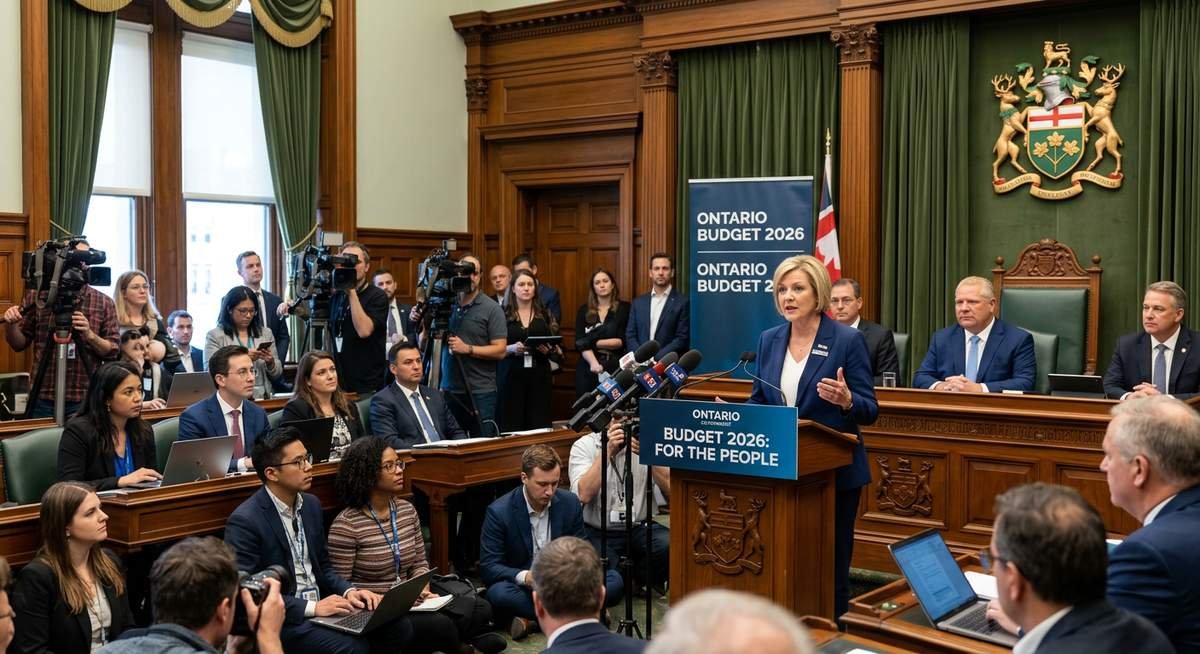
Ontario’s 2026 provincial budget announcement lands a $14.6 billion deficit on the books — the province’s largest outside of pandemic years — while committing roughly $232 billion in total spending aimed squarely at tariff fallout, healthcare staffing, and infrastructure backlogs. The Doug Ford government tabled the fiscal plan in late March 2026, pitching it as a defensive budget built for economic turbulence.
That framing is doing heavy lifting. The deficit is real, the debt trajectory is steep, and the policy bets embedded in this budget will shape Ontario’s fiscal room for years. Healthcare gets the biggest single allocation. Trade-exposed manufacturers and displaced workers get new relief dollars. Housing policy leans on zoning reform rather than cash. Every sector gets something; nobody gets everything.
What follows breaks down the actual numbers, compares them to the Ontario budget announcement 2023 and 2024 cycles, and flags what independent analysts think about the fiscal math. The goal is simple: cut through the political packaging and show what changed, what didn’t, and what it means for your household.
2026 Ontario Budget at a Glance: Key Highlights
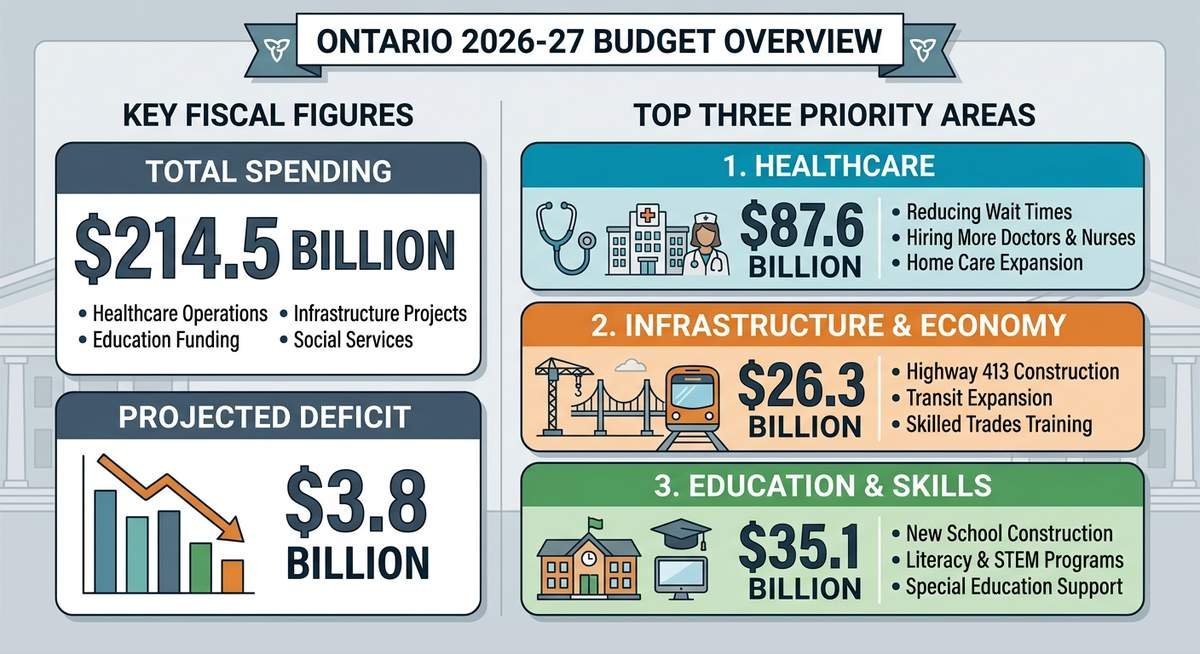
The 2026 Ontario budget announcement projects total spending of approximately $232 billion against revenues of roughly $207 billion, producing a deficit of $14.6 billion — the largest single-year shortfall the province has recorded outside of the pandemic years. Every budget announcement Ontario releases carries fiscal consequences, and this one is no exception: the government is borrowing to fund services today, adding to a total debt burden that now exceeds $426 billion and costs billions annually just to service.
Headline Fiscal Numbers
Total program spending climbs roughly 4.6 percent over the 2025 budget, driven largely by healthcare commitments and new tariff-response measures. Revenue growth, however, is forecast to lag behind — a direct consequence of tariff economic uncertainty in Canada dampening corporate activity and consumer spending across the province. The deficit, in plain terms, means Ontario is spending about $27 million more per day than it collects.
| Fiscal Metric | 2025 Budget | 2026 Budget | Year-over-Year Change |
|---|---|---|---|
| Total Spending | ~$221.7B | ~$232B | +~$10.3B (+4.6%) |
| Total Revenue | ~$204B | ~$207B | +~$3B (+1.5%) |
| Projected Deficit | ~$9.8B | ~$14.6B | +~$4.8B |
| Net Debt | ~$415B | ~~$426B | Increasing |
The Government’s Three Core Priorities
Three stated pillars organize the 2026 spending. Tariff protection comes first — shielding Ontario workers and businesses from U.S. trade disruption runs through nearly every ministry and accounts for several billion in new relief and retraining dollars. Public services hold second position, with healthcare commanding the largest single allocation. Infrastructure rounds out the triad: transit expansions, highway corridors, and housing supply acceleration all draw multi-year capital commitments.
Healthcare alone reportedly accounts for over $85 billion in program spending, representing more than a third of the entire budget envelope. Infrastructure commitments, including transit expansion and highway corridors, add tens of billions more in capital commitments spread across multiple fiscal years. The tariff-response pillar — the newest and most politically visible addition — channels direct support toward manufacturing workers, skills retraining programs, and small business stabilization funds facing cross-border trade disruption.
Sector-by-Sector Impact Breakdown
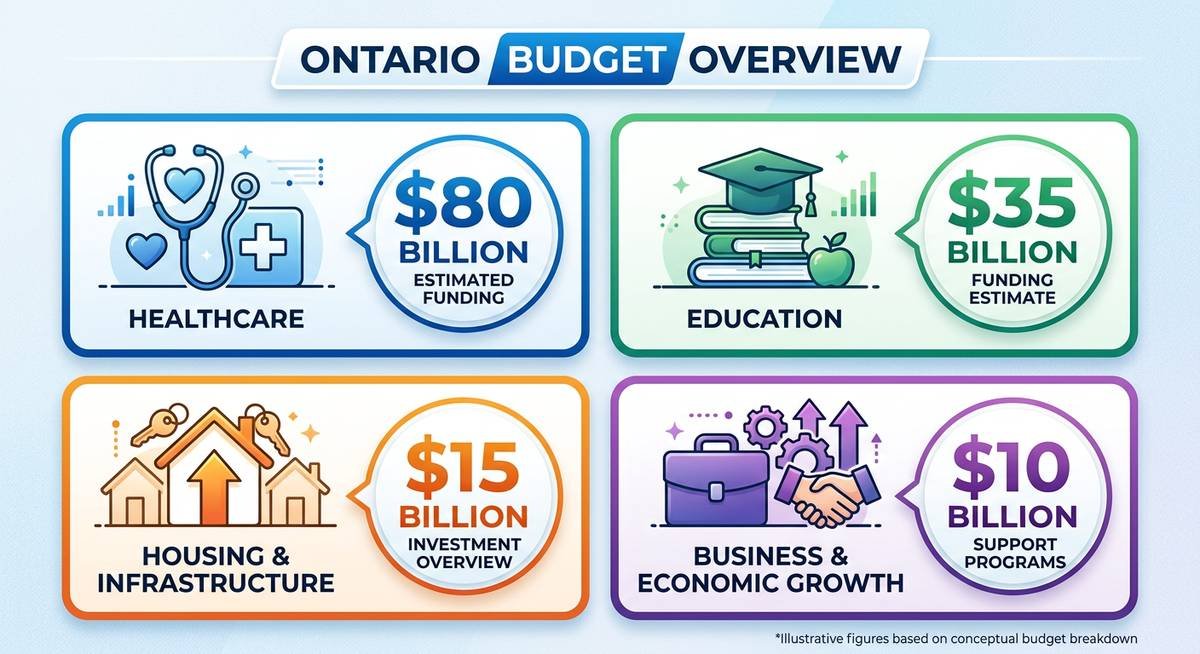
Healthcare takes the biggest slice at over $85 billion, small businesses get the most aggressive tariff-response funding in any Ontario provincial budget announcement to date, and housing policy doubles down on supply-side regulatory tools instead of direct subsidies. Education and families see expanded workforce retraining tied to U.S. trade disruption — a new emphasis that barely existed in the Ontario budget announcement 2024 cycle.
Healthcare and Public Services
Healthcare stays the budget’s largest single line item. Hospital capacity funding holds above pre-pandemic baselines, long-term care bed construction gets dedicated dollars aimed at Ontario’s aging population, and community mental health and addictions services see incremental increases. None of this is new direction — it continues commitments from the Ontario budget announcement 2023 and 2024 cycles — but the sustained funding level signals the government views healthcare as non-negotiable even as the deficit widens.
Education and Families
Families with young children see continued investment in the Canada-wide early learning and child care agreement, keeping regulated daily fees on a path toward the federally targeted $10-a-day benchmark. According to the Government of Ontario’s 2026 Budget, school infrastructure funding addresses deferred maintenance across the province’s aging building stock, with capital allocations directed toward repairs rather than large-scale new construction. Post-secondary support includes skills training partnerships tied directly to workforce disruption from U.S. trade pressures — a clear signal of where the government sees near-term labour market risk.
Housing and Infrastructure
Capital spending on transit and roads represents one of the budget’s most visible commitments, with major transit corridor projects in the Greater Toronto Area continuing to draw multi-billion-dollar provincial contributions. Housing affordability measures focus on supply-side tools — zoning reform support for municipalities and development charge relief — rather than direct demand subsidies. The Ontario deficit and debt burden makes large new housing grants politically difficult, so the government leans on regulatory levers to hit its broader goal of 1.5 million new homes by 2031, a target first set in the province’s 2022 housing action plan.
Small Business and Workers
The sharpest policy response to U.S. tariffs lands here. The budget includes targeted relief for export-dependent manufacturers and small businesses in sectors facing direct trade disruption, alongside expanded skills retraining programs for displaced workers. According to the Financial Accountability Office of Ontario, trade-exposed industries account for a significant share of provincial employment, making workforce transition support a fiscal and political necessity. Payroll tax thresholds and the small business corporate tax rate hold steady — no new increases — which the government frames as stability during a period of genuine economic turbulence.
| Sector | Key Funding Focus | Notable Change vs. 2025 |
|---|---|---|
| Healthcare | Hospital capacity, long-term care, mental health | Sustained; incremental LTC bed additions |
| Education & Families | Child care fees, school repairs, skills training | Workforce retraining expanded |
| Housing & Infrastructure | Transit corridors, development charge relief | Supply-side focus maintained |
| Small Business & Workers | Tariff relief, retraining, stable tax rates | New trade-disruption support programs |
Across every sector, the Ontario budget announcement reflects a government balancing genuine service demand against a widening deficit — spending where political pressure is highest while avoiding new tax measures that could further strain businesses already navigating a volatile trade environment.
How the 2026 Budget Compares to Previous Years
Ontario’s deficit jumped from $6.6 billion in 2025 to $14.6 billion in 2026 — the sharpest single-year expansion since the pandemic — while net debt climbed above $426 billion. That reverses two years of gradual fiscal improvement and puts the province on a trajectory the Financial Accountability Office of Ontario (2025) has flagged as a medium-term sustainability concern.
Deficit and Debt Trajectory (2024–2026)
The Ontario provincial fiscal plan has swung significantly across three consecutive budgets. The 2024 budget projected a deficit of approximately $9.8 billion, which narrowed to a reported $6.6 billion in the 2025 fiscal plan as revenues outpaced expectations. The 2026 budget reverses that progress, projecting a deficit reportedly in the range of $14.6 billion — the largest single-year shortfall since the post-pandemic recovery period.
| Budget Year | Projected Deficit | Total Program Spending | Net Debt (Projected) |
|---|---|---|---|
| 2024 | ~$9.8 billion | ~$204 billion | ~$399 billion |
| 2025 | ~$6.6 billion | ~$214 billion | ~$410 billion |
| 2026 | ~$14.6 billion | ~$232 billion | ~$426 billion |
Ontario’s debt burden now represents a growing share of GDP, a trajectory the Financial Accountability Office of Ontario has flagged as a medium-term sustainability concern. Each dollar added to net debt increases annual debt-servicing costs — money that cannot be redirected to hospitals or schools.
Shifting Spending Priorities
The composition of spending has shifted meaningfully alongside the headline numbers. Infrastructure capital allocations climbed roughly 18% compared to the 2024 budget, reflecting both the Ontario deficit and debt burden conversation and a deliberate push to stimulate domestic economic activity amid U.S. trade disruption. Healthcare spending has grown steadily across all three budgets, while post-secondary education funding remained essentially flat in real terms between 2025 and 2026, according to the Government of Ontario’s own year-over-year spending tables.
The starkest pivot sits in economic and worker-support programming. That category barely registered in the Ontario budget 2023 or the 2024 fiscal plan. Now it commands billions. The Ford government’s posture has moved from post-pandemic normalization — the dominant theme through 2024 and 2025 — to active industrial and labour-market defense. Whether that pivot outlasts the current tariff crisis depends entirely on how the U.S. trade situation evolves.
Expert Reactions and Opposition Response
Independent fiscal analysts call the deficit structural, not cyclical — meaning it won’t close on its own when trade pressures ease. Opposition parties argue the Ford government’s spending priorities leave too many Ontarians behind on housing and long-term care. Business groups cautiously welcome tariff relief but are pressing for faster regulatory action on procurement and permitting.
What Economists Are Saying
The Financial Accountability Office of Ontario has consistently warned that the province’s structural deficit reflects more than temporary tariff uncertainty — the gap between recurring revenues and program spending will not close automatically when trade pressures ease. TD Economics (2025) similarly noted that Ontario’s deficit trajectory is tracking above the median for large Canadian provinces, raising questions about fiscal sustainability if interest rates remain elevated. The budget’s GDP growth assumptions are viewed by TD Economics as optimistic given ongoing U.S. trade disruption.
Opposition and Advocacy Group Reactions
| Voice | Core Criticism or Concern |
|---|---|
| Ontario NDP | Insufficient investment in affordable housing and long-term care staffing |
| Ontario Liberals | Deficit spending lacks a credible return-to-balance timeline |
| Ontario Greens | No meaningful climate or clean-economy spending amid tariff disruption |
| Ontario Chamber of Commerce | Cautious support for worker supports; wants faster regulatory relief |
| CUPE Ontario | Public-sector wage caps remain a sticking point despite new health funding |
The Ontario NDP’s critique landed hardest on home care and mental health gaps, arguing the budget repeats prior-year underfunding patterns. Business associations broadly welcomed tariff relief measures but pressed for faster timelines on infrastructure procurement.
Frequently Asked Questions
What is in the 2026 Ontario budget announcement?
The 2026 Ontario budget announcement outlines a $232 billion spending plan anchored by three priorities: shielding workers from U.S. tariff disruption, expanding public services, and accelerating infrastructure construction. The Ontario provincial fiscal plan projects a $14.6 billion deficit while committing new dollars to healthcare, housing, and skills training across the province.
How does the deficit affect everyday Ontarians?
A larger deficit means the province borrows more, which adds to Ontario’s total debt burden — now projected above $426 billion — and increases annual interest costs that could otherwise fund hospitals or schools. The 2026 deficit does not trigger immediate tax increases, but the Ontario deficit and debt burden narrows the Doug Ford government’s fiscal flexibility in future years.
When do the budget measures take effect?
Most tariff-response relief measures take effect in spring 2026, while major infrastructure spending rolls out through 2027. Some program expansions require enabling legislation to pass first, so enrollment windows vary by initiative — check ontario.ca/budget for program-specific timelines as legislation progresses.
Where can I read the full budget?
The complete Ontario provincial fiscal plan is published at budget.ontario.ca, including detailed spending tables. The Financial Accountability Office of Ontario also publishes independent projections and assessments alongside the official documents.
What happened in the Ontario budget announcement 2023?
The Ontario budget 2023, titled “Building a Strong Ontario,” focused on infrastructure spending and restraining program growth after pandemic-era deficits. The 2023 Ontario budget projected a path to balance by 2024-25, with total program spending around $190 billion and a deficit near $1.3 billion. Healthcare received new funding for surgical backlogs, while housing policy introduced the first iteration of zoning reform incentives for municipalities.
How did the Ontario budget announcement 2024 differ from 2023 and 2026?
The Ontario budget announcement 2024 projected a deficit of approximately $9.8 billion — a sharp reversal from the near-balance achieved in 2023 — driven by slower revenue growth and rising healthcare commitments. The 2024 cycle marked a transition between post-pandemic normalization and the tariff-response posture that now dominates the 2026 plan. Infrastructure spending began climbing in 2024, but the dedicated trade-disruption programs that define the 2026 budget had not yet materialized.
Is there an Ontario budget announcement today?
The most recent Ontario budget announcement was tabled in late March 2026. Ontario typically releases its provincial budget once per year in the spring, with an optional fall economic statement that updates fiscal projections. For real-time updates on any new Ontario budget announcement today, check the official ontario.ca/budget page or the Financial Accountability Office of Ontario’s publication feed.
What is the relationship between the Ontario budget and Speech from the Throne?
The Ontario budget and Speech from the Throne serve different purposes in the provincial legislative process. The Speech from the Throne opens a new legislative session and outlines the government’s broad policy agenda — it sets direction but commits no dollars. The Ontario provincial budget announcement, by contrast, attaches specific dollar figures to those priorities and requires a formal vote in the legislature. The Speech from the Throne typically precedes the budget by weeks or months, and the budget is where rhetoric meets fiscal reality.
Does the UK budget 2024 domicile rule affect Ontario residents?
The UK budget 2024 domicile changes — which abolished the non-domicile tax status effective April 2025 — apply specifically to UK tax residents, not Canadians. Ontario residents with UK assets, income, or dual residency may face indirect effects through changes in how foreign income is taxed in Britain, but the Ontario provincial budget announcement operates under an entirely separate tax framework. Canadians with cross-border UK exposure should consult a tax advisor familiar with both jurisdictions.
Conclusion
Ontario’s 2026 budget announcement boils down to a straightforward gamble: borrow heavily now to buffer the tariff shock and keep public services running, then hope economic growth closes the gap before debt-servicing costs eat the fiscal room. The $14.6 billion deficit and $426 billion in projected net debt make that a high-stakes bet.
Spring 2026 is when most relief measures kick in. If you run a trade-exposed business or work in manufacturing, check the tariff-response program details at ontario.ca/budget as enrollment windows open. For healthcare and education commitments, the real test comes with the fall economic statement — historically, that is where quiet revisions happen.
The Financial Accountability Office of Ontario publishes independent fiscal assessments worth reading alongside the government’s own numbers. Those reports are the closest thing Ontario has to a budget reality check.