





Super Grok is not worth $30 a month for most casual users — but professionals who hit Grok message limits daily routinely recover that cost within the first week of subscribing. xAI launched SuperGrok as a standalone AI subscription in early 2025, and as of March 2026 the tier structure has expanded to include SuperGrok Heavy at $300 per month for enterprise-grade access to Grok 4 Heavy.
The real question isn’t whether SuperGrok is good — it’s whether you use it enough to justify paying 50% more than ChatGPT Plus or Claude Pro. A content strategist running DeepSearch sessions all day lives in a completely different reality than someone who fires off three questions a week on the free tier. And the gap between those two user types determines everything about whether this subscription makes financial sense.
What follows is a feature-by-feature breakdown across SuperGrok and SuperGrok Heavy — pricing versus competitors, real-world performance for image generation, video, coding, the controversial Spicy Mode, and unfiltered community feedback from people who have actually paid for months.
What SuperGrok Actually Offers
SuperGrok is xAI’s standalone premium subscription at $30 per month (or $300 per year), providing full access to Grok 4, higher usage quotas, Think Mode extended reasoning, DeepSearch, and image generation through the Aurora engine. According to xAI’s official product page (2026), SuperGrok operates independently of any X social media subscription — no X Premium required.
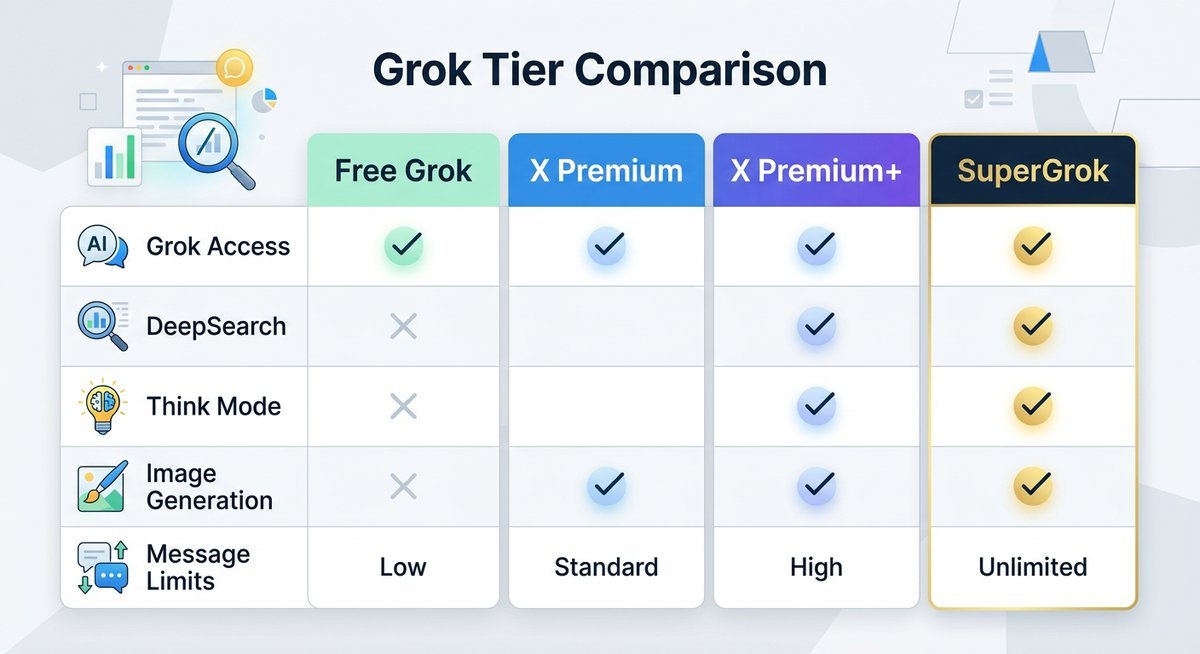
Core Features Breakdown
The subscription bundles several capabilities that free users hit walls on fast. Think Mode lets Grok 4 work through multi-step problems with extended reasoning before responding — a genuine differentiator for research and analysis workflows.
- Full Grok 4 access — xAI’s flagship model with 128,000-token context window, substantially more capable than the Grok 3 mini available on free accounts
- Think Mode — extended reasoning for complex analysis, writing, and multi-step problem solving
- DeepSearch — real-time web search with source synthesis at significantly higher daily quotas than free or X Premium tiers
- Aurora image generation — unlimited AI-generated images through xAI’s Aurora engine, a major draw for creators
- Grok Imagine beta — text-to-video generation in 6-15 second clips, available to SuperGrok subscribers since August 2025
- Voice and vision input — multimodal interactions on iOS and Android apps
- Projects workspace — organized project management for ongoing research threads
Free Grok caps users at roughly 10 queries every 2 hours on Grok 3, with no Think Mode, no DeepSearch at scale, and severely limited image generation. Anyone querying the model more than a handful of times daily will bump into those ceilings within a single work session.
Early subscribers praised the breadth of features bundled into one price. One experienced user who had previously cycled through Perplexity, ChatGPT, DeepSeek, and open-source models via Ollama shared a detailed breakdown on r/grok — a community of over 100,000 members primarily focused on Grok product feedback and technical discussion:
“You can basically replace Perplexity and ChatGPT Pro with this. The search ability is comparable, and the CoT in Grok 3 is as good as DeepSeek. It’s cheaper than ChatGPT Pro. You can actually use it consistently, unlike DeepSeek, which times out constantly. It also has an excellent context window far larger than ChatGPT.”
— r/grok, February 2025
That same reviewer flagged two notable weaknesses: no memory persistence between sessions (something ChatGPT had already shipped) and image generation that was, in his words, “literally the worst.” The candid mix of genuine praise and sharp criticism is typical of how experienced users evaluate SuperGrok — strong on reasoning and search, weaker on everything else.
SuperGrok Heavy: The $300 Tier
SuperGrok Heavy costs $300 per month with no annual discount. Launched in July 2025 alongside Grok 4, this tier targets power users and enterprises requiring maximum compute priority. According to Grokipedia (2026), SuperGrok Heavy provides exclusive access to Grok 4 Heavy — a multi-agent, higher-compute version featuring parallel test-time reasoning, 256,000-token context window, native tool use, and reserved GPU slots during peak demand.
For individual users, SuperGrok Heavy is almost never worth it. The $300 price tag makes sense exclusively for enterprise workloads, production deployments, or research teams that need guaranteed priority access when global demand spikes. Community feedback reinforces this — the reaction to Heavy’s pricing has been near-universally negative among individual subscribers:
“I paid $300 and subscribed to Grok 4 Heavy. It takes forever to think. Yet, after thinking its unable to fix the code which was written by Grok 4 Heavy itself. Elon Musk just used the right words to market it like saying its more intelligent than PhD and stuff. But it just doesn’t work. Waste of money.”
— r/grok, July 2025
Another subscriber whose Heavy subscription expired put it more diplomatically but reached the same conclusion: “I think Grok itself is still super good for other things, but I can’t justify spending $300 per month on it. I spent the last few days testing alternatives.” The pattern is consistent — even users who genuinely like Grok’s core product find the 10x jump from $30 to $300 impossible to rationalize for personal use. Everyone else should start with the standard $30 SuperGrok tier.
SuperGrok Pricing Versus Competitors
SuperGrok at $30 per month is the most expensive mainstream consumer AI subscription — $10 more than ChatGPT Plus and Claude Pro, and $10 above Gemini Advanced. That premium needs to earn its keep feature by feature, not just on brand hype.

| Feature | SuperGrok ($30/mo) | ChatGPT Plus ($20/mo) | Claude Pro ($20/mo) | Gemini Advanced ($20/mo) |
|---|---|---|---|---|
| Flagship Model | Grok 4 | GPT-4o | Claude Opus 4 | Gemini 2.5 Pro |
| Context Window | 128K tokens | 128K tokens | 200K tokens | 1M tokens |
| Image Generation | Unlimited (Aurora) | Yes (DALL-E 3) | No | Yes (Imagen 3) |
| Video Generation | Yes (Grok Imagine beta) | Yes (Sora) | No | Yes (Veo 2) |
| Web Search | DeepSearch + Think Mode | Web browsing | Limited | Google Search built-in |
| Standout Edge | Real-time X/Twitter data | Widest plugin ecosystem | Largest context + coding | Google Workspace integration |
| Annual Plan | $300/year ($25/mo) | $200/year ($16.67/mo) | $216/year ($18/mo) | $240/year ($20/mo) |
The clearest justification for the $10 premium is the real-time X platform data pipeline. Grok can pull live posts, trending topics, and public discourse in a way that ChatGPT and Claude simply cannot. For journalists, social media managers, and trend analysts, that access alone can justify the extra cost. For everyone else, the math tilts toward competitors at two-thirds the price.
Experienced users who have compared the products side by side tend to frame it pragmatically. One user on r/grok — who disclosed upfront that he wasn’t an Elon fan but wanted to evaluate the tool on its merits — summarized the competitive landscape this way: “It doesn’t matter if it’s 2% worse than o1 or whatever, it’s fast and good enough. If DeepSeek would take my money and provide reliable access they would have my money. But they don’t.” That’s the pragmatic case for SuperGrok in a nutshell: not the best at any one thing, but reliably available and bundling features that would otherwise require multiple subscriptions.
On the SuperGrok annual plan, the effective monthly cost drops to $25 — narrowing the gap with competitors. According to a comprehensive tier analysis by DataStudios (2025), the annual commitment makes the most sense for users who have already confirmed daily usage over at least two consecutive months. At that price point, committed daily users get real value. Everyone else should stick with the monthly option for the easy exit.
SuperGrok for Image Generation
Aurora, xAI’s image generation engine, produces unlimited images for SuperGrok subscribers — and the output quality has been a moving target since its October 2025 launch. Early reactions were positive, but longer-term subscribers have reported a frustrating pattern of quality regression that colors the entire value proposition.
Aurora handles photorealistic renders, illustrations, diagrams, and stylized artwork with competitive quality at its best. Compared to DALL-E 3 on ChatGPT Plus, Aurora tends to produce sharper photorealistic output but occasionally struggles with complex text rendering inside images. Gemini Advanced’s Imagen 3 offers similar photorealism but with tighter content moderation filters that limit creative range.
The lived experience of paying subscribers, though, paints a more complicated picture. Long-term users have reported a noticeable decline in Aurora output quality over time:
“It used to give very varied realistic images using ‘photography’ in the prompt, from very professional photos to more amateur, casual photos without having to ask for it. Now it gives you the same image over and over with very slight variations, half of them look like the worst old Flux slop — those plastic cartoonish-looking orange-skinned humans with the typical AI face. Another problem is the limit with SuperGrok is very low, especially considering how much of the stuff it generates is pure unusable slop.”
— r/grok, early 2025
That assessment aligns with a broader complaint pattern: Aurora’s “unlimited” quota becomes less meaningful when you need 50-100 generations to get one usable result, compared to earlier versions where a handful of attempts produced something worth keeping.
The practical question — is Super Grok worth it for image generation alone? — depends on volume and tolerance for iteration. Casual creators generating fewer than 20 images per month will find free alternatives adequate. Professional content teams producing 50-plus images weekly may still get value from Aurora’s unlimited quota, but should go in with clear eyes about current quality limitations. Claude Pro, notably, offers no image generation at all — if visual content creation matters to your workflow, that eliminates Anthropic’s offering from the comparison entirely.
SuperGrok for Video Generation
Grok Imagine, xAI’s text-to-video engine, entered beta for SuperGrok subscribers in August 2025 and generates 6-15 second clips in 5-20 seconds with native audio. That speed advantage is its primary differentiator — Sora on ChatGPT Plus renders longer films but takes 1-5 minutes per generation, while Google’s Veo produces 30-second clips optimized for advertising.
The feature works well for social media content, short promotional clips, and rapid visual prototyping. It falls short for professional video production, long-form content, or anything requiring precise scene control. The output quality sits in “impressive demo, rough production tool” territory as of early 2026.
SuperGrok Heavy subscribers get higher video generation quotas and priority queue access during peak demand. For most individual creators, the standard SuperGrok tier provides sufficient video generation capacity for regular social media posting schedules.
SuperGrok for Coding
Grok 4 handles standard coding tasks competently — function generation, debugging common patterns, explaining codebases, and writing tests. For everyday development work, it performs within striking distance of GPT-4o and Claude Opus 4. The gap shows up on edge cases.
Multi-file debugging sessions, obscure library versions, and legacy codebases expose weaknesses that GPT-4o navigates more consistently. According to Lifehacker’s independent testing (2025), Grok’s coding outputs trail behind competitors on complex, multi-step programming tasks. Claude Pro’s 200,000-token context window also gives it a structural advantage for large codebase analysis that Grok 4’s 128K window cannot match.
Developer feedback is split. xAI’s separate Grok Code Fast 1 model — available through GitHub Copilot — has earned genuine praise from developers. One user on r/GithubCopilot described it as “absolutely amazing” and noted the experience “feels very close to Claude Sonnet 4” with unlimited usage and no throttling. But that’s a different product from the SuperGrok chat subscription. Within SuperGrok itself, coding quality has drawn more mixed reactions, with a paying subscriber who used it daily for months noting that “code generation has gotten noticeably worse — it straight-up doesn’t understand what I’m asking for anymore. Claude handles the exact same tasks way better.”
Critically, SuperGrok does not include xAI API credits. The subscription grants chat-level access only. Developers needing programmatic integration for production workflows must purchase API access separately through x.ai — a cost that stacks on top of the $30 monthly fee. ChatGPT Plus and Claude Pro both offer tighter tooling ecosystems with more mature function-calling support.
SuperGrok works as a secondary coding assistant for brainstorming and quick prototyping. It should not replace a primary coding-focused AI subscription for anyone shipping production code regularly.
SuperGrok Spicy Mode
Spicy Mode was a content moderation setting in Grok Imagine that permitted significantly broader creative freedom for image and video generation, including suggestive and edgy content that other platforms would reject outright. It became one of SuperGrok’s most discussed features — and one of its most controversial.
Between October 2025 and January 2026, Spicy Mode allowed users to generate imagery that pushed well past the boundaries enforced by DALL-E, Imagen, and Midjourney. User reports indicated the mode could produce inappropriate imagery of real people without consent, triggering regulatory backlash from authorities in the UK, EU, and India.
xAI has since tightened Spicy Mode’s guardrails substantially. The reaction from paying subscribers was immediate and sharp. Frustrated users on r/grok questioned why the feature existed at all in its neutered state:
“What’s the point of having a ‘Spicy’ mode when 99% of the requests are met with ‘Content Moderated’? What’s the point of having this feature when everything gets censored? Roll back the moderation to the beginning of October please.”
— r/grok, October 2025
Some subscribers still find value in the post-crackdown version. Experienced users report that even after tightening, Grok remains “by far the most open and spicy paid LLM” compared to every other subscription service — with one subscriber calling it “easily worth the subscription” specifically for creative content that other platforms refuse to generate. The gap between what Spicy Mode promises and what it delivers, though, is narrower than it was at launch. Anyone subscribing specifically for the original unrestricted Spicy Mode should know that the version available today is meaningfully more constrained.
What Reddit Actually Says About SuperGrok
The r/grok subreddit — xAI’s most active user community, with a mix of enthusiasts, skeptics, and paying subscribers sharing unfiltered product feedback — has become the single best source of honest SuperGrok evaluations. The consensus through early 2026 splits cleanly along usage patterns, and the tone has shifted noticeably more negative over time.
Power users who need DeepSearch and Think Mode for professional research generally report positive ROI, especially when real-time X data is the bottleneck. But the honeymoon phase has cooled. Multiple long-term subscribers report that overall quality has degraded since launch — not just in image generation, but across the core product.
“I’ve been paying for SuperGrok since October last year. Right now the paid version is in the absolute worst state it’s ever been in. And no, it’s not just the censorship. I use it for real work every single day: research, fact-checking, drafting articles, simple HTML, and Imagine as my personal photo stock. Image quality has completely tanked. Code generation has gotten noticeably worse. This is my last working month with SuperGrok. I’m not renewing.”
— r/grok, early 2026
Casual users who upgraded out of curiosity overwhelmingly report canceling within the first month. Several threads specifically warn against stacking SuperGrok with X Premium+ ($40/month), calling the $70 combined spend “absurd redundancy” since feature overlap between the two is significant.
Price-conscious users have broken down the value calculation methodically. One particularly thorough analysis — from a subscriber who benchmarked SuperGrok against ChatGPT, Gemini, Perplexity, and DeepSeek — concluded that SuperGrok “may not be worth it if you’re on a budget, as alternatives offer similar or better features at a lower cost. DeepSeek at $0.50 is a steal for technical tasks.” The same user noted SuperGrok’s strength: “if you prioritize real-time research, synthesis, and reasoning, where Grok excels.”
The clearest community consensus: SuperGrok makes financial sense only if you use it heavily enough to hit the free tier’s limits multiple times per week. Below that threshold, the $30 monthly fee is paying for potential you’re not converting into actual productivity.
The Verdict: Who Should Subscribe
SuperGrok earns its $30 monthly price for high-frequency users who push against message limits daily and rely on DeepSearch, Think Mode, or Aurora image generation for professional output. Below that usage threshold, the subscription is a luxury, not a tool.
| User Type | Recommended Tier | Key Deciding Factor | Weekly Usage Threshold |
|---|---|---|---|
| Casual / Social X User | Free Grok or X Premium | Rarely hits message limits | Fewer than 3 cap hits/week |
| Content Creator / Researcher | SuperGrok | DeepSearch + Aurora save measurable hours | 10+ substantive sessions/week |
| Developer (chat/prototyping) | SuperGrok or Claude Pro | Task type determines winner | Daily coding use |
| Developer (API/production) | ChatGPT Plus or Claude Pro | SuperGrok lacks API credit inclusion | Any production workload |
| Video/Image Creator | SuperGrok | Unlimited Aurora + Grok Imagine beta | 20+ generations/week |
| Enterprise / Research Team | SuperGrok Heavy | Priority compute + Grok 4 Heavy access | Mission-critical daily use |
The most practical move before committing: exhaust the free version deliberately across a full work week. Hit its limits on purpose. If you find yourself frustrated by cutoffs on DeepSearch, Think Mode, or image generation, that friction is your clearest signal that the upgrade pays for itself.
For anyone currently paying for X Premium+ primarily for Grok access, switching to standalone SuperGrok at $30 per month often makes more sense — the Grok capabilities are deeper, and you avoid the $40 X Premium+ price that bundles social features you may not need. For AI-first users, SuperGrok standalone beats X Premium+ almost every time. Paying for both simultaneously? Almost never justified — the feature overlap makes that $70 combined spend hard to rationalize.
Frequently Asked Questions
Is Grok available in Hong Kong?
Grok is accessible in Hong Kong as of early 2026. xAI’s restricted regions include China, Russia, Cuba, Iraq, and Belarus, but Hong Kong is not on the blocked list. Users in Hong Kong can access both the free tier and paid SuperGrok subscriptions through grok.com and the X platform without a VPN.
What is the difference between SuperGrok and X Premium+?
SuperGrok ($30/month) is a standalone AI subscription focused exclusively on Grok model access with higher quotas, Think Mode, DeepSearch, and Aurora image generation. X Premium+ ($40/month) is a social media subscription that bundles Grok access alongside verification, creator monetization, and ad-free browsing on X. SuperGrok delivers deeper AI capabilities; X Premium+ is broader but shallower on the Grok side.
Is SuperGrok worth it for animation?
Grok Imagine generates short 6-15 second animated clips, which works for social media content and rapid visual prototyping. It is not a replacement for dedicated animation software like After Effects or Blender. Creators doing professional animation work will find the output too limited in length, resolution control, and scene precision. For quick animated social content, it adds genuine value.
Can you cancel SuperGrok anytime?
Yes. Cancellation is self-serve through your account settings — no support call required. Access continues through the end of your current billing cycle. Users who subscribed through iOS or Android apps must cancel through Apple’s App Store or Google Play respectively, not through the X platform directly.
Is SuperX the same as SuperGrok?
No. SuperX is an unrelated brand that appears in searches alongside SuperGrok due to the shared “super” prefix and association with the X/Twitter ecosystem. SuperGrok is xAI’s AI subscription product. SuperX refers to various other products and services with no connection to xAI or Grok.
Is paying for SuperGrok worth the subscription cost?
At $30 per month, the subscription justifies itself for users who interact with the model at least 10 substantive sessions per week — roughly two sessions per working day. The time saved on research and content generation alone covers the cost at that frequency. Below that threshold, the free tier or X Premium’s bundled Grok access is sufficient. The annual plan at $300/year ($25/month effective) improves the value calculation for committed users.
Conclusion
SuperGrok earns its $30 monthly price for professionals and high-frequency users who regularly push against Grok message limits and depend on DeepSearch, Think Mode, Aurora image generation, or Grok Imagine video clips for daily work. For power users already paying for X Premium+, the value is real but requires evaluating feature overlap carefully to avoid paying $70 combined for redundant capabilities.
The community verdict — drawn from months of subscriber feedback on r/grok and across AI forums — leans cautiously positive for heavy users and firmly negative for casual ones. Quality regressions in image generation and coding have eroded early enthusiasm, but DeepSearch and Think Mode remain genuinely strong. Casual users should stay on the free tier. SuperGrok Heavy at $300 per month makes sense almost exclusively for enterprise teams expensing the cost. And before subscribing, spend one honest week pushing the free version to its limits — that experience tells you more than any comparison table can.