




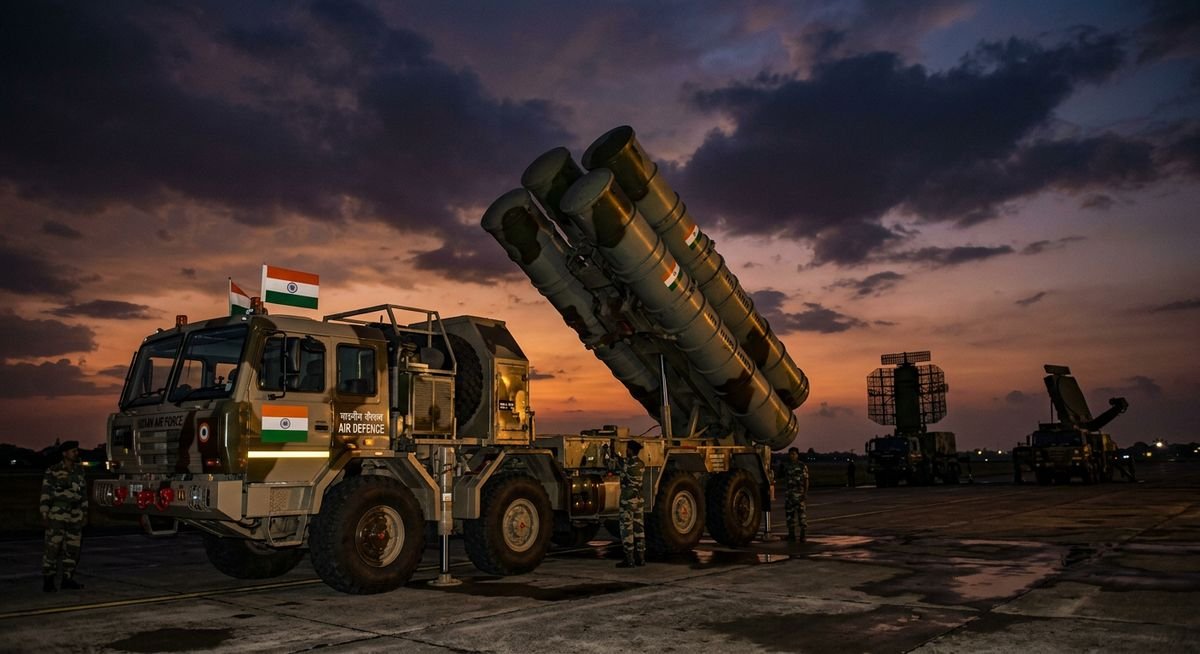
India’s Defence Acquisition Council cleared procurement of five squadrons of Project Kusha in September 2023 at approximately ₹21,700 crore, less than half what India paid for five S-400 Triumf squadrons from Russia at around ₹45,000 crore. That single number tells most of the story. Developed by the Defence Research and Development Organisation (DRDO) and slated for manufacturing by Bharat Electronics Limited (BEL), the Extended Range Air Defence System (ERADS) — widely discussed as the primary project kusha s-400 alternative — is India’s most serious bid to build a sovereign, long-range surface-to-air missile capability without foreign dependency.
What Is Project Kusha?
Project Kusha is an indigenously developed long-range surface-to-air missile system designed to intercept aircraft, cruise missiles, ballistic missiles, and hypersonic threats at ranges up to 400 kilometres and altitudes exceeding 30 kilometres. The system is also known as ERADS (Extended Range Air Defence System) and is sometimes called India’s “desi S-400” in defence circles. DRDO leads the technical development, while BEL has been awarded a manufacturing contract estimated at ₹40,000 crore, making it one of the largest indigenous defence orders in India’s history.
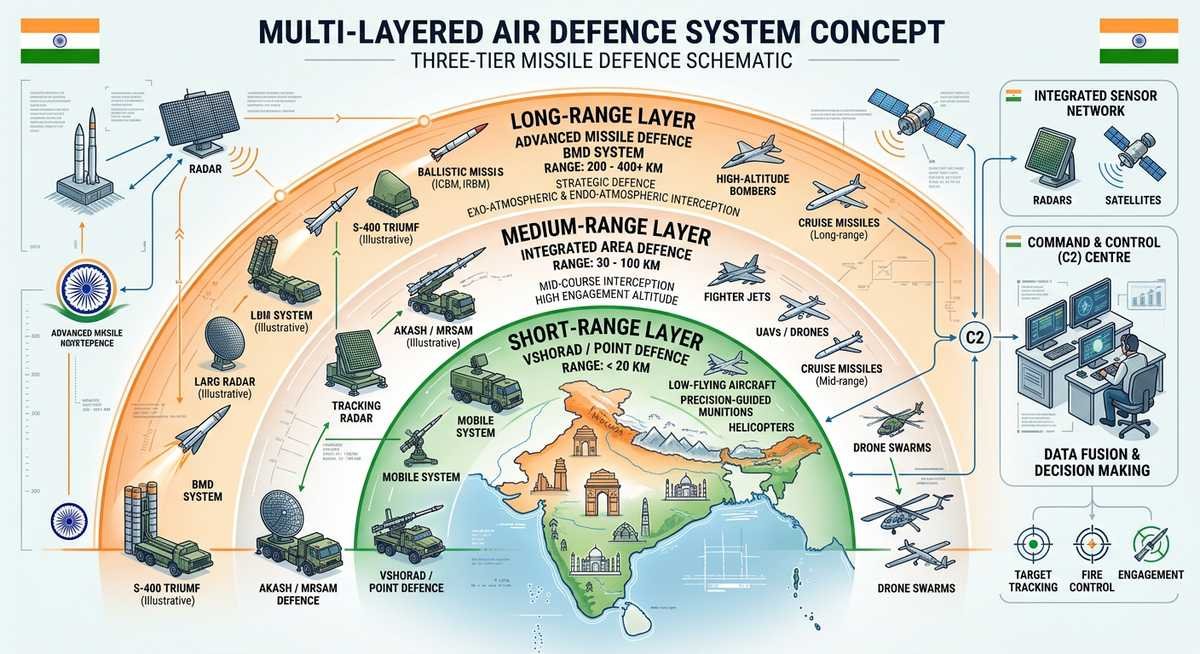
The Acceptance of Necessity (AoN) was granted by the Defence Acquisition Council in September 2023, formally launching the procurement process for five squadrons intended for the Indian Air Force. The system sits at the apex of India’s multi-layered air defence architecture under Mission Sudarshan Chakra (MSC), the government’s framework for creating an interlocking, multi-layered shield against aerial and missile threats across the country’s vast geography.
Three Variants: M1, M2, and M3 Explained
Project Kusha is not a single missile — it is a family of three interoperable interceptors covering the full spectrum from medium to extreme long range. Each variant addresses a distinct threat layer, and together they create a tiered engagement zone that no single foreign system currently deployed in India can replicate alone.
| Variant | Range | Category | Primary Target | Trial Timeline |
|---|---|---|---|---|
| M1 | ~150 km | Short-to-medium range | Aircraft, cruise missiles | 2025-2026 (completed initial trials) |
| M2 | ~250 km | Long range | Aircraft, ballistic missiles | 2027 |
| M3 | 350-400 km | Extreme long range | Hypersonic threats, stealth aircraft | Q2 2026 (Kusha-3 guided trial) |
The M1 variant completed its first captive flight in 2025, and guided trials from the Integrated Test Range (ITR) at Chandipur were scheduled for 2026. The M2, at 250 km, places it in the same tier as the S-400’s 48N6DM missile. The M3 is the flagship: DRDO has described it as a hypersonic-capable interceptor weighing approximately 1,673 kg, notably lighter than Russia’s comparable 40N6E missile, which weighs 1,893 kg and stretches to 7.8 metres. A lighter, more compact interceptor translates directly to easier logistics, faster reload times, and greater mobility on the battlefield.
That weight difference is easy to overlook in specification sheets, but for an air force managing complex theatre logistics, a 220 kg advantage per missile across hundreds of rounds adds up to a real operational edge.
Project Kusha vs S-400 vs Patriot: Full Comparison
Project Kusha is being positioned as a direct alternative to the S-400 Triumf and, to a lesser extent, the American MIM-104 Patriot. The comparison matters because India currently operates both foreign systems and must make long-term decisions about fleet expansion, maintenance contracts, and strategic autonomy.
| Parameter | Project Kusha (M3) | S-400 Triumf | MIM-104 Patriot PAC-3 |
|---|---|---|---|
| Max Range | ~400 km | ~400 km (40N6E) | ~160 km (PAC-3 MSE) |
| Max Altitude | ~30 km+ | ~30 km | ~24 km |
| System Cost (5 squadrons) | ~₹21,700 Cr | ~₹45,000 Cr | >₹40,000 Cr (estimated) |
| Per-Missile Cost | ~₹40-50 Cr (est.) | ~₹100 Cr | ~₹80-90 Cr (est.) |
| Variants | 3 (M1, M2, M3) | 4 missiles (9M96E/E2, 48N6DM, 40N6E) | 2 (PAC-2, PAC-3) |
| Indigenous Support | Full (DRDO + BEL) | Dependent on Russia | Dependent on USA |
| Mission Algorithm Access | Full access | Restricted | Restricted |
| Operational Status | Under development (induction 2028-2030) | Operational in India | Not deployed in India |
The S-400 remains India’s most capable deployed long-range air defence asset, but its geopolitical cost became starkly visible when US sanctions under CAATSA (Countering America’s Adversaries Through Sanctions Act) threatened India’s relationship with Washington following the 2018 purchase. Project Kusha eliminates that vulnerability entirely. India gets a system with comparable range, full mission algorithm access, and no third-party chokepoint over spare parts, software updates, or operational decisions.
Development Timeline and Key Milestones
Project Kusha’s development arc runs from a 2023 approval to an expected operational capability between 2028 and 2030. The pace is aggressive by Indian defence programme standards.
- 2023: Preliminary Design Review (PDR) completed; Defence Acquisition Council grants AoN for five IAF squadrons (September 2023)
- 2025: First Kusha-1 (M1) captive flight completed; DRDO and BEL finalise M1 prototype
- 2026: M1 guided trials from ITR Chandipur; Kusha-3 (M3) guided trial scheduled for Q2 2026
- 2027: M2 and M3 full-scale user trials; system integration testing with IAF infrastructure
- 2028: Phase I development completion target; first induction into service
- 2030: Full deployment across all five squadrons
According to Wikipedia’s Project Kusha entry, phased induction of all three variants into service is expected between 2028 and 2030. The Hindu BusinessLine reported in 2025 that DRDO is simultaneously developing all three Kusha variants on overlapping timelines to accelerate deployment. That seven-year runway from AoN to full operational capability is notably ambitious — the British FLAADS ground-based air defence system took over a decade from concept to deployment.
Project Kusha and Mission Sudarshan Chakra
India’s air defence architecture is not designed around any single system. Mission Sudarshan Chakra is the strategic framework for a multi-layered, interlocking shield that assigns different systems to different threat bands based on range, altitude, and threat type. Project Kusha sits at the outermost layer, the long-range envelope, working in concert with medium-range systems like the indigenously developed Akash missile and short-range systems like MRSAM.
The integration occurs through India’s Integrated Air Command and Control System (IACCS), which provides a unified operational picture and allows different systems to hand off threats between engagement zones. A ballistic missile detected at extreme range by Kusha’s radar could be engaged first by the M3 interceptor and, if it survives, picked up by shorter-range systems in a layered engagement. This architecture, rather than any single weapon, is what makes modern air defence resilient.
Russia’s S-400 systems in India operate within this same IACCS network, but their long-term integration carries risk. Any diplomatic disruption with Moscow, as India witnessed during the Ukraine war period when spare parts availability became uncertain, can degrade operational readiness in ways that no amount of training or maintenance can fully compensate for. Project Kusha resolves this structural vulnerability by replacing the foreign long-range layer with an indigenous one.
Why Indigenous Matters: The Strategic Case for Project Kusha
The cost argument is clear, but the strategic argument runs deeper. India’s experience operating foreign air defence systems has repeatedly collided with geopolitical reality. The CAATSA pressure following the S-400 purchase demonstrated that even a negotiated, bilateral contract can become a bargaining chip in a larger diplomatic contest. India’s military planners have drawn a straightforward conclusion: any critical system that cannot be operated, maintained, and modified without foreign permission is not fully sovereign.
Project Kusha gives India four things no foreign purchase can: full access to the mission algorithms (the software that determines when and how the system engages), the ability to modify performance parameters for specific Indian threat environments, a domestic supply chain that functions regardless of international sanctions, and the foundation for technology transfer that builds future capability. According to analysts quoted by Defence News India, the cost reduction of nearly 30-40 percent compared to the S-400, substantial in any defence budget, is almost secondary to the sovereignty argument.
The BEL manufacturing contract, valued at approximately ₹40,000 crore, also anchors significant industrial capability in India’s defence manufacturing base. That investment creates jobs, builds radar and propulsion expertise, and positions India for potential export of the system to friendly nations, a market where no credible indigenous Indian competitor currently exists.
Frequently Asked Questions
What is Project Kusha and what does ERADS stand for?
Project Kusha is India’s indigenously developed long-range surface-to-air missile defence system, also known as ERADS (Extended Range Air Defence System). Frequently described as a project kusha s-400 alternative, it is developed by DRDO and manufactured by BEL, designed to intercept aircraft, cruise missiles, ballistic missiles, and hypersonic threats at ranges up to 400 kilometres. The project was formally approved by the Defence Acquisition Council in September 2023.
When will Project Kusha be ready and inducted into service?
Project Kusha’s phased induction into the Indian Air Force is expected between 2028 and 2030, according to Wikipedia and multiple defence sources. Phase I development is targeted for completion by 2028. The M1 variant has already undergone initial trials in 2025-2026, with M2 and M3 trials scheduled for 2027.
How much cheaper is Project Kusha compared to the S-400?
Five squadrons of Project Kusha are cleared for procurement at approximately ₹21,700 crore, compared to approximately ₹45,000 crore (around $5.43 billion) that India paid for five S-400 squadrons. That represents a saving of roughly ₹23,000 crore, or nearly 52 percent. Per-missile costs are also estimated to be significantly lower, with S-400 missiles priced around ₹100 crore each versus an estimated ₹40-50 crore for Kusha interceptors.
What are the M1, M2, and M3 variants of Project Kusha?
Project Kusha includes three interceptor variants: M1 covers short-to-medium range up to approximately 150 km; M2 covers long range up to approximately 250 km; and M3 covers extreme long range up to 350-400 km. Together they form a tiered engagement capability designed to address the full spectrum of aerial threats from different altitudes and ranges.
How does Project Kusha compare technically to the S-400?
At maximum range (M3 vs S-400’s 40N6E), both systems reach approximately 400 km. Project Kusha’s M3 interceptor weighs around 1,673 kg, lighter than the S-400’s comparable 40N6E at 1,893 kg. The primary technical differentiator is operational sovereignty: India retains full access to mission algorithms, modification rights, and an indigenous supply chain with Project Kusha, none of which are available with the foreign S-400.
Can Project Kusha eventually replace India’s existing S-400 systems?
Project Kusha is designed to fulfil the same long-range air defence role as the S-400, and its three-variant architecture covers the same threat bands. Once fully operational (2028-2030), it can logically serve as the primary replacement for S-400 squadrons as they reach end of service life. India’s current S-400 systems are expected to serve for 20-25 years from induction, so a direct one-for-one replacement transition would likely begin in the late 2030s or early 2040s.
What is Mission Sudarshan Chakra and how does Project Kusha fit in?
Mission Sudarshan Chakra (MSC) is India’s strategic framework for establishing a multi-layered national air and missile defence shield. It assigns different systems, Akash for medium range, MRSAM for short range, and Project Kusha for long range, to interlocking engagement zones connected through the Integrated Air Command and Control System (IACCS). Project Kusha is the outermost, longest-range layer of this architecture.
Who is developing and manufacturing Project Kusha?
DRDO (Defence Research and Development Organisation) is the primary developer responsible for system design, missile development, and integration. BEL (Bharat Electronics Limited) is the designated manufacturer and has received a contract estimated at approximately ₹40,000 crore for radar systems and system integration. The partnership mirrors the DRDO-BEL model successfully used for the Akash missile system.
Does Project Kusha have export potential?
India has not formally announced export plans for Project Kusha, but the system’s cost advantage and indigenisation credentials make it a credible candidate for countries seeking affordable long-range air defence that does not come with US or Russian geopolitical strings attached. India’s defence export push under programmes like iDEX and the Defence Export Promotion Policy explicitly targets this market segment. Project Kusha would be the flagship product in any serious Indian long-range air defence export offering.
How does Project Kusha compare to the American Patriot system?
The Patriot PAC-3 MSE has a maximum range of approximately 160 km, significantly less than Project Kusha’s M3 at 400 km. Patriot’s procurement cost for a comparable number of squadrons is estimated above ₹40,000 crore, similar to the S-400 and nearly twice Project Kusha’s cleared procurement price. Patriot does benefit from decades of operational use and combat-proven performance, an area where Project Kusha will need years of service to build a comparable track record.