




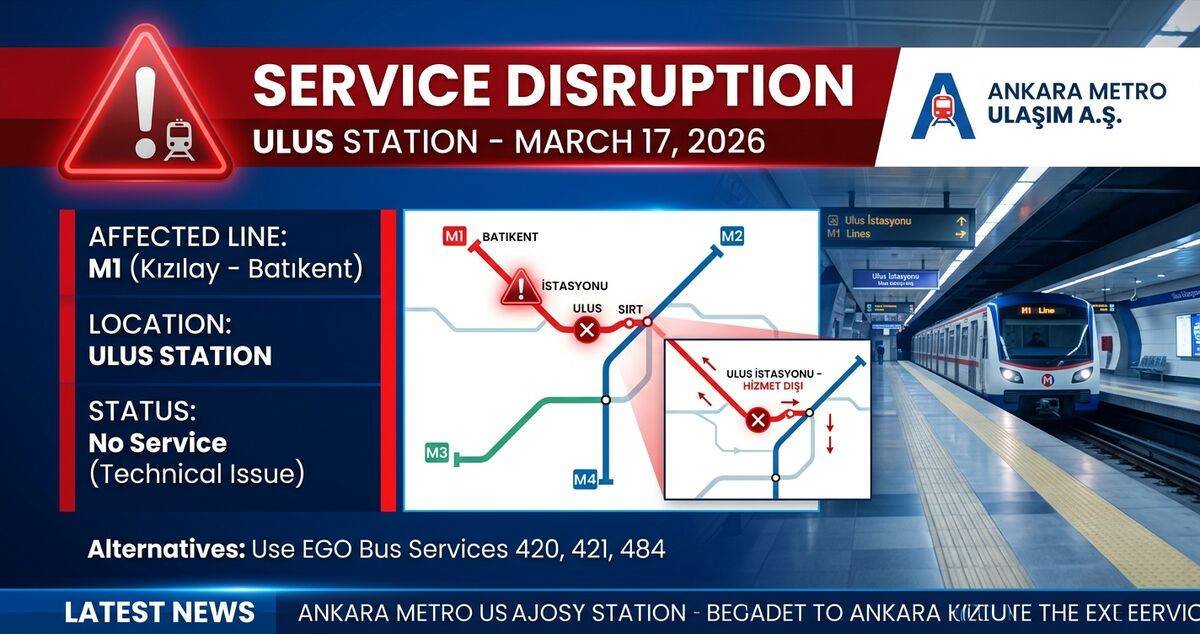
Thousands of Ankara commuters faced unexpected challenges this morning as the metro system experienced a significant service disruption. At approximately 6:45 AM on March 17, 2026, unauthorized track access at Ulus Station triggered immediate safety protocols, forcing EGO General Directorate to modify train operations across a key section of the M1 line.
The disruption caught morning rush hour travelers off guard. Students heading to class and professionals commuting to work found themselves navigating crowded transfer points at Yenimahalle and Sıhhiye stations. The incident—while causing inconvenience—demonstrates Ankara Metro’s commitment to passenger safety over schedule adherence.
This comprehensive guide provides everything you need to know: the current situation, step-by-step transfer instructions, alternative routes, and answers to your most pressing questions. Whether you’re a daily commuter or new to Ankara’s transit system, you’ll find actionable information to navigate today’s disruption and understand the broader context of what happened.
What’s Happening Right Now?
CURRENT STATUS (Updated March 17, 2026, 9:15 AM):
- ⚠️ SERVICE DISRUPTED: Ulus Station area temporarily closed
- 🚇 Affected Line: M1 Line (Kızılay-Batıkent section)
- ⏱️ Since: Approximately 6:45 AM
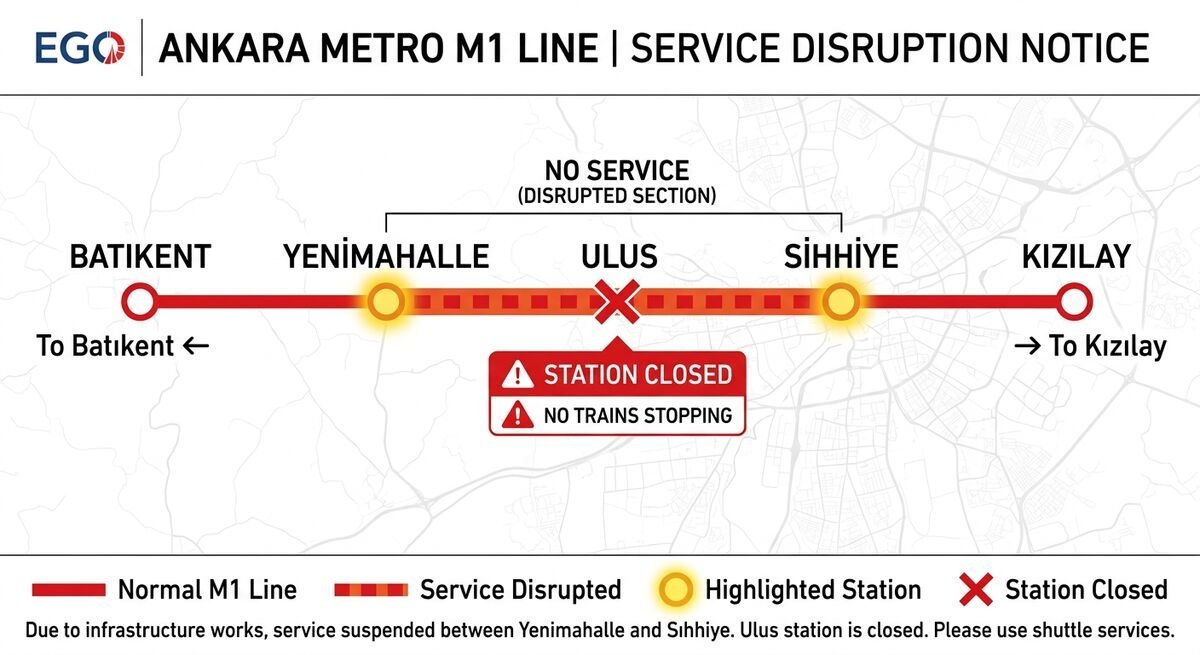
- 🔄 Current Service: Yenimahalle ↔ Sıhhiye (transfer required at both stations)
- 👥 Crowding Levels: High at Atatürk Kültür Merkezi and Yenimahalle stations
- 🔧 Resolution Status: EGO teams actively working; no estimated completion time yet
- ✅ Other Lines: M2, M3, M4, and Ankaray operating normally
What Caused the Disruption
Early this morning, one or more individuals gained unauthorized access to the metro tracks at Ulus Station. When track intrusions occur, Ankara Metro’s safety systems immediately trigger protective protocols. These protocols require temporarily stopping train service in the affected area, cutting power to potentially dangerous sections, and deploying security personnel to secure the location.
EGO General Directorate’s official statement confirms: “Due to unauthorized entry onto the tracks at Ulus Station, there are operational disruptions. Metro services are temporarily running between Yenimahalle – Sıhhiye stations with transfers required.”
The good news? No injuries have been reported.
Track intrusions, while disruptive, are relatively rare in Ankara’s metro system and are typically resolved within a few hours once the area is secured and track safety is verified.
Investigation Ongoing
EGO teams are currently conducting a thorough investigation to understand how the unauthorized access occurred, assess any potential track damage, and ensure all safety systems are functioning correctly before resuming normal operations. This careful approach may feel frustrating when you’re trying to get somewhere, but it’s precisely this commitment to safety that keeps Ankara Metro one of Turkey’s most reliable transit systems.
How This Affects Your Commute
The disruption doesn’t affect all travelers equally. Your experience depends heavily on where you’re starting and where you need to go.
If You’re At These Stations…
| Your Current Station | What To Do | Alternative Options |
|---|---|---|
| Kızılay | Transfer to M2, M3, M4, or Ankaray for other destinations | Multiple connections available; least affected hub |
| Ulus | Station currently closed; do not attempt entry | Walk 5 minutes to Ulus Ankaray station |
| Yenimahalle | Expect major crowds; allow 20-30 extra minutes | EGO buses 561, 581 provide alternatives |
| Sıhhiye | Major transfer point; follow crowd control and staff directions | Can transfer to Ankaray toward Kızılay |
| Atatürk Kültür Merkezi | Heavy transfer traffic; platforms very crowded | Consider exiting and using bus 581 |
| Batıkent | Service runs normally to Yenimahalle only | Must transfer at Yenimahalle to continue |
Transfer Instructions Step-by-Step
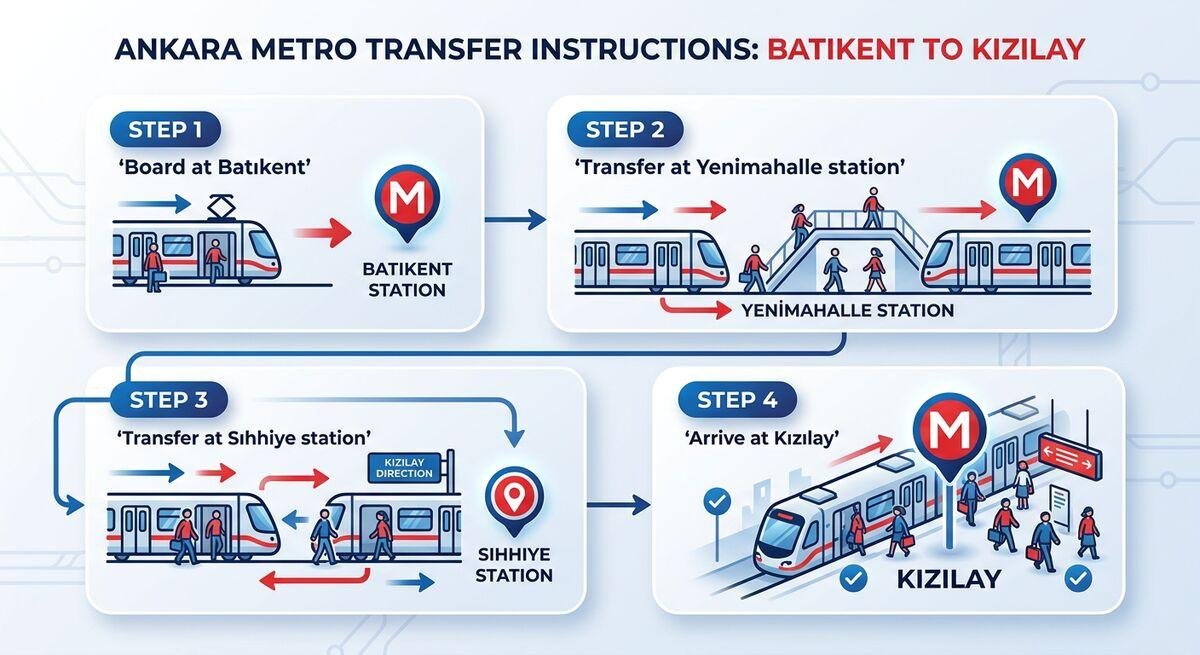
If You’re Traveling from Batıkent toward Kızılay:
- Board the metro normally at Batıkent or any station along the line
- Ride to Yenimahalle Station (terminus of current service)
- Exit the train and follow “Aktarma” (Transfer) signs
- Navigate to the opposite platform
- Wait for the next Sıhhiye-bound train (approximately 8-12 minute intervals)
- Board and ride to Sıhhiye Station
- Exit again and re-enter the system
- Board the Kızılay-bound train
- Continue to your final destination
Total added time: 25-35 minutes during peak hours
If You’re Traveling from Kızılay toward Batıkent:
The same process applies in reverse: Kızılay → Sıhhiye → transfer → Yenimahalle → transfer → Batıkent direction.
Pro Tips for Smoother Transfers:
- AnkaraKart works everywhere: Your transit card is valid on all EGO buses, so don’t hesitate to use bus alternatives if metro platforms look overwhelming.
- Morning rush (7:00-9:00 AM) is worst: If your schedule allows any flexibility, waiting until 9:30 AM will significantly reduce crowding.
- Follow the crowd: During disruptions, most experienced commuters know efficient routes. Station staff are also positioned at key points to provide guidance.
- Keep right on escalators: Turkish transit etiquette—stand on the right, walk on the left. This becomes crucial during crowded disruptions.
Alternative Bus Routes
If the double-transfer process sounds exhausting, several EGO bus routes cover similar ground:
- Bus 561: Yenimahalle → Ulus → Kızılay (20-25 minutes)
- Bus 581: Batıkent → Yenimahalle → Sıhhiye (30 minutes)
- Bus 625: Batıkent → Ulus → Kızılay (25-30 minutes)
During metro disruptions, EGO often increases bus frequency on these routes. Your AnkaraKart transfer credit applies, meaning you won’t pay a full additional fare if you transfer from metro to bus within the allowed time window.
Understanding Unauthorized Track Access
If you’re wondering “how does someone even get onto metro tracks?” and “why does it cause such massive disruptions?”—you’re not alone. Let’s break down what actually happened this morning.
What Unauthorized Track Access Means
In simple terms, someone entered the railway area who shouldn’t have been there. This could happen in several ways: climbing down from platforms, entering through maintenance areas, or breaching platform-level barriers. Sometimes these intrusions are intentional (individuals in crisis, vandalism attempts, or thrill-seekers). Other times they’re accidental—someone drops something valuable and unwisely attempts to retrieve it.
We don’t yet know the specifics of today’s incident. EGO has not released details about whether this was one person or multiple people, nor whether it was intentional or accidental. That information will likely emerge as the investigation continues.
Why It Causes Such Major Disruptions
When someone is on the tracks, everything stops. Here’s why:
Human safety comes first. Metro trains can weigh 40-50 tons and can’t stop quickly. Even at reduced speeds in stations, stopping distances can exceed 100 meters. If there’s any possibility of a person being in a train’s path, operations must cease immediately.
Electrical hazards are deadly. Metro tracks carry high-voltage electricity. Power must be cut to the affected section before anyone—whether the intruder or rescue personnel—can safely be in the area.
Track integrity must be verified. Once the person is removed and the situation is secured, engineers must inspect the tracks. Did the intruder damage any equipment? Are all safety systems still functioning? These checks take time but prevent potentially catastrophic failures later.
Cascading effects. Even a localized intrusion affects train scheduling across the line. Trains can’t simply “skip” a station—they need somewhere to turn around or wait. This is why service gets split into segments during these incidents.
Safety Systems in Action
Today’s disruption, frustrating as it is, actually demonstrates that Ankara Metro’s safety systems work exactly as designed. Here’s what happened behind the scenes:
CCTV Detection: Ankara Metro stations are equipped with extensive camera coverage. When someone enters a restricted area, control center operators can see it immediately.
Emergency Communication: Train operators maintain constant radio contact with the control center. The moment an intrusion is detected, all trains in the area receive stop commands.
Power Control: Within seconds, electrical power to the affected track section can be cut remotely, eliminating electrocution risk.
Emergency Response: Station staff and security personnel are deployed to the location. Depending on the situation, police and medical personnel may also respond.
Systematic Verification: Before resuming service, multiple checks occur: Is the intruder safely removed? Are all track sections clear? Is power safely restored? Are all signals functioning? Only after all verifications do trains resume.
This process takes time—typically 1-3 hours—but it’s time well spent to ensure your safety.
How Common Is This?
Track intrusions are relatively rare in Ankara. The system experiences approximately 3-5 major service disruptions per year, and unauthorized track access accounts for only a fraction of those. By comparison:
- London Underground: ~50 track intrusion incidents annually
- New York City Subway: ~200 incidents annually
- Tokyo Metro: ~30 incidents annually
Given that Ankara Metro serves over 600,000 passengers daily across 70+ stations, today’s incident represents an outlier rather than a pattern. The system maintains a strong safety record for a network of its size and age.
Ankara Metro System Overview
If you’re new to Ankara or unfamiliar with how the metro system works, here’s everything you need to know to understand today’s situation in context.
Quick Facts:
- First Opened: 1996 (Ankaray light rail), 1997 (M1 Metro)
- Total Lines: 4 metro lines (M1, M2, M3, M4) + 1 light rail line (Ankaray)
- Total Stations: 70+ stations across the network
- Daily Ridership: Approximately 600,000 passengers (pre-pandemic peak: 700,000+)
- Annual Ridership: 172 million passengers (2024)
- Operator: EGO General Directorate, part of Ankara Metropolitan Municipality
- System Length: ~70 kilometers of track
The Five Lines Explained
| Line | Route | Stations | Color Code | Length | Key Destinations |
|---|---|---|---|---|---|
| M1 | Kızılay ↔ Batıkent | 18 | Red | 14.7 km | Government district, residential areas |
| M2 | Kızılay ↔ Koru | 11 | Blue | 16.6 km | Universities (ODTÜ), business district |
| M3 | Batıkent ↔ OSB-Törekent | 11 | Orange | 16.6 km | Industrial zone, residential |
| M4 | Kızılay ↔ Şehitler | 14 | Purple | 16.6 km | Airport connection (future), south corridor |
| Ankaray (A1) | AŞTİ ↔ Dikimevi | 11 | Green | 8.7 km | Main bus terminal, historic center |
The Hub: Kızılay Station
If Ankara Metro has a beating heart, it’s Kızılay. This massive underground complex connects M1, M2, M3, and M4 lines, making it the most critical transfer point in the entire system. Above ground, Kızılay is Ankara’s downtown—the cultural, commercial, and governmental center. During today’s disruption, Kızılay remains fully operational, which is why alternative routes through this hub still work effectively.
Operating Hours
- First trains: Approximately 6:00 AM from terminal stations
- Last trains: Between 12:30 AM and 1:10 AM depending on line
- M4 line: Operates until 1:10 AM all days (latest service)
- Peak frequency: Every 5-10 minutes
- Off-peak frequency: Every 15-20 minutes
- No overnight service: System closes for maintenance
Fares and Payment
- Single ride ticket: 10 TL (approximately)
- AnkaraKart (contactless card): ~7 TL per ride (discounted)
- Student/senior discount: 50% off
- Transfer window: Multiple rides within time limit counted as one fare
- Monthly pass: ~550 TL for unlimited rides
- Where to buy: Kiosks at stations, some convenience stores, via EGO mobile app
Your AnkaraKart is the most convenient option—it works across all metro lines, Ankaray, EGO buses, and even some cable car services. During disruptions like today’s, the card’s automatic transfer credit becomes especially valuable, as moving between metro and bus doesn’t charge you twice.
Future Expansion
Despite today’s hiccup, Ankara Metro continues growing. Five new lines are in various stages of planning and construction, including a highly anticipated direct line to Esenboğa Airport. Once complete, the expanded network will span over 120 kilometers, making Ankara one of Turkey’s best-connected cities by rail.
Staying Informed: Real-Time Updates
Don’t rely solely on this article. The situation is evolving, and EGO provides several channels for real-time information.
Official EGO Sources (Most Reliable)
1. X (Twitter): @egobilgi
- EGO’s primary communication channel during disruptions
- Updates posted in Turkish
- Typical response time: Updates every 15-30 minutes during active situations
- Link: https://x.com/egobilgi
- Follow this account and turn on notifications if you’re a daily commuter
2. EGO Mobile App (“EGO Cep’te”)
- Real-time train tracking
- Service disruption alerts
- Route planning that adjusts for disruptions
- AnkaraKart balance checking and top-up
- Available: iOS App Store, Google Play Store
- Free download, Turkish interface
- The single best tool for Ankara commuters
3. Official EGO Website
- Comprehensive service information
- Downloadable metro maps (PDF)
- Announcement archive
- Contact information
- Link: https://ego.gov.tr
- English version available (limited)
4. Station Announcements
- PA system broadcasts in Turkish
- Digital display boards at platforms
- Station staff available at ticket counters
- Don’t hesitate to ask staff for help—they’re trained for disruptions
Third-Party Tools (Helpful but not official)
- Moovit App: Real-time tracking with community updates, multiple languages including English
- Google Maps: Transit directions that sometimes reflect disruptions (15-30 minute delay in updates)
- Yandex Metro: Offline metro maps, useful for planning
- Local News: Haber Ankara, Sözcü Ankara provide Turkish-language updates
Emergency Contact
EGO Call Center: 444 4 346 (444 4 EGO)
- Available 24/7
- Turkish language support
- For emergencies, lost items, customer service
- International visitors: Have a Turkish speaker assist if possible
Frequently Asked Questions
When will normal service resume?
EGO has not provided a specific timeline yet. Based on previous similar incidents in Ankara Metro and international metro systems, track intrusion resolutions typically take 1-3 hours once the area is secured. The disruption began around 6:45 AM on March 17, 2026. If investigations and safety checks proceed smoothly, full service could resume by late morning or early afternoon. However, these timelines are not guaranteed. Check @egobilgi on X for official updates—EGO will announce service restoration as soon as it’s confirmed safe.
Which metro lines are affected?
Primarily the M1 Line (Red Line) running between Kızılay and Batıkent, specifically the section that includes Ulus Station. Service is currently operating in two split segments: Batıkent to Yenimahalle, and Sıhhiye to Kızılay. Passengers must exit at Yenimahalle or Sıhhiye and transfer to continue their journey. All other lines—M2 (Blue), M3 (Orange), M4 (Purple), and Ankaray (Green)—are operating on normal schedules and can be used as alternatives for some routes.
Can I get a refund on my metro fare?
EGO typically does not offer refunds for service disruptions, as the policy considers that your AnkaraKart fare covers access to the transit system, and alternative routes (even with transfers) still get you to your destination. However, if you were completely unable to complete your journey and exited the system within 30 minutes without reaching your destination, you may retain partial transfer credit on your card. For specific cases involving significant financial impact or unique circumstances, contact EGO customer service at 444 4 346, though approval is not guaranteed.
Is my AnkaraKart valid on replacement buses?
Yes, absolutely! Your AnkaraKart works seamlessly on all EGO-operated buses, including any special replacement bus services that might be deployed during the disruption. Even better, if you transfer from metro to bus (or vice versa) within the allowed time window (typically 45-60 minutes), the system treats it as a continuing journey rather than charging you a full second fare. This integrated payment system is one of Ankara’s transit strengths—during disruptions, you can freely mix metro, bus, and Ankaray without worrying about fare penalties.
How often do disruptions like this happen?
Ankara Metro experiences major service disruptions approximately 3-5 times per year, though not all are due to unauthorized track access. The most common causes are technical malfunctions (electrical systems, signaling equipment), which account for roughly 60% of disruptions. Unauthorized track access is relatively rare, occurring 1-2 times annually. Extreme weather (heavy snow, flooding) causes occasional disruptions during winter months. Construction-related planned maintenance, while disruptive, is announced well in advance. Compared to larger metro systems worldwide, Ankara’s disruption frequency is actually quite low, reflecting strong operational standards.
Is Ankara Metro safe to use?
Yes, Ankara Metro maintains strong safety standards and is one of Turkey’s safest public transportation systems. Today’s disruption is actually evidence of effective safety protocols—when a potential risk is detected, service is immediately modified to protect passengers rather than maintaining schedule at all costs. The system features comprehensive CCTV monitoring at all stations, emergency communication buttons in every train car, fire suppression systems, platform edge barriers at select high-traffic stations, trained station personnel, and direct communication links to police and medical services. Statistically, riding Ankara Metro is far safer than driving a personal vehicle in the city.
What should students do if they’re going to be late for class?
Communicate with your school or university immediately, preferably before you even leave home if you anticipate significant delays. Most educational institutions in Ankara are well aware of metro disruptions (they affect thousands of students) and have established policies for excused lateness during public transportation emergencies. Universities like ODTÜ (Middle East Technical University), Ankara Üniversitesi, Hacettepe, and Gazi typically provide accommodations. Take a screenshot of EGO’s official announcement from their X account (@egobilgi) as documentation—professors and administrators generally accept this as valid proof. If your institution has an online student portal, check for emergency announcements; schools sometimes proactively post updates about metro-related attendance policies.
Are there taxi or ride-share alternatives?
Yes, but manage your expectations. Taxis are available at taxi stands near all major metro stations, and ride-share services like BiTaksi operate throughout Ankara. However, during metro disruptions, several factors come into play: demand skyrockets (expect longer wait times), prices may surge during peak hours, and most importantly, traffic congestion worsens significantly as thousands of commuters shift to roads. A journey that costs 15 TL by metro might cost 50-80 TL by taxi, and might not even be faster due to gridlock. If you’re considering taxis, weigh whether the premium cost is worth it for your specific situation. For most commuters, the bus alternatives or the metro transfer process, while inconvenient, remain the most practical choice.
Where can I find a map of the affected area?
Official Ankara Metro maps are posted at all stations, typically near ticket machines and at platform entrances. The EGO mobile app includes interactive digital maps that should reflect current service conditions (look for any disruption overlays). You can also visit ego.gov.tr and navigate to the rail system section to download PDF maps of all lines. Third-party apps like Moovit, Yandex Metro, and Google Maps provide metro network maps, though real-time disruption updates on these platforms may lag behind official EGO sources by 15-30 minutes. This article also includes descriptions of the affected section—essentially, the Ulus area of the M1 Red Line between Yenimahalle and Sıhhiye.
What happens if there’s an emergency while I’m on the metro?
Every metro train car is equipped with emergency communication buttons (usually near doors and in the center of cars) that connect directly to the train operator. If you press one, you can speak to the operator immediately to report medical emergencies, security concerns, or other urgent situations. Stations have clearly marked emergency exits (green lit signs), fire extinguishers, first aid kits, and trained staff. For medical emergencies, inform any station personnel you see—they can call paramedics who can reach any station in the system within 5-10 minutes. For security concerns, station staff can contact police. Never hesitate to use emergency systems; they’re there precisely for unexpected situations, and there’s no penalty for legitimate emergency use.
Conclusion
This morning’s unauthorized track access at Ulus Station serves as a reminder that even the most reliable transit systems face unexpected challenges. The disruption—requiring transfers at Yenimahalle and Sıhhiye for M1 Line travelers—has tested the patience of Ankara’s commuters. But it has also demonstrated the effectiveness of EGO’s safety protocols, prioritizing passenger wellbeing over schedule adherence.
As of this writing, EGO teams continue working to resolve the situation and restore normal operations. While no specific timeline has been announced, similar incidents typically resolve within a few hours. Continue monitoring @egobilgi on X and the EGO mobile app for the most current information.
If you’re planning travel in the coming hours, download the EGO app if you haven’t already, consider alternative routes via M2, M3, M4, or Ankaray if they serve your destinations, and allow extra travel time during the remainder of today’s peak hours. The temporary inconvenience, while frustrating, reflects a transportation system that takes your safety seriously.
Ankara Metro has served millions of passengers safely over nearly three decades of operation, continuously expanding and improving. Today’s incident is an anomaly in an otherwise reliable system. Once normal operations resume, you can ride with confidence knowing the very protocols that caused today’s delays are constantly working to keep you safe.
For future reference, bookmark this article and share it with friends or colleagues who might find it helpful. Stay informed, stay patient, and stay safe on Ankara’s metro system.