





Droven.io is an AI news and intelligence platform at the center of the droven io future of ai conversation, aggregating, curating, and analyzing developments across the global artificial intelligence sector — from large language model breakthroughs and enterprise automation to regulatory shifts and open-source model advances. In 2026, the platform has become a go-to resource for professionals, researchers, and business leaders trying to keep up with one of the fastest-moving technology sectors on the planet.
The timing matters. AI is no longer a topic for specialists. Generative systems now run in live customer environments. Agentic AI handles workflows that once required teams. Regulators across three continents are enforcing new rules. Staying current is not optional — it is a professional baseline. That is the gap Droven.io is built to fill.
What Is Droven.io and What Does It Actually Cover?
Droven.io is an AI-focused media and intelligence platform that tracks developments across the full spectrum of artificial intelligence: model releases, enterprise deployments, startup activity, regulatory updates, research milestones, and hardware advances. The platform sits at the intersection of journalism and technical analysis, making complex AI news accessible to both technical and non-technical audiences.
Unlike general technology news outlets that treat AI as one topic among many, Droven.io treats AI as a full-time beat. Its coverage spans multiple dimensions of the AI industry:
- Model developments: New large language models, multimodal systems, and open-source releases from labs including Anthropic, OpenAI, Meta AI, Google DeepMind, and Mistral
- Enterprise adoption: How organizations across finance, healthcare, legal, and manufacturing are deploying AI in production environments
- Regulatory environment: The EU AI Act, U.S. executive orders on AI safety, and emerging governance frameworks globally
- Hardware competition: NVIDIA, AMD, Intel, and the growing wave of custom silicon from cloud providers
- Workforce and skills: How AI is reshaping job markets, certification demand, and the skills professionals need to stay competitive
The platform’s practical focus — on what AI means for real work, real careers, and real business operations — is what separates it from purely academic or research-oriented sources.
The Five AI Trends Droven.io Is Tracking in 2026
Droven.io’s reporting consistently surfaces five major forces reshaping AI this year, each representing a genuine structural shift with real implications for businesses, careers, and public policy, not a short-lived headline cycle.
1. Generative AI Has Left the Pilot Phase
Generative AI tools, including large language models, image generation systems, and multimodal applications, have crossed from experimentation into full-scale enterprise production. Organizations across finance, healthcare, legal services, and retail are running generative AI in live customer-facing and internal operational environments. This is not a pilot anymore. The question now is not whether to deploy generative AI, but how to govern and scale it.
2. AI Agents Are Rewriting Automation
Agentic AI, systems that can plan, reason, and execute multi-step tasks without continuous human input, has become the dominant paradigm in enterprise software development. Unlike simple chatbots, AI agents browse the web, write and run code, interact with external APIs, and manage complex workflows autonomously. According to prefactor.tech’s 2026 AI agent adoption analysis, 79% of companies report that AI agents are already being adopted within their organizations, while a separate G2 enterprise report puts the share with agents already running in production at 57%. That pace is remarkable, and Droven.io has tracked the deployment patterns closely across industries.
3. The EU AI Act Is Live, and Compliance Is Lagging
The European Union’s landmark AI regulation has moved into active enforcement. Organizations operating in or selling to EU markets must now classify their AI systems by risk level, implement mandatory oversight mechanisms, and maintain compliance documentation. The reality on the ground, though, is uneven. According to reporting tracked by Droven.io, only 8 of 27 EU Member States had operational national contact points in place as of March 2026. The legal requirement exists; the infrastructure to support it is still catching up. For compliance and legal teams, this gap is both a warning and an opportunity.
4. Open-Source AI Is Narrowing the Gap With Proprietary Models
One of the most consequential developments in recent AI news is the rapid improvement of open-source models. Meta’s LLaMA series, Mistral’s model family, and a growing roster of community-driven releases have become serious alternatives to commercial APIs for a widening range of enterprise use cases. This trend is dramatically lowering the barrier to AI adoption, giving organizations the ability to fine-tune and deploy models on their own infrastructure, without ongoing API costs or vendor lock-in. The competitive dynamics of the AI industry are shifting as a result.
5. The AI Hardware Race Is Intensifying
NVIDIA’s dominance in AI chip supply is being challenged on multiple fronts: by AMD and Intel, by a growing cluster of custom chip startups, and by hyperscaler-designed silicon from Google (TPUs), Amazon (Trainium), and Microsoft. This hardware competition is directly reducing AI training costs, changing deployment economics, and making frontier AI capabilities accessible to a broader range of organizations. Droven.io’s coverage of this race provides context that purely financial or business media tend to miss.
How AI Is Changing Work and Business, What Droven.io’s Coverage Shows
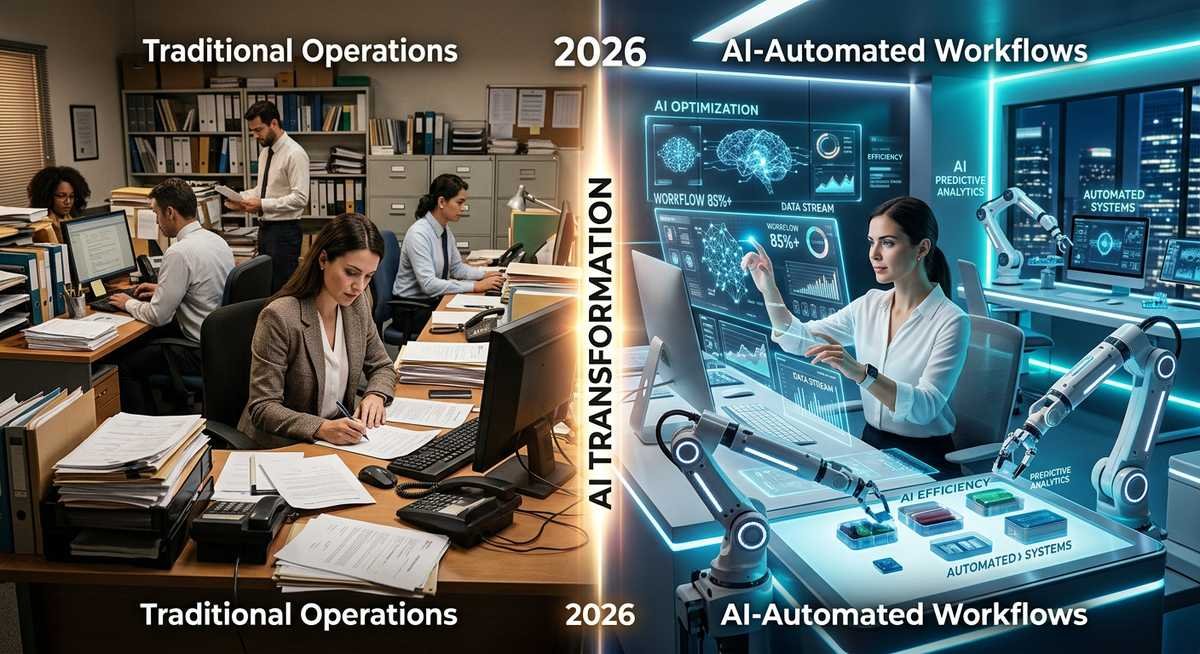
AI is restructuring work fastest in high-volume, well-defined tasks, document processing, code review, customer routing, while simultaneously generating new job categories like MLOps engineer and AI governance officer that barely existed five years ago. The net effect is a labor market that is being reorganized, not simply shrunk.
Automation is accelerating fastest in tasks that are well-defined and high-volume: document processing, customer inquiry routing, data entry, code review, and standard reporting. Jobs in these areas are evolving, not necessarily disappearing, but the skill mix required is changing significantly. The professionals gaining ground are those who can direct AI systems, validate their outputs, and integrate them into existing workflows.
At the same time, new categories of work are emerging. Prompt engineering, MLOps, AI governance, and AI product management barely existed as job titles five years ago. Today they appear in enterprise hiring at scale. The labor market is not simply contracting around AI, it is being restructured around it.
Small businesses are among the quiet beneficiaries of this shift. A business owner who once needed a team for social media management, basic bookkeeping, or customer communication can now accomplish comparable outputs with AI tools and one person who knows how to use them. The access gap between large and small organizations is narrowing faster than most analysts expected.
The Challenges That Get Less Coverage, and Why They Matter
Droven.io’s coverage of the future of AI does not stop at capability announcements. Privacy risks, security vulnerabilities, and workforce disruption get sustained attention across the platform, and the reasons why are direct and practical.
Privacy remains genuinely unsolved at the enterprise level. Organizations are deploying AI systems trained on data they do not fully control or understand. Data governance frameworks are struggling to keep pace with the speed of AI adoption. For individuals, the surface area of personal data in AI systems, from health records to financial behavior to communication patterns, is growing without proportionate transparency.
Security risks are evolving in kind. AI-generated phishing, deepfake-enabled fraud, and prompt injection attacks against AI systems are real threats in 2026, not theoretical ones. The organizations best positioned to navigate these risks are treating AI security as a dedicated function, not a subset of general IT security.
The skills gap is the challenge that directly affects the most people. Across the technology sector, AI-certified professionals earn between 20 and 45 percent more than non-certified peers in equivalent roles, according to widely cited industry surveys, a premium that reflects genuine market scarcity. Millions of AI-relevant positions are projected to go unfilled over the next three years across every major economy. The professionals who will close that gap are not necessarily those with the most technical background, they are those who invest in understanding how AI systems work, where they fail, and how to use them responsibly.
Staying Current With AI Through Droven.io
Following platforms like Droven.io as a daily professional habit, five to ten minutes of high-signal scanning, is the practical approach to staying current without being overwhelmed by the volume of AI news. Coverage is organized for actionable relevance, not just information volume.
Droven.io’s structure supports exactly that. Coverage is organized to surface developments that have practical implications: when a major model release changes what is possible, when a regulatory update creates compliance requirements, when an open-source advance shifts the competitive terrain. The signal-to-noise ratio is the whole point. For anyone navigating the droven io future of ai narrative with professional intent, that filtering function is genuinely valuable.
For professionals who want to go deeper, the platform provides a starting point for tracking the research community (arXiv, NeurIPS, ICML), the key labs (Anthropic, OpenAI, Google DeepMind, Meta AI), and the governance bodies (EU AI Office, NIST AI Risk Management Framework) that are shaping the field’s direction.
The AI industry in 2026 rewards people who understand what is actually happening, not what is being hyped, not what has already peaked. Droven.io is designed to close that gap, and the five trends above illustrate exactly why that kind of clear-headed coverage is valuable right now.
Frequently Asked Questions About Droven.io and the Future of AI
What is Droven.io?
Droven.io is an AI news and intelligence platform that tracks, curates, and analyzes developments across the global artificial intelligence sector, covering model releases, enterprise deployments, regulatory updates, hardware advances, and workforce changes affecting both professionals and businesses.
Is Droven.io a reliable source for AI information?
Droven.io focuses specifically on AI as a full-time coverage area rather than treating it as one topic among many, which allows for more consistent depth. Like any news aggregation platform, readers benefit from cross-referencing coverage with primary sources (official research papers, regulatory filings, company announcements) for high-stakes decisions.
What does the future of AI look like according to Droven.io’s coverage?
Based on consistent themes across Droven.io’s reporting, the near-term future of AI is defined by five major developments: generative AI moving fully into enterprise production, agentic AI systems automating complex multi-step workflows, active enforcement of the EU AI Act, rapid improvement of open-source models, and intensifying competition in AI hardware from multiple chip manufacturers.
How widely are AI agents being adopted in enterprise environments?
Adoption is accelerating significantly. According to 2026 data from G2’s enterprise AI analysis, 57% of companies already have AI agents running in production, with 79% reporting active adoption across their organizations. This marks a clear shift from the experimentation phase that characterized most enterprise AI programs in 2023 and 2024.
How is the EU AI Act being enforced in 2026?
The EU AI Act moved into active enforcement in 2026, requiring organizations to classify AI systems by risk level and implement oversight mechanisms. Implementation is uneven: only 8 of 27 EU Member States had operational national contact points in place as of March 2026, meaning the regulatory infrastructure is still being built while compliance requirements are already in effect.
What is happening with open-source AI models?
Open-source AI models from Meta (LLaMA), Mistral, and community contributors have significantly narrowed the performance gap with proprietary commercial models. This is lowering the cost and complexity of AI deployment, enabling organizations to run and fine-tune models on their own infrastructure without relying on external APIs or accepting vendor lock-in.
How is AI affecting the job market?
AI is restructuring rather than simply eliminating jobs. High-volume, well-defined tasks (document processing, data entry, routing) are being automated, while new roles, prompt engineer, MLOps specialist, AI governance officer, AI product manager, are emerging at scale. Professionals with the ability to direct AI systems, validate outputs, and manage human-AI workflows are gaining significant career advantage.