




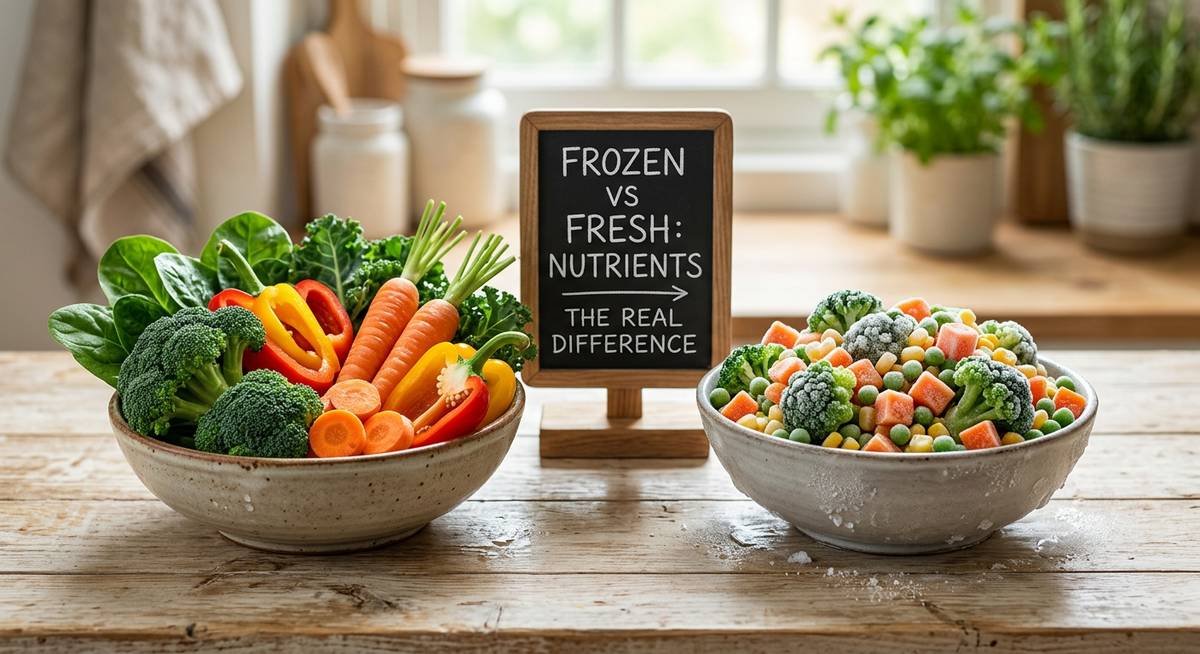
Both fresh and frozen vegetables can deliver excellent nutrition — but which one actually wins depends less on the label and more on how long that broccoli sat in a truck before it reached your plate. The frozen vs fresh vegetable nutrients debate has a genuinely surprising answer: the “fresh” bag of spinach in your fridge may already have lost a significant share of its folate and Vitamin C before you’ve even opened it. When people ask which is healthier frozen or fresh vegetables, the honest answer requires looking at supply chains, not just nutrition labels.
Here’s the part most shoppers don’t know about frozen vegetable nutrition. Frozen vegetables are typically harvested and processed within hours, locking in nutrients at peak ripeness. The blanching process — a brief heat treatment applied before freezing — does cause modest losses in water-soluble vitamins, but it also halts the enzyme activity that drives ongoing nutrient degradation. Fresh produce, by contrast, continues losing nutrients from the moment it’s picked, and supermarket timelines of 3 to 14 days post-harvest are common.
The real answer in the frozen vegetables vs fresh vegetables debate isn’t a simple winner. Vegetable type, storage time, and cooking method all shift the outcome — sometimes dramatically. Peas frozen the same day they’re picked can outperform “fresh” peas that crossed three state lines. The full picture is more nuanced, and more useful, than either side of the debate usually admits.
How Freezing Affects Nutrient Content
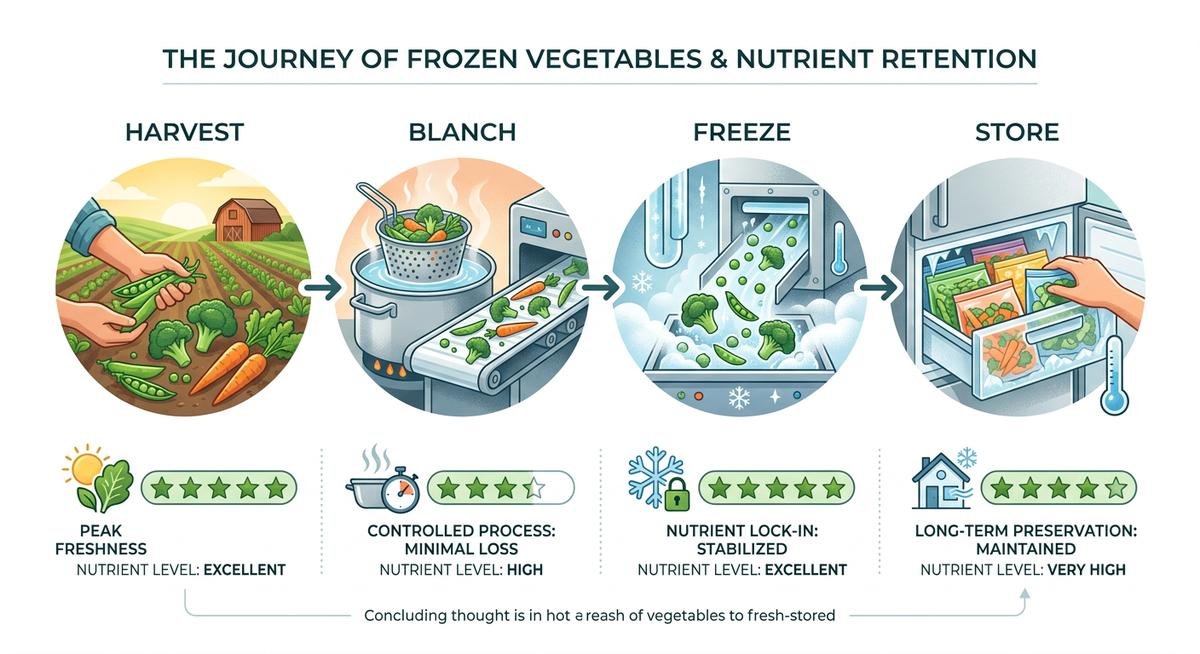
Freezing itself causes almost no nutrient loss. The real action happens in the 90 seconds before the vegetables ever reach sub-zero temperatures — during a heat treatment called blanching that determines how nutritious your frozen broccoli or peas will actually be.
The blanching step and why it matters
Before freezing, commercial processors submerge vegetables in boiling water or expose them to steam for roughly 1–3 minutes. The goal is to deactivate naturally occurring enzymes — peroxidase and lipoxygenase, specifically — that would otherwise continue breaking down color, flavor, and nutrients even at freezer temperatures.
Blanching works, but it comes at a cost. Water-soluble vitamins, particularly Vitamin C and certain B vitamins like folate, leach out during this brief heat exposure. Research published in the Journal of Food Composition and Analysis has found Vitamin C losses from blanching ranging from 10% to 40% depending on the vegetable and blanching duration. Fat-soluble nutrients tell a different story — beta-carotene, Vitamin K, and Vitamin E are largely unaffected because they don’t dissolve into the blanching water.
Once blanching is complete, the nutrient degradation process essentially stops. Rapid freezing to around -18°C locks cellular structure in place, halting the enzymatic and oxidative reactions that erode nutritional value over time.
What freezing locks in
After that initial blanching loss, frozen vegetables hold their nutritional profile with remarkable stability. A bag of frozen peas processed within hours of harvest can genuinely contain more Vitamin C than “fresh” peas that spent five days in transit and two more on a supermarket shelf.
Bioavailability — how effectively the body absorbs and uses a nutrient — is not meaningfully altered by freezing. Retained nutrients in frozen vegetables are absorbed at comparable rates to those in their fresh counterparts, according to research reviewed by the Institute of Food Technologists. The nutrient is still the nutrient; the freezer simply pressed pause on its decline.
The nuance most people miss is that blanching losses vary significantly by vegetable. Peas and corn, with their protective outer layers, lose relatively little during blanching. Delicate leafy greens like spinach, with high surface-area-to-volume ratios, are more vulnerable — a gap that matters when comparing nutrients in fresh vs frozen vegetables across different produce types rather than treating all vegetables as a single category.
The “Fresh-But-Stored” Problem Most Shoppers Don’t Know About
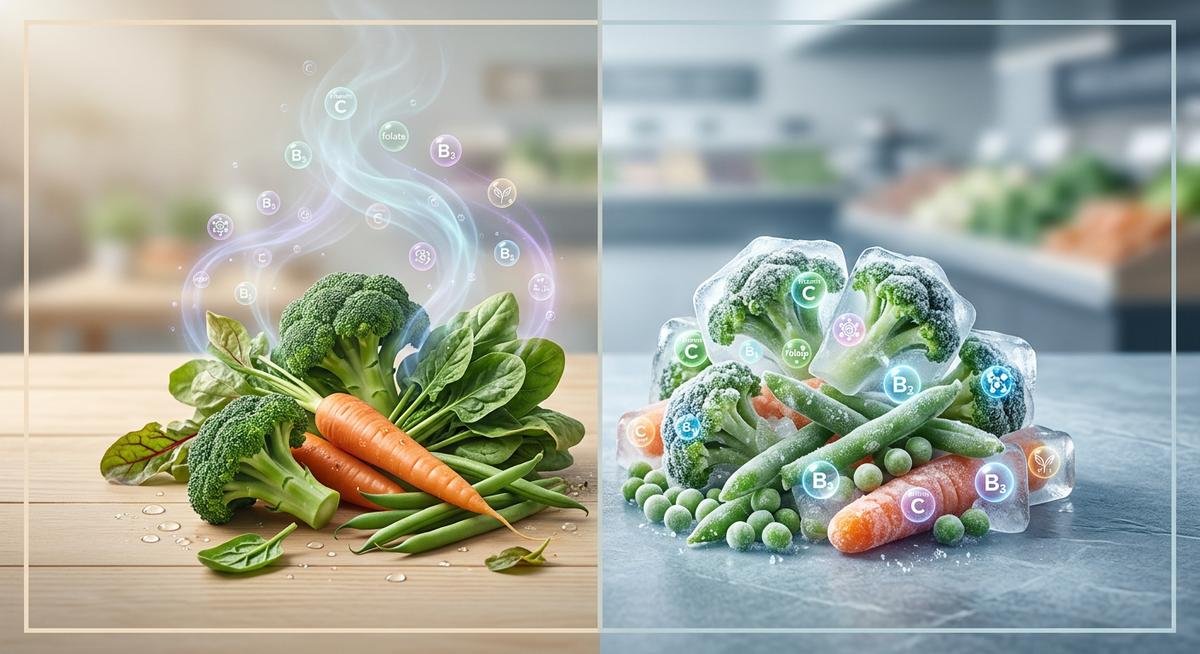
Fresh produce labeled “fresh” at the supermarket can lose 20–50% of certain water-soluble vitamins before it reaches your plate — because most fresh vegetables spend 3 to 14 days in transit and cold storage after harvest, during which nutrient degradation continues uninterrupted. In many cases, that timeline makes supermarket “fresh” measurably less nutritious than frozen vegetables processed within hours of picking.
From farm to shelf: the hidden timeline
Most fresh produce travels through a supply chain that includes harvesting, field cooling, packing, regional distribution, long-haul transport, and retail display — a process that routinely spans 3 to 14 days before a consumer picks it up. Nutrient degradation doesn’t pause during transit. It accelerates.
Research published in the Journal of Agricultural and Food Chemistry found that fresh spinach stored at room temperature lost approximately 50% of its folate within 8 days of harvest. Even under refrigeration — the best-case scenario — Vitamin C in broccoli begins declining measurably within 24 to 48 hours of harvest. Cold storage slows the process; it doesn’t stop it.
The question of how long fresh vegetables retain nutrients after harvest doesn’t have a comfortable answer for most supermarket produce. For water-soluble vitamins like Vitamin C and folate, the window is genuinely short.
When “fresh” is actually older than frozen
Commercial frozen vegetables are typically blanched and frozen within hours of harvest, locking in nutrients at near-peak ripeness. The fresh peas on a supermarket shelf may have been picked the same week — or they may have spent 10 days in a refrigerated container crossing the country.
That gap widens considerably for out-of-season produce shipped internationally. A bag of frozen peas processed in July can genuinely contain more Vitamin C in January than “fresh” peas flown in from thousands of miles away.
| Stage | Fresh Vegetable | Frozen Vegetable |
|---|---|---|
| Time from harvest to processing | 3–14 days (typical supply chain) | Hours (processed at source) |
| Nutrient degradation during transit | Continuous — cold storage slows, doesn’t stop | Minimal — freezing pauses degradation after blanching |
| Vitamin C loss before purchase | Measurable within 24–48 hrs; significant by day 7+ | Modest loss during blanching; stable after freezing |
| Folate retention (spinach example) | ~50% loss possible within 8 days at room temperature | Partial blanching loss; remainder well-preserved frozen |
None of this makes fresh vegetable vs frozen a clear-cut contest. Bought locally, in season, and eaten within two to three days of purchase, fresh produce is hard to beat. The problem is that most shoppers aren’t buying under those conditions — and the label “fresh” offers no indication of where a vegetable actually sits on that timeline.
Frozen vs Fresh Vegetables Nutrition Facts: A Nutrient-by-Nutrient Breakdown
Across most common vegetables, frozen options retain nutrients comparably to — and sometimes better than — supermarket fresh, particularly for Vitamin C, folate, and antioxidants like beta-carotene. These frozen vegetables vs fresh nutrition facts challenge the widespread assumption that the produce aisle always delivers superior nutrition. According to a 2017 study by researchers at the University of California, Davis, published in the Journal of Food Composition and Analysis, frozen vegetables matched or exceeded fresh in nutrient content for the majority of vitamins tested across eight common vegetables. The critical variable is which nutrient, which vegetable, and how long that “fresh” bag has actually been sitting in a cold room before it reached your kitchen.
How to Read the Comparison
The table below reflects general research findings on nutrient retention relative to a freshly harvested baseline of 100%. “Fresh” values assume typical supermarket storage of 3–7 days post-harvest — the realistic timeline for most shoppers, not an idealized farm-to-table scenario. “Frozen” values account for blanching process losses but assume proper continuous frozen storage; cooking method will shift these numbers further, which the next section covers in detail.
Nutrient Comparison Table
Nutrient degradation does not affect all vegetables equally. Peas and corn are structurally robust; their cell walls tolerate blanching well. Spinach, by contrast, is delicate — its water-soluble vitamins are highly vulnerable to both heat and prolonged storage. The table captures these distinctions rather than flattening them into a single verdict.
| Vegetable | Vitamin C Fresh / Frozen | Folate Fresh / Frozen | Beta-Carotene Fresh / Frozen | Potassium Fresh / Frozen | Fiber Fresh / Frozen |
|---|---|---|---|---|---|
| Broccoli | Moderate (~70%) / Moderate (~65%) | Moderate (~75%) / Moderate (~70%) | High (~90%) / High (~88%) | High (~92%) / High (~90%) | High (~98%) / High (~97%) |
| Peas | Moderate (~72%) / Moderate–High (~75%) | Moderate (~78%) / Moderate (~72%) | High (~88%) / High (~85%) | High (~93%) / High (~91%) | High (~99%) / High (~98%) |
| Spinach | Low–Moderate (~55%) / Low (~50%) | Low (~50%) / Low–Moderate (~55%) | High (~85%) / Moderate–High (~80%) | High (~90%) / Moderate–High (~85%) | High (~97%) / High (~95%) |
| Corn | Moderate (~68%) / Moderate–High (~72%) | Moderate (~74%) / Moderate (~70%) | High (~90%) / High (~88%) | High (~94%) / High (~92%) | High (~99%) / High (~98%) |
| Carrots | Moderate (~65%) / Moderate (~60%) | Moderate (~70%) / Moderate (~65%) | High (~92%) / High (~90%) | High (~93%) / High (~91%) | High (~98%) / High (~97%) |
Data reflects peer-reviewed research averages on nutrient retention relative to freshly harvested baseline. Individual results vary by cultivar, growing season, harvest maturity, and storage conditions. “Fresh” assumes 3–7 days post-harvest supermarket storage; “Frozen” assumes blanching plus continuous frozen storage at or below −18°C (0°F).
Key Takeaways from the Data
The frozen veg vs fresh veg nutrition numbers tell a more nuanced story than any single “fresh wins” or “frozen wins” headline. A few patterns stand out clearly.
- Peas and corn freeze exceptionally well. Both vegetables show frozen retention figures that match or slightly exceed their supermarket-fresh equivalents for Vitamin C — a direct consequence of being processed within hours of harvest, before nutrient degradation can accelerate.
- Vitamin C is the most vulnerable nutrient in both forms. Vitamin C suffers losses from the blanching process before freezing and from prolonged cold storage after harvest. No preparation method fully eliminates this gap from the true fresh-harvested baseline.
- Beta-carotene and potassium are remarkably stable. Across all five vegetables, both nutrients retain 85–94% of baseline values regardless of fresh or frozen status — making carrots and broccoli reliable sources of these nutrients in either form.
- Fiber is essentially unaffected by freezing. Retention sits at 95–99% across the board. For anyone prioritizing digestive health, the fresh-versus-frozen debate is irrelevant on this particular nutrient.
- Spinach is the exception, not the rule. Spinach’s folate and Vitamin C figures are notably lower and more variable than the other vegetables listed — best consumed fresh within 2–3 days of purchase, or cooked from frozen rather than thawed and served raw.
Why Cooking Method Matters More Than Fresh vs Frozen
Steaming preserves roughly 80–90% of most vitamins in both fresh and frozen vegetables, while boiling can leach out 25–50% of water-soluble nutrients into the cooking water. When comparing frozen vegetables nutrition vs fresh, the preparation method you choose after buying has a larger impact on final nutrient delivery than the frozen-versus-fresh decision itself.
Steaming vs boiling vs microwaving
A 2009 study published in the Journal of Zhejiang University Science B compared nutrient retention across cooking methods for broccoli. Steaming retained 83% of Vitamin C, while boiling dropped retention to just 54%. Microwaving with minimal water sat between the two at roughly 74% retention.
Frozen vegetables actually have an advantage here. Because they can go straight from the freezer into a steamer or microwave — no thawing necessary — they spend less total time exposed to heat. Fresh vegetables often require washing, chopping, and longer cook times, all of which extend nutrient exposure to heat and water. The practical lesson: steam or microwave frozen vegetables without thawing for maximum nutrient retention.
Frozen vegetables nutrition loss during cooking
The total frozen vegetables nutrition loss across the entire chain — harvest, blanching, freezing, storage, and cooking — typically ranges from 15% to 50% for Vitamin C depending on the specific vegetable and cooking method. For comparison, fresh vegetables that have spent a week in supermarket cold storage and then get boiled for 10 minutes can lose 40–75% of their original Vitamin C, according to data from the U.S. Department of Agriculture. The gap between frozen and fresh narrows — and sometimes reverses — once real-world cooking enters the equation.
| Cooking Method | Vitamin C Retention (Broccoli) | Best For |
|---|---|---|
| Steaming (5 min) | ~80–90% | Maximum nutrient preservation |
| Microwaving (minimal water) | ~70–80% | Speed + good retention |
| Stir-frying (high heat, short time) | ~65–75% | Flavor + reasonable retention |
| Boiling (10 min) | ~50–60% | Convenience, but highest nutrient loss |
Buying Frozen Vegetables in Hong Kong
Hong Kong imports over 90% of its fresh vegetables, primarily from mainland China, Australia, and the United States, according to the Agriculture, Fisheries and Conservation Department. That long supply chain means “fresh” produce on Hong Kong supermarket shelves routinely carries 5–10 days of post-harvest storage — longer than most other major cities. For Hong Kong shoppers specifically, frozen vegetables from brands like Birds Eye, Edgell, and local options available at ParknShop and Wellcome offer a practical way to secure peak-harvest nutrition without depending on import timelines.
The frozen vegetables hk market has expanded significantly in recent years. Stores like CitySuper and HKTV Mall now stock organic frozen vegetable lines from European and North American producers, giving health-conscious Hong Kong consumers access to flash-frozen produce that was processed within hours of harvest — a meaningful nutritional advantage when the fresh alternative spent a week in a shipping container.
Frequently Asked Questions
Are frozen vegetables just as healthy as fresh vegetables?
In many cases, yes — and sometimes frozen vegetables are more nutritious than their supermarket “fresh” counterparts. Fresh produce can spend 3–14 days in transit and cold storage before purchase, during which nutrient degradation continues. Frozen vegetables are typically processed within hours of harvest, locking in nutrients at peak ripeness.
Do vegetables lose nutrients when frozen?
The blanching process before freezing causes modest losses in water-soluble vitamins — Vitamin C can decline by roughly 10–40% depending on the vegetable and blanching duration. However, freezing itself causes minimal additional nutrient loss. Once blanched and frozen, nutrient degradation is essentially paused.
Which vegetables are healthier fresh or frozen?
It depends on the vegetable and how quickly fresh produce is consumed. Peas and corn retain nutrients exceptionally well when frozen. Delicate leafy greens like spinach show more variable results — best eaten fresh within 2–3 days of purchase, or cooked from frozen rather than stored fresh for a week.
Does freezing destroy vitamins in vegetables?
Freezing alone does not destroy vitamins. The real nutrient loss happens during blanching and cooking, not the freeze itself. Fat-soluble nutrients like beta-carotene and Vitamin K remain largely stable through both blanching and frozen storage, making frozen vegetables a reliable source of these micronutrients year-round.
Is frozen or fresh veg better for you?
Neither is categorically better — the answer depends on how quickly you eat fresh produce after buying it. Frozen vegetables processed within hours of harvest often retain more Vitamin C and folate than “fresh” vegetables that spent a week in supermarket cold storage. Fresh produce eaten within 1–2 days of purchase from a local source will typically match or slightly exceed frozen for most nutrients.
Do fresh or frozen vegetables have more nutrients?
Fresh vegetables straight from the farm contain the most nutrients. Supermarket “fresh” vegetables, however, have usually lost measurable amounts of water-soluble vitamins during 3–14 days of transit. Frozen vegetables lock in nutrients at harvest, making them nutritionally comparable — and sometimes superior — to store-bought fresh produce, according to research published in the Journal of Food Composition and Analysis (2017).
Conclusion
The frozen vegetables vs fresh debate has no universal winner — the outcome depends on how long produce has been stored, which vegetable you’re eating, and how you cook it. Frozen wins on convenience, cost, and often on nutrient retention when fresh produce has already spent days in transit. Fresh wins when eaten within 24–48 hours of purchase or used raw.
The biggest lever on nutrient degradation isn’t the freezer aisle versus the produce section. It’s your cooking method. Steamed frozen broccoli will outdeliver boiled fresh broccoli on Vitamin C every time.
Skip the anxiety at the grocery store. Buy fresh when you’ll use it immediately. Reach for frozen when life gets busy. Both choices, cooked well, put genuinely nutritious food on your plate.