




When people ask “is Xevotellos model expensive,” the direct answer is: the Base starts at $600 and the Ultra reaches $1,500, placing the lineup in the mid-to-premium laptop segment. That $600 entry point sits near the Lenovo IdeaPad 5 ($580) and below both the Dell Inspiron 15 ($650) and Apple’s MacBook Air ($1,200). Pricing data for the Xevotellos lineup is sourced from the brand’s product listings and third-party tech coverage; independent retail verification varies by region.
Xevotellos Model Pricing: What Each Tier Costs
Xevotellos currently sells three distinct configurations. The Base model runs $600, the Pro runs $900, and the Ultra tops out at $1,500. Each step up brings meaningful hardware improvements rather than just incremental spec bumps.
| Model | Price | Processor | RAM | Storage | Best For |
|---|---|---|---|---|---|
| Xevotellos Base | $600 | 2.0 GHz | 8GB | 256GB SSD | Everyday tasks, students |
| Xevotellos Pro | $900 | 3.2 GHz | 16GB | 512GB SSD | Professionals, multitaskers |
| Xevotellos Ultra | $1,500 | 4.0 GHz | 32GB | 1TB SSD | Intensive workloads, power users |
All three configurations share the same 15.6-inch Full HD display, aluminum chassis construction, Wi-Fi 6 connectivity, and up to 12 hours of battery life. The differences lie entirely in processing power, memory, and storage capacity. For buyers who need a reliable workhorse for browsing, document editing, and video calls, the Base covers that ground at a competitive price. Stepping to the Pro doubles the RAM and processor speed, which noticeably changes how the device handles creative applications and parallel workloads.
The Ultra tier is a different conversation. At $1,500, it costs $300 more than a MacBook Air, which means it needs to deliver tangible performance advantages for that premium to make sense.
Xevotellos vs. Competitors: How the Pricing Stacks Up
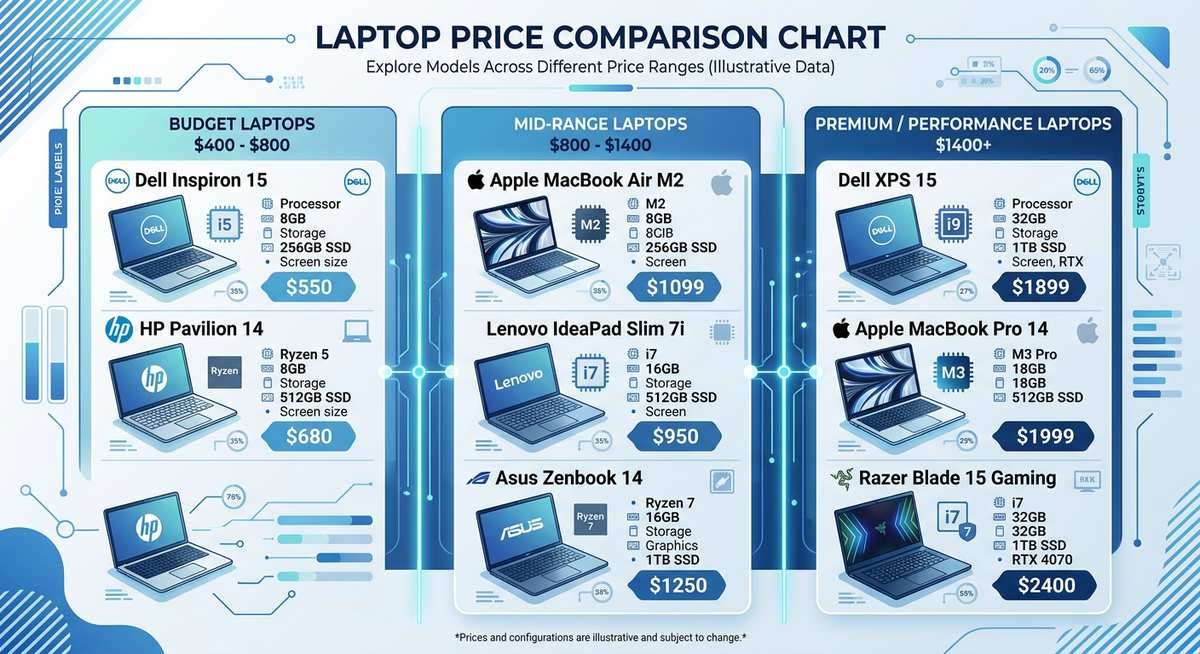
The Xevotellos model is not expensive relative to most direct competitors at equivalent tiers. The $600 Base undercuts Dell and HP while matching Lenovo on price, the $900 Pro fills a gap neither brand occupies cleanly, and the $1,500 Ultra competes on specs against Apple at $1,200.
| Brand & Model | Price | Key Specs | Battery Life |
|---|---|---|---|
| Xevotellos Base | $600 | 2.0 GHz, 8GB RAM, 256GB SSD | Up to 12 hours |
| Lenovo IdeaPad 5 | $580 | Similar entry-level specs | Up to 10 hours |
| Dell Inspiron 15 | $650 | Mid-range Intel, 8GB RAM | Up to 8 hours |
| HP Pavilion 15 | $700 | AMD or Intel, 8-16GB RAM | Up to 9 hours |
| Xevotellos Pro | $900 | 3.2 GHz, 16GB RAM, 512GB SSD | Up to 12 hours |
| Apple MacBook Air | $1,200 | Apple M-series chip, 8GB RAM | Up to 18 hours |
| Xevotellos Ultra | $1,500 | 4.0 GHz, 32GB RAM, 1TB SSD | Up to 12 hours |
At the entry point, Xevotellos is essentially matched against the Lenovo IdeaPad 5 on price, with a $20 premium. The Xevotellos Base’s advantage here is the claimed 12-hour battery life, which beats both the Inspiron 15 (8 hours) and the HP Pavilion 15 (9 hours). Battery endurance is one of those specifications that matters far more than the spec sheet suggests once someone starts carrying a laptop through a full workday.
The Pro tier at $900 occupies a space that neither Dell nor HP fills cleanly. Dell’s mid-range offerings sit closer to $800-$850, while HP’s Spectre line jumps to $1,000+. For buyers who find both prices too far apart, the Xevotellos Pro lands in that gap with 16GB RAM and 512GB SSD included at the base price rather than as upgrades.
Where the pricing story gets harder to defend is at the Ultra tier. The MacBook Air at $1,200 offers Apple’s M-series processor, which benchmarks exceptionally well per watt, and a longer 18-hour battery life. Paying $300 more for the Xevotellos Ultra means betting on higher raw clock speed (4.0 GHz) and more RAM (32GB) over Apple’s ecosystem efficiency. That trade-off makes sense for Windows-dependent workflows or applications requiring memory-intensive operations where 32GB of RAM provides headroom that Apple’s base configuration cannot match.
What the Price Buys: Xevotellos Features Worth Knowing
Across all three tiers, Xevotellos includes aluminum construction, Wi-Fi 6, a 15.6-inch Full HD display, and up to 12 hours of battery life as standard. These are features that budget competitors often charge extra for or simply omit.
- Aluminum chassis across all tiers. Budget laptops from Dell and HP at the $580-$650 range typically use polycarbonate plastic. Xevotellos uses aerospace-grade aluminum construction starting at $600, which affects both durability perception and heat dissipation.
- Wi-Fi 6 standard across the lineup. Wi-Fi 6 is not universal at the $600 price point. Dell and HP often reserve it for configurations priced above $700-$750.
- Consistent 12-hour battery across tiers. Many laptop manufacturers advertise maximum battery figures for the lightest configuration. Xevotellos maintains the same 12-hour claim across Base, Pro, and Ultra, which suggests the battery capacity scales with processor requirements rather than dropping with premium models.
- Advanced thermal management. The brand’s cooling architecture allows high-refresh gaming (144Hz in applicable configurations) and 4K video editing without sustained performance throttling during extended sessions.
User feedback cited by third-party tech coverage points to battery life and screen clarity as the most consistently praised attributes. The most common criticism, across multiple independent reviews, centers on limited global service availability, which is a meaningful practical concern for buyers outside major urban markets. Xevotellos is a newer brand in comparison to Dell, HP, or Lenovo, and its service network has not yet reached the same geographic breadth as those established manufacturers.
Is Xevotellos Worth the Price? A Use-Case Breakdown
Whether the Xevotellos model is expensive or fair value depends entirely on the buyer’s actual use case, because the same $600 price point lands differently for a student than it does for a creative professional needing multitasking headroom.
For students and everyday users: The $600 Base model competes directly with Lenovo’s IdeaPad 5. The Xevotellos edges ahead on battery life and build quality at nearly the same price. For someone who prioritizes long battery life and a sturdier feel over brand recognition, the Base makes a reasonable case.
For working professionals: The Pro at $900 hits a useful sweet spot. Sixteen gigabytes of RAM handles multitasking across developer tools, design applications, and video conferencing simultaneously without the slowdowns that 8GB configurations regularly produce. Comparable Dell and HP configurations with equivalent RAM typically run $850-$950, so the Pro’s pricing is not aggressive, but it is defensible.
For power users and creatives: The Ultra at $1,500 is the most debatable purchase. The hardware specifications, particularly 32GB RAM and 4.0 GHz processing, are genuinely strong for the price. The hesitation comes from the brand’s emerging status. Apple at $1,200 and Dell’s XPS 15 in the same range carry decades of established support infrastructure, service networks, and third-party accessory compatibility. Xevotellos asks buyers to prioritize raw specs over that ecosystem reliability.
The brand itself occupies an honest position: strong hardware numbers at prices that are not dramatically below established competitors, with the trade-off being limited global service coverage and a shorter track record.
FAQ: Xevotellos Model Pricing and Value
Is Xevotellos model expensive?
Is Xevotellos model expensive compared to the broader market? Not particularly. The Base at $600 is priced similarly to the Lenovo IdeaPad 5 and below Dell and HP equivalents. The Pro ($900) and Ultra ($1,500) sit at mid-to-high price points, competitive with comparable configurations from established brands.
Which Xevotellos model offers the best value for money?
The Pro model at $900 provides the strongest value-to-performance ratio in the lineup. The jump from 8GB to 16GB RAM and from 2.0 GHz to 3.2 GHz processing is significant for professional workloads, and the price increase from the Base is $300, which is reasonable for that hardware improvement.
How does Xevotellos compare to Dell and HP on price?
Xevotellos Base ($600) is $50-$100 less than the Dell Inspiron 15 ($650) and HP Pavilion 15 ($700) for comparable configurations. The Xevotellos Base also offers aluminum construction and Wi-Fi 6 at that price, which Dell and HP typically reserve for higher configurations.
Is the Xevotellos model worth buying in 2025?
For buyers prioritizing hardware specifications per dollar and battery life, Xevotellos offers a solid proposition at all three tiers. The main risk is limited service availability in some regions. Buyers in areas without authorized service centers should factor in repair accessibility before purchasing.
Where can I buy a Xevotellos model at the best price?
Xevotellos models are available through the brand’s official website, authorized dealers, and online retailers including Amazon. For the best warranty coverage and access to customer support, purchasing directly from the official website or an authorized reseller is recommended.
Can the Xevotellos Base model handle gaming?
Light gaming and casual titles are manageable on the Base configuration, but the 2.0 GHz processor and entry-level specifications limit performance in demanding games. The Ultra tier, with dedicated graphics support and a 144Hz refresh rate capability, is the appropriate choice for regular gaming use.
Does Xevotellos offer any financing or installment options?
Financing availability varies by retailer and region. Buyers purchasing through Amazon, Best Buy, or authorized dealers may have access to installment plans through those platforms’ existing payment programs. Checking with the specific retailer at the time of purchase provides the most current financing options.
Final Take on Whether Is Xevotellos Model Expensive
Xevotellos prices its models at a level that demands direct comparison with established brands rather than positioning itself as a budget alternative. At $600, the Base holds its own against the Lenovo IdeaPad 5 on hardware while offering better battery life. The Pro at $900 fills a genuine gap in the mid-range market. The Ultra at $1,500 competes on raw specification numbers but asks buyers to prioritize clock speed and RAM over ecosystem maturity.
The one factor that deserves honest weight before buying: service coverage. Users in regions with limited Xevotellos service presence face a meaningful practical risk that hardware specifications alone cannot offset. For buyers in markets with confirmed authorized service access, the pricing represents reasonable value. For everyone else, that question is worth resolving before committing.