



OBOL — four letters, and the only correct answer to the crossword clue “one sixth of a drachma.” This ancient Greek coin appears in major puzzle grids roughly seven times a year, clued as everything from “Charon’s fee” to “old Greek monetary unit.” Memorize those four letters once and you’ll never hesitate over a Greek-coinage crossing again.
But the obol was far more than a convenient crossword fill. Struck in silver and weighing barely 0.72 grams, this tiny disc anchored daily commerce across the Greek world for over three centuries. Six obols made one drachma — and that ratio threaded its way through everything from Athenian jury wages to the mythological fare for crossing the River Styx. The word itself carries a pre-monetary history tied to iron cooking spits and fistfuls of metal, and the coin’s most famous job had nothing to do with buying bread.
The Crossword Answer: One Sixth of a Drachma
The crossword clue “one sixth of a drachma” always resolves to OBOL — four letters, alternating vowel-consonant, and clean crosses with nearly any intersecting fill. No other ancient Greek coin matches a one-sixth-drachma valuation with a four-letter name, which is why clue databases like Crossword Tracker log it as one of the most reliable numismatic entries in puzzle construction.
Why OBOL Is Always the Answer
The obol was the standard small-denomination coin in ancient Greece, valued at exactly one sixth of a drachma. Solvers searching for “coin one sixth of a drachma crossword” or “ancient greek coin that was one sixth of a drachma crossword clue” land on the same four letters every time. The six-letter variant OBOLUS occasionally surfaces in themeless puzzles with wider fill, and the plural OBOLI (five letters) appears when the clue specifies “ancient Greek coins worth one sixth of a drachma.” For the standard four-letter grid slot, OBOL has no competition.
Confirming the letter count before filling saves real time — especially when the crossing answers are uncertain. O-B-O-L: two vowels, two consonants, zero ambiguity. Whether the clue reads “one sixth of a drachma,” “one sixth drachma,” “1/6 of a drachma,” or simply “Greek coin,” the fill is identical.
Crossword Clue Variations
Constructors rotate phrasing deliberately to keep experienced solvers from auto-piloting. Recognizing the full range of clue wordings turns OBOL into an automatic get regardless of how the puzzle frames it.
| Clue Phrasing | Letter Count | Puzzle Context |
|---|---|---|
| One sixth of a drachma | 4 (OBOL) | Most common direct definition |
| Ancient Greek coin | 4 (OBOL) | General knowledge clue |
| Old Greek coin worth one sixth of a drachma | 4 (OBOL) | Extended definition style |
| Charon’s fee | 4 (OBOL) | Mythology-themed puzzle |
| Ferryman’s payment, in myth | 4 (OBOL) | Classical mythology angle |
| Ancient Greek coins (plural) | 5 (OBOLI) | Plural form for wider grids |
| Silver coin of ancient Greece | 6 (OBOLUS) | Full Latin form, rare |
Solvers also encounter the phrasing “ancient greek coins worth one sixth of a drachma crossword” when searching for the plural form OBOLI (five letters) or OBOLUS (six letters). “Charon’s fee” tends to stump solvers unfamiliar with Greek mythology — the ferryman of the underworld demanded an obol to carry souls across the River Styx. Different clue, same coin, same four letters.
The Obol — Ancient Greek Coin Worth One Sixth of a Drachma
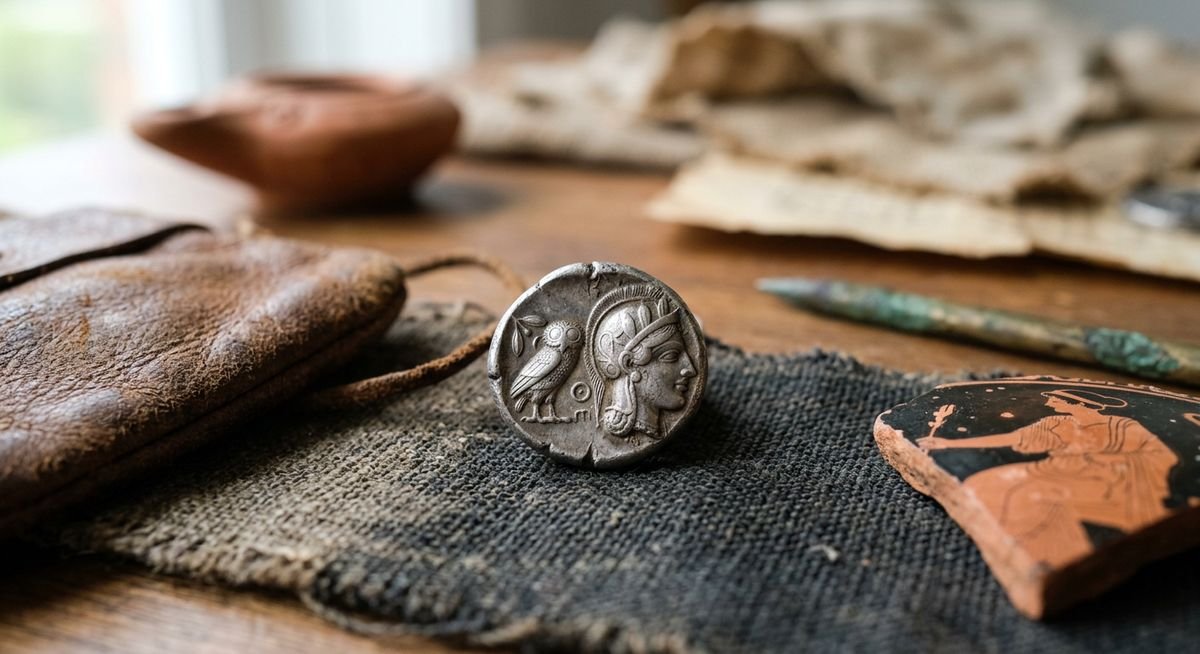
The obol was a small silver coin weighing approximately 0.72 grams and measuring 8 to 11 millimeters across — smaller than a modern shirt button. Minted from the sixth century BCE onward, this ancient Greek coin — one sixth of a drachma in value — circulated so widely that archaeological finds span mainland Attica to colonial settlements in Sicily and the Black Sea coast. A sixth of drachma in any search query leads to the same answer.
Physical Description and Minting
Athenian obols bore the helmeted head of Athena on the obverse and a small owl on the reverse — the same imagery that graced the famous tetradrachm, compressed onto a tiny flan of silver. Other city-states stamped their own symbols: Corinthian obols featured Pegasus, while Aeginetan versions carried a sea turtle. Every ancient Greek coin one sixth of a drachma in value carried the stamp of its home city. According to the British Museum’s numismatic collection, well-struck obols with sharp detail remain genuinely scarce, making them prized among modern collectors.
Bronze obols appeared during the Hellenistic era as city-states shifted away from silver for small denominations. Silver shortages, rising military costs, and the practical reality that a coin worth one sixth of a drachma didn’t justify precious metal by the third century BCE all drove the transition.
Greek Coin Denominations: Where the Obol Fits
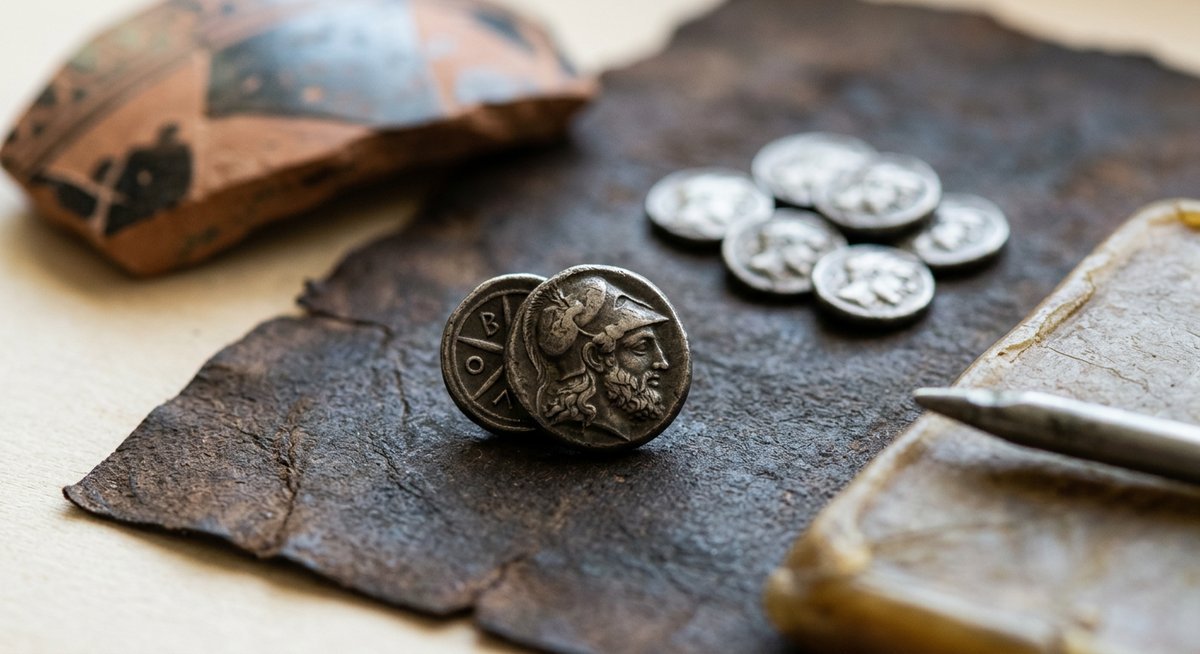
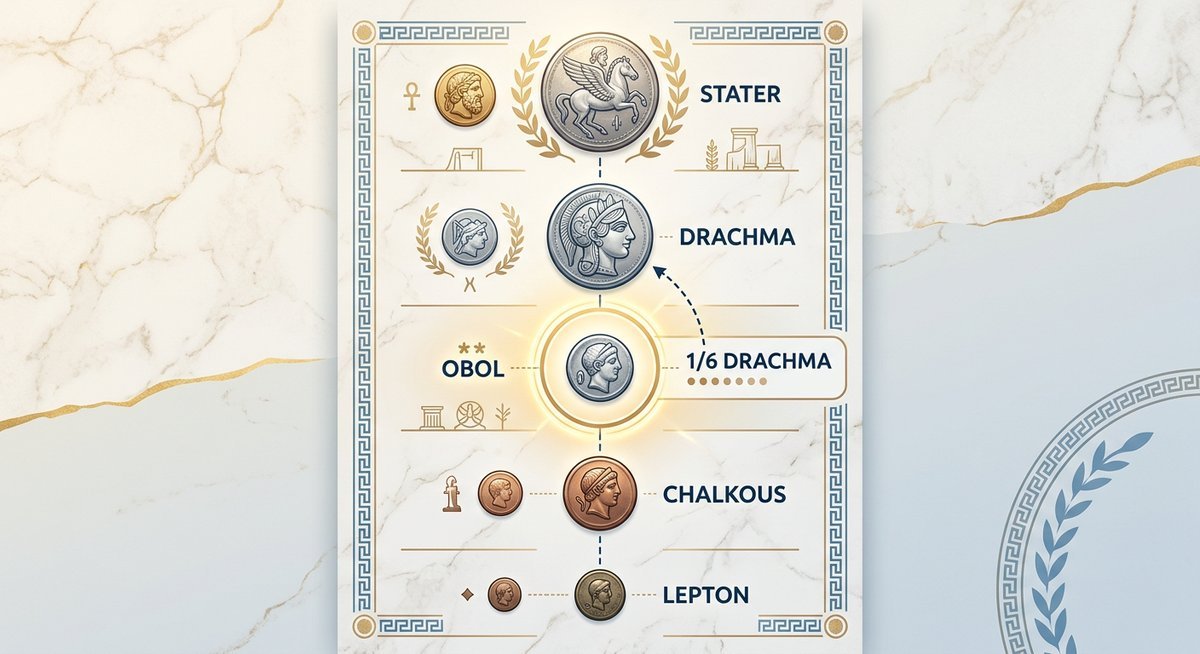
Six obols equaled one drachma — a ratio fixed across all Attic-standard mints. Below the obol sat fractional coins, while above it, the drachma, tetradrachm, and mina structured increasingly large transactions. Data compiled by the American Numismatic Society helps reconstruct the full denomination ladder:
| Denomination | Value in Obols | Approx. Weight (Silver) | Typical Use |
|---|---|---|---|
| Tetartemorion | 1/4 | ~0.18 g | Smallest purchases |
| Hemiobol | 1/2 | ~0.36 g | Minor daily transactions |
| Obol | 1 | ~0.72 g | Bread, cheap wine, ferry tolls |
| Diobol | 2 | ~1.44 g | Modest meals, small services |
| Triobol (hemidrachm) | 3 | ~2.16 g | Athenian juror pay after 425 BCE |
| Drachma | 6 | ~4.3 g | Skilled laborer’s daily wage |
| Tetradrachm | 24 | ~17.2 g | Major commerce, tribute payments |
| Mina | 600 | ~430 g | Large contracts, dowries |
The Athenian statesman Pericles raised juror compensation to three obols per day around 425 BCE — half a drachma — a wage that tells you exactly where the obol sat on the economic ladder. A single obol bought a modest loaf of bread or a cup of watered wine in fifth-century Athens. Not a living wage, but enough to make every citizen’s daily transactions possible.
How Much Is One Drachma Worth in Modern Money
One ancient Athenian drachma contained approximately 4.3 grams of silver, which translates to about $4.15 USD at early-2026 silver spot prices (roughly $30 per troy ounce). An obol — 1/6 of a drachma — works out to approximately $0.69 in pure metal value. But metal content dramatically understates what these coins could actually buy.
What an Obol Could Buy in Ancient Athens
A skilled construction worker on the Erechtheion temple project in 408 BCE earned one drachma per day, according to building accounts preserved in stone inscriptions and analyzed by scholars at the Perseus Digital Library at Tufts University. Mapping that daily wage to a modern equivalent of $100 to $150 puts one obol — one sixth of the day’s earnings — at roughly $17 to $25 in purchasing power. That gap between the obol’s silver melt value ($0.69) and its real economic weight ($17–$25) mirrors the same principle that separates a modern quarter’s nickel-copper content from its face value.
Converting Ancient Drachmas to Modern Currency
Exact conversions are impossible. Price ratios between goods in antiquity don’t map onto modern economies — a drachma bought a day’s labor or a sheep, but never a house. Scholars typically advise thinking in purchasing-power bands rather than fixed exchange rates.
| Conversion Method | 1 Drachma Approx. | 1 Obol Approx. |
|---|---|---|
| Silver melt value (2026) | ~$4.15 | ~$0.69 |
| Daily wage equivalence | ~$100 to $150 | ~$17 to $25 |
| Bread purchasing power | ~$30 to $50 | ~$5 to $8 |
The wage-based estimate gives the most useful approximation for understanding how ancient Greeks experienced the obol’s real value. The modern Greek drachma (used until Greece adopted the euro in 2002) converted at a fixed rate of approximately 340.75 drachmas per euro — a far cry from its ancient namesake’s purchasing power.
Charon’s Obol — Paying the Ferryman of the Dead
A single obol placed in the mouth or on the eyes of the dead paid Charon — the ferryman who carried souls across the River Styx into Hades. No coin, no crossing. Ancient Greek funerary tradition made this transaction non-negotiable, and the practice persisted from the archaic period through late Roman times.
The Ferryman’s Fee
The denomination was deliberate. One sixth of a drachma — the smallest practical coin in the system — meant passage to the afterlife cost almost nothing, yet still demanded a physical token from the living economy. Aristophanes referenced the fare in The Frogs (405 BCE) as common knowledge, not obscure theology. Lucian of Samosata, writing centuries later in Dialogues of the Dead, still cited the same price. The obol’s role in funerary practice remained remarkably stable across Greek literary tradition.
Greek religion rarely demanded expensive sacrifice for ordinary afterlife passage. The obol kept death affordable — a fact that says something sharp about Athenian civic values: even the poorest citizen could cross the Styx.
Coins Found in Ancient Greek Graves
Archaeology backs the literary record with physical evidence. Excavations across the Mediterranean have recovered coins positioned near or inside the skulls of buried remains, consistent with the mouth-placement described by ancient authors.
| Site | Region | Period | Coin Placement |
|---|---|---|---|
| Kerameikos necropolis | Athens, Attica | 5th to 4th c. BCE | Inside mouth/jaw |
| Selinunte | Sicily | 5th c. BCE | Near skull |
| Olbia | Black Sea coast | 4th to 3rd c. BCE | Eye sockets |
| Amphipolis | Macedonia | 4th c. BCE | Jaw area |
Not every burial included a coin. Wealthier graves sometimes contained larger denominations — tetrobols or even drachmas — while the poorest graves had none at all. That variation itself confirms the obol’s role: it was the minimum viable payment, the floor of the afterlife economy, accessible to almost anyone who could afford to die properly.
Dram vs Drachma — Untangling Two Often-Confused Terms
“Sixth of a dram” and “one sixth of a dram” sound nearly identical to “sixth of a drachma” — and all three appear in crossword puzzles — but they belong to completely different measurement systems. The confusion is widespread, but the terms are unrelated.
Drachma: The Greek Monetary Unit
The drachma (from Greek drax, meaning “grasp” or “handful”) was the primary silver coin of ancient Greece. One sixth of a drachma equals one obol. The word itself traces to a pre-coinage era when iron cooking spits (obeloi) served as proto-currency — a drachma was literally a handful of spits, which ancient sources specify as six. Aristotle references this spit-to-coin transition in his Politics, and archaeological deposits of bundled iron spits recovered at the Sanctuary of Hera at Argos provide physical corroboration. Six spits per grasp. Six obols per drachma. The arithmetic of money preserved the memory of the objects it replaced.
Dram: The Apothecary Weight
The dram (also spelled “drachm” in pharmacological texts, from the same Greek root) is a unit of weight in the avoirdupois and apothecary systems. One avoirdupois dram equals 1/16 of an ounce, or about 1.77 grams. One sixtieth of a dram — the answer to “what is one sixtieth of a dram” — is a minim, an apothecary unit equal to approximately 0.0616 milliliters, used historically to measure liquid medicine doses before metric standardization.
The linguistic link is real: both “drachma” and “dram” descend from Greek drachme. One measures money (ancient Greece), the other measures weight (apothecary tradition). Crossword solvers encountering “sixth of a dram” should check the letter count — if the grid wants four letters, the constructor is almost certainly blurring the dram/drachma line, and the answer remains OBOL.
Frequently Asked Questions
What is one sixth of a drachma?
One sixth of a drachma is an obol (also spelled obolus), a small silver coin used throughout ancient Greece weighing approximately 0.72 grams. The obol served as the basic fractional denomination of the Greek monetary system, handling everyday purchases like bread, wine, and ferry tolls across the ancient Mediterranean world.
What is the crossword answer for one sixth of a drachma?
OBOL — four letters. Variant clues include “ancient Greek coin,” “Charon’s fee,” “old coin worth one sixth of a drachma,” and “Greek monetary unit.” The five-letter plural OBOLI and six-letter Latin form OBOLUS appear in puzzles requiring longer fill.
What ancient Greek coin was one sixth of a drachma?
The obol. Whether you search for “greek coin one sixth of a drachma” or “ancient Greek coins worth one sixth of a drachma,” the answer is the same. Obols were minted across the Greek world from the sixth century BCE, with the most recognizable examples produced in Athens bearing the helmeted head of Athena on the obverse and her owl on the reverse.
How much is one drachma worth?
An ancient Athenian drachma contained about 4.3 grams of silver, worth roughly $4.15 at 2026 silver prices. In purchasing power terms, one drachma equaled a skilled laborer’s daily wage — equivalent to approximately $100 to $150 in modern money.
How much is 1 drachma worth today?
The modern Greek drachma, used until Greece adopted the euro in 2002, converted at a fixed rate of 340.75 drachmas per euro — approximately $0.003 USD per drachma. Ancient drachmas in collectible condition sell at numismatic auctions for $50 to several thousand dollars depending on preservation.
What is one sixtieth of a dram?
A minim — the smallest unit in the apothecary measurement system, equal to about 0.0616 milliliters. The dram (not drachma) is a unit of weight in the avoirdupois and apothecary systems. One sixtieth of a dram is unrelated to Greek coinage; the similar-sounding words share a Greek etymological root but measure entirely different things.
Is “sixth of a dram” the same as “sixth of a drachma”?
No. A drachma is an ancient Greek coin; a dram is a unit of weight used in pharmacology and the avoirdupois system. Both words descend from the Greek drachme, which is why crossword constructors sometimes blur the distinction. When a puzzle clues “sixth of a dram” and the grid requires four letters, the intended answer is still OBOL.
Why was the obol placed in dead people’s mouths?
Ancient Greeks believed the obol paid Charon’s ferry fare for transporting the soul across the River Styx into the underworld. Without payment, the soul wandered the riverbank for a hundred years. The practice appears in literary sources from Aristophanes to Lucian and is confirmed by archaeological coin finds in Greek burials across the Mediterranean.
The obol is a denomination of ancient Greek coinage valued at one sixth of a drachma, and Charon is the ferryman of Greek mythology who charged that exact fare. Whether you came for the four-letter crossword answer or stayed for the iron spits and underworld economics, the same 0.72-gram coin delivered.