




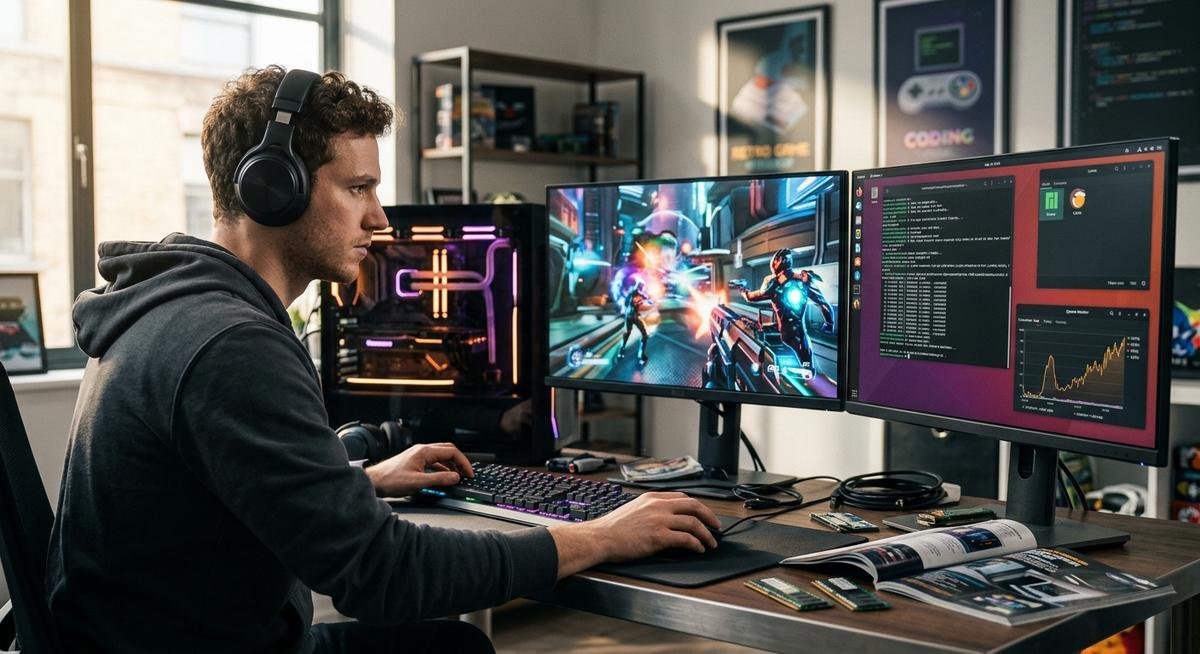
Steam’s Hardware Survey recorded Linux at 3.19% market share in December 2025 — up from 2.29% just twelve months earlier, according to Phoronix’s analysis of the December 2025 survey data. That translates to roughly 4.2 million active monthly gamers choosing Linux over Windows. The tech hacks PBLinuxGaming community has refined are a big part of why that number keeps climbing: driver tuning, Proton configuration, kernel-level tweaks, and distro selection strategies that collectively close the performance gap most people assume still exists.
PBLinuxGaming functions as a community-driven knowledge hub — not a distribution, not a product. Members share field-tested configs, benchmark results, and troubleshooting playbooks built from daily gaming sessions across dozens of hardware configurations. The hacks here draw from that collective experience, cross-referenced with benchmark data from Phoronix, LTT Labs, and the r/linux_gaming community on Reddit.
Gaming on Linux: Where Things Actually Stand
Nearly 90% of Windows games now run on Linux through Valve’s Proton compatibility layer, according to ProtonDB data compiled by Boiling Steam. Over 21,600 titles carry Deck Verified or Playable status. That compatibility figure would have been unthinkable five years ago, when gaming on Linux meant either running native ports (slim pickings) or wrestling with Wine configurations that broke more often than they worked.
Three forces drove this shift. Valve invested heavily in Proton and shipped the Steam Deck — now past 5.6 million units sold as of mid-2025. AMD committed to open-source GPU drivers that perform better than their proprietary counterparts. And Windows 11’s forced Copilot integration, OneDrive nagging, and machine-breaking updates pushed a visible wave of users toward Linux alternatives. The r/linux_gaming subreddit grew from a niche technical forum into one of the most active gaming communities on Reddit, with daily threads comparing framerates, distro experiences, and Proton workarounds.
| Metric | Value | Source |
|---|---|---|
| Linux Steam Market Share (Dec 2025) | 3.19% | Steam Hardware Survey |
| Monthly Active Linux Gamers | ~4.2 million | Calculated from Steam MAU |
| Deck Verified/Playable Games | 21,694+ | Valve Deck Verified DB |
| Windows Games Running via Proton | ~90% | ProtonDB / Boiling Steam |
| Steam Deck Units Sold | ~5.6 million | Analyst estimates, mid-2025 |
Anti-cheat remains the last real barrier. Fortnite, Apex Legends, and PUBG still block Linux users due to kernel-level anti-cheat that refuses to run under Proton. Every other category — single-player RPGs, indie titles, competitive shooters without invasive anti-cheat — works well enough that most switchers never look back.
What Linus Tech Tips Taught Everyone About Linux Gaming
Linus Sebastian’s original “Switching to Linux Challenge” in late 2021 generated over 11 million combined views across four episodes and did more to publicize Linux gaming’s rough edges than any benchmark article ever could. The series showed Linus accidentally deleting his desktop environment, fighting NVIDIA driver installations, and ultimately concluding that “gaming on Linux is NOT ready” — a verdict that stung the community but also catalyzed real improvements from Valve, Canonical, and System76.
LTT Labs revisited the question in June 2025 with a methodical benchmark series titled “Is 2025 the Year of the Linux Desktop?” The results told a more nuanced story. AMD hardware performed within 5-10% of Windows on most titles. Intel’s Arc B580, however, delivered performance anywhere from 20% to 100% worse on Linux — a gap LTT Labs attributed to immature open-source Intel GPU drivers rather than Linux itself. The takeaway from tech tips Linus has consistently reinforced: hardware choice matters enormously on Linux, and AMD’s open-source driver commitment gives it a structural advantage over NVIDIA and Intel for gaming workloads.
LTT PC Builds That Actually Work on Linux
Linus tech tips pc builds have historically favored NVIDIA GPUs — a reasonable choice for Windows, but a recurring pain point for Linux. The 2025 LTT Labs benchmarks confirmed what the PBLinuxGaming community has argued for years: AMD Radeon cards running Mesa’s RADV driver with the ACO shader compiler backend consistently outperform NVIDIA’s proprietary Linux driver in gaming workloads, particularly in Vulkan-native titles. When linux gaming linus tech tips coverage finally acknowledged this gap with data, it validated a recommendation the community had been making since Mesa 20.2 shipped ACO as the default backend. Every major linus tech tips gaming on linux segment since has reinforced the same conclusion: pick AMD if you want the path of least resistance.
For anyone building a gaming PC intended for Linux, the formula is straightforward: AMD CPU (Ryzen 7000 or 9000 series), AMD GPU (RX 7000 or 9000 series), and 32GB of DDR5 RAM. That combination gives you full open-source driver support, Wayland compatibility without hacks, and the smoothest Proton experience available. NVIDIA works — and the proprietary driver has improved substantially — but you’ll still hit Wayland edge cases and occasional kernel module headaches that AMD users simply don’t encounter.
The SteamOS-on-PC Push
Linus tech tips free pc giveaways and budget build videos have increasingly featured SteamOS as a Windows alternative for dedicated gaming machines. Valve’s official SteamOS 3.x release for generic PCs — announced alongside the Steam Machine hardware refresh — means any old tower or linus tech tips free pc build can become a console-like gaming appliance. SteamOS handles driver installation, Proton configuration, and controller mapping automatically, removing every friction point that plagued Linus during his original challenge.
Choosing the Right OS Linux for Gaming
Bazzite grew 1.29% in a single month to reach 5.53% of all Linux gaming installations in November 2025, making it the fastest-growing gaming distro on the Steam survey. That growth reflects a consensus forming across the gaming linux reddit communities and beyond: for pure gaming, immutable Fedora-based distributions offer the best balance of stability, driver freshness, and out-of-box configuration.
| Distro | Base | Steam Survey Share | Best For |
|---|---|---|---|
| SteamOS Holo | Arch | 26.42% | Steam Deck / console-like experience |
| Arch Linux | Independent | 9.97% | Advanced users wanting full control |
| CachyOS | Arch | 6.74% | Performance-tuned Arch with gaming optimizations |
| Bazzite | Fedora Atomic | 5.53% | Desktop/handheld gaming, immutable system |
| Nobara | Fedora | ~3% | Fedora with gaming patches pre-applied |
| Pop!_OS | Ubuntu | ~2% | NVIDIA users, beginner-friendly |
Gaming OS Tweaks That Deliver Measurable Gains
Picking the right distro is step one. Gaming os tweaks applied on top of that base are where the real differentiation happens. Three system-level changes — CPU governor, swap behavior, and I/O scheduler — affect every game you launch, regardless of whether it runs native or through Proton.
Set the CPU frequency governor to performance using sudo cpupower frequency-set -g performance. This prevents the kernel from downclocking mid-frame, which causes the micro-stutter that plagues default Linux installations. Reduce swap aggressiveness by setting vm.swappiness=10 in /etc/sysctl.conf (default is 60), then apply with sudo sysctl -p. This keeps game assets in RAM instead of paging them to disk. Both tweaks take under a minute and survive reboots.
Feral Interactive’s GameMode daemon automates the governor switch and adds I/O priority boosting. Install with sudo apt install gamemode on Debian-based systems, sudo pacman -S gamemode on Arch, or sudo dnf install gamemode on Fedora. Add gamemoderun %command% to any game’s Steam launch options, and GameMode handles the rest — temporarily switching the CPU governor, raising process priority, and requesting GPU performance mode from the driver.
Performance Hacks and Gaming on Linux Tips
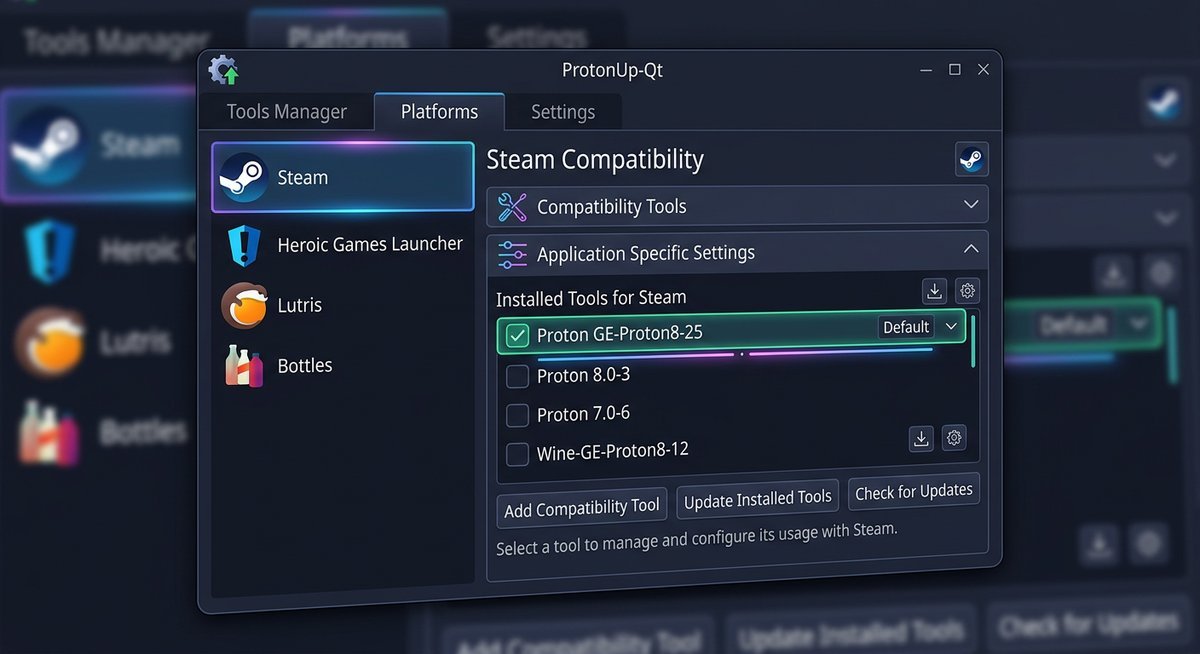
Proton GE — the community fork maintained by developer GloriousEggroll — is the single highest-impact software change most Linux gamers can make. According to the GloriousEggroll project changelog, Proton GE incorporates upstream Wine patches, codec fixes, and game-specific workarounds weeks ahead of Valve’s official release cycle. Install it through ProtonUp-Qt (flatpak install flathub net.davidotek.pupgui2), select the latest GE-Proton build, and force it per-game in Steam’s compatibility settings.
Gaming hacks for pc performance on Linux extend well beyond Proton. DXVK translates DirectX 9/10/11 calls into Vulkan, cutting draw-call overhead in CPU-bound scenarios. The DXVK_ASYNC=1 launch flag compiles shaders asynchronously, eliminating the stutter spikes that plague first-time shader compilation. Stack it with GameMode: DXVK_ASYNC=1 gamemoderun %command% in a single launch options line.
| Launch Flag | Effect | When to Use |
|---|---|---|
DXVK_ASYNC=1 %command% | Async shader compilation, reduces stutter | Open-world and shader-heavy titles |
gamemoderun %command% | CPU governor + I/O priority boost | Every game, always |
MANGOHUD=1 %command% | Real-time FPS/frametime overlay | Benchmarking and diagnostics |
ENABLE_VKBASALT=1 %command% | Vulkan post-processing sharpening | Upscaled or blurry titles |
PROTON_USE_WINED3D=0 %command% | Forces DXVK over WineD3D | DX9-DX11 games defaulting to OpenGL |
Game Modifications and Modding on Linux
Linux game cheat engines and modding tools work differently than on Windows, but the ecosystem is more capable than most people realize. Cheat Engine runs under Wine/Proton for single-player save editing and value manipulation. Lutris and Heroic Games Launcher handle non-Steam titles from Epic, GOG, and Battle.net with Proton or native Wine prefixes. Modding frameworks like Vortex (through Proton) and native tools like r2modman support Linux natively for games with active modding communities.
The gaming on linux tips that matter most for modding: always use separate Wine prefixes for modded games to avoid corrupting your main Proton installation. Set STEAM_COMPAT_DATA_PATH to a custom directory before launching heavily modded titles. Back up your compatdata folder before applying mods that modify game DLLs — reverting a broken mod is trivial when you have a clean prefix snapshot.
Linux Gaming Benchmarks and Real-World Test Results
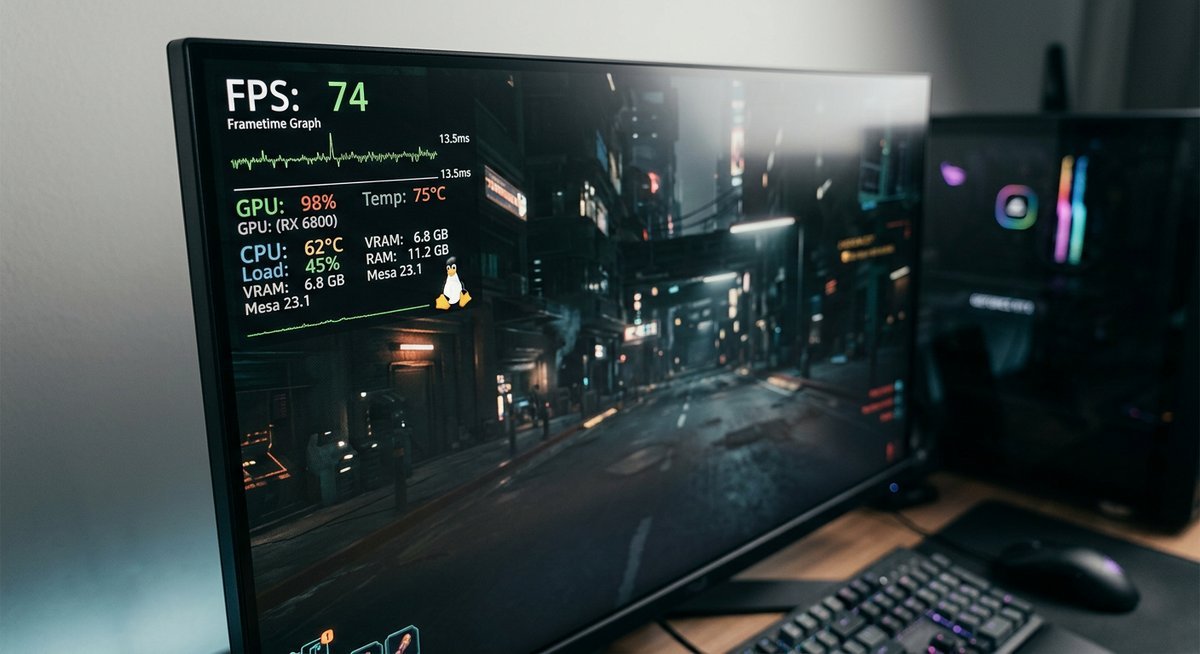
Raw benchmark data from Phoronix and LTT Labs paints a consistent picture: AMD GPUs running Mesa RADV on Linux reach within 5-10% of their Windows DirectX performance in most titles, and occasionally surpass it in Vulkan-native games. NVIDIA’s proprietary driver narrows the gap to roughly 10-15% in DirectX titles translated through DXVK, with Vulkan-native games performing nearly identically across both platforms.
The linux gaming test results that matter most come from the gaming pc linux reddit community, where users post identical-hardware comparisons with MangoHud frametime logs. A recurring finding on r/linux_gaming: AMD Ryzen processors paired with Radeon GPUs and the performance CPU governor consistently match or beat Windows framerates in Vulkan-path games like Doom Eternal, Baldur’s Gate 3, and CS2. The gap widens in DirectX 12 titles that rely on VKD3D-Proton translation, where Linux typically trails by 10-20% depending on the game’s DX12 implementation quality.
Audio latency is a benchmark category that gaming linux reddit threads increasingly flag. PipeWire’s default quantum of 1,024 samples introduces buffering overhead. According to the PipeWire project documentation, reducing this to 256 samples via ~/.config/pipewire/pipewire.conf.d/99-low-latency.conf eliminates the audio-induced frame pacing irregularities that most guides overlook entirely. Run pw-top to confirm the active quantum value during a gaming session.
Frequently Asked Questions
What is PBLinuxGaming and what tech hacks does it focus on?
PBLinuxGaming is a community-driven knowledge hub for Linux gaming optimization, covering Proton GE configuration, GPU driver tuning, kernel parameter tweaks, and distro selection. The community shares field-tested configs and benchmark data rather than theoretical advice, with active contributors across Arch, Fedora, and Ubuntu-based distributions.
Is gaming on Linux good enough to replace Windows in 2026?
For roughly 90% of the Steam library, yes — Proton compatibility has reached a point where most single-player and cooperative titles run without configuration. Anti-cheat dependent competitive games (Fortnite, Apex Legends) remain the primary exception. AMD hardware users experience the smoothest transition due to superior open-source driver support.
What did Linus Tech Tips conclude about Linux gaming?
LTT’s 2021 challenge called Linux gaming “not ready,” citing driver issues and desktop environment instability. Their 2025 follow-up benchmark series found AMD GPUs within 5-10% of Windows performance, though Intel Arc GPUs lagged by 20-100%. Linus Sebastian has since tested SteamOS on PC hardware and acknowledged significant ecosystem improvements.
Which Linux distro is best for gaming?
Bazzite leads community recommendations for dedicated gaming PCs — it is Fedora-based, immutable, and ships with Steam and gaming optimizations pre-configured. CachyOS suits advanced users wanting Arch with performance tuning. Nobara provides Fedora with GloriousEggroll’s gaming patches. SteamOS works best for console-like setups and Steam Deck.
Can a Linux laptop work for both gaming and hacking?
A linux laptop hacker setup is entirely viable by dual-booting or running a gaming-focused distro like Bazzite alongside security tools installed via Flatpak or Distrobox containers. Kali Linux tools run in Distrobox on any base distro without conflicting with gaming drivers. Laptops with AMD APUs (Ryzen 7 7840U or newer) offer the best balance of GPU performance and open-source driver reliability for this dual-use scenario.
How do gaming hacks for PC differ on Linux vs Windows?
Linux gaming hacks operate at the system level — CPU governors, I/O schedulers, Vulkan translation layers, and audio stack configuration — rather than through third-party overlay software. The core difference is that Linux exposes kernel parameters directly, giving users granular control over process scheduling and memory management that Windows abstracts away behind registry tweaks and vendor utilities.
Where are the best Reddit communities for Linux gaming?
The r/linux_gaming subreddit is the primary hub, with daily threads covering Proton compatibility, benchmark results, and distro comparisons. r/SteamDeck covers handheld-specific tweaks. r/linuxhardware helps with GPU and peripheral compatibility questions. Searching “gaming pc linux reddit” surfaces archived benchmark comparison threads with MangoHud frametime data attached.
Conclusion
Six optimization layers — distro selection, GPU driver configuration, Proton GE setup, kernel parameter tuning, audio stack optimization, and systematic benchmarking with MangoHud — cover the full stack of performance gains available on existing Linux hardware. The tech hacks PBLinuxGaming community has stress-tested these methods across hundreds of configurations, and the results are consistent: AMD hardware paired with the right distro and a handful of launch flags closes the gap with Windows to single-digit percentages in most titles.
Apply one change at a time. Measure with MangoHud between each step. The biggest mistake is stacking every tweak simultaneously and losing the ability to identify what actually moved the needle — or what broke something. Start with Proton GE (broadest immediate impact), then work through driver verification, GameMode, kernel parameters, and PipeWire tuning in that order.