




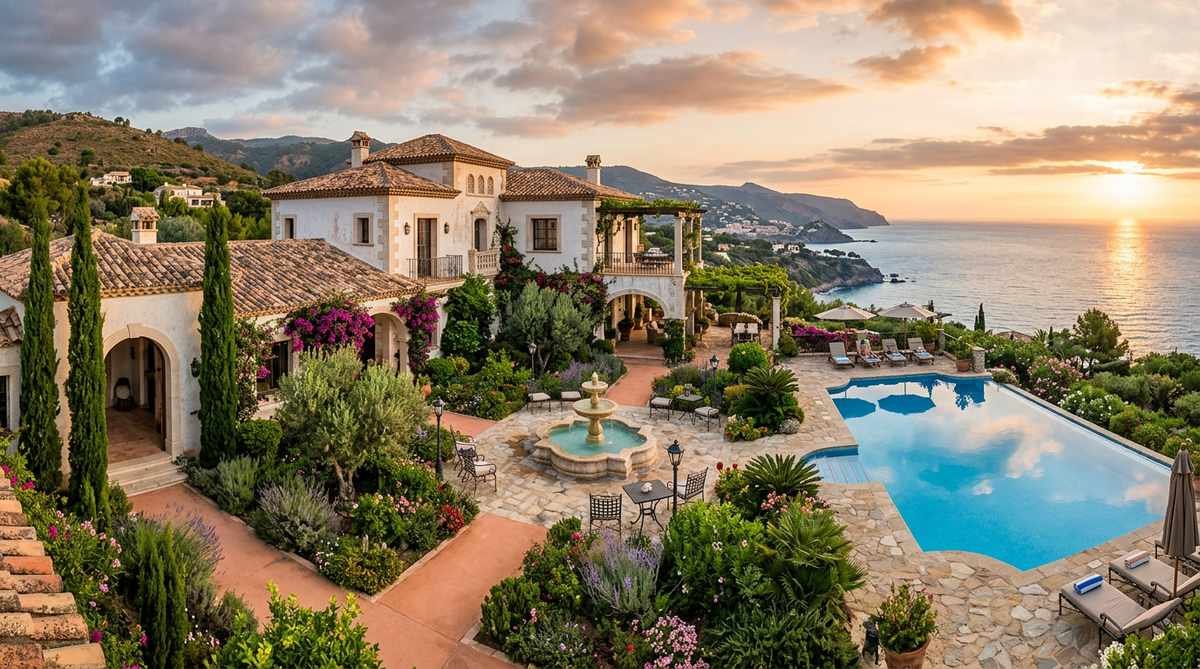
A villa is a large, private residence — typically freestanding, set amid gardens or landscaped grounds, and associated with luxury, seclusion, and a connection to outdoor living. The word traces back to ancient Rome, where patrician families retreated to countryside estates to escape the noise and heat of the city, but the concept has evolved into one of the most sought-after property types in global real estate today. Whether you’re exploring one as a vacation rental in Tuscany or weighing it as an investment in Bali, understanding what defines a villa helps you make sharper decisions.
What Is a Villa? Definition and Origins
A villa is a substantial private dwelling that emphasizes spacious indoor-outdoor living, set apart from neighbors by land, gardens, or natural barriers. Unlike a standard single-family home, a villa typically implies a degree of architectural grandeur, privacy, and self-contained amenities. Modern usage varies: in Britain, the term often refers to a detached suburban house from the Victorian era; in continental Europe, it generally means a large country house; in Southeast Asia and the Caribbean, “villa” frequently signals a luxury vacation property with private pool.
The word itself derives from the Latin villa, which described Roman rural estates that combined agriculture with leisure. Merriam-Webster defines it as “a country estate” or “the rural or suburban residence of a wealthy person.” The Wiktionary etymology traces it through Italian, connecting the modern villa to the same Latin root that gave English words like “village” and “villain” (originally, a person attached to a villa).
What makes the definition elastic is purpose: a villa can be a permanent residence, a vacation retreat, or a rental investment. This flexibility is part of what drives its global appeal.
Key Characteristics of a Villa: What Sets It Apart
Villas share a recognizable set of physical and spatial traits that distinguish them from standard houses, apartments, or even mansions. The most consistent marker is an emphasis on outdoor living — terraces, gardens, courtyards, and often a private pool or spa.
| Feature | Villa | Standard House | Mansion |
|---|---|---|---|
| Outdoor living emphasis | Central, often dominant | Variable | Present but secondary |
| Private grounds | Always | Usually small | Large, formal |
| Architectural grandeur | Moderate to high | Low to moderate | Very high |
| Self-contained amenities | Often (pool, kitchen, staff quarters) | Basic | Extensive |
| Story count | Often single-story | 1-3 stories | 2-4+ stories |
| Location | Countryside, coast, resort | Urban/suburban | Urban/suburban |
According to Palm Paradise Realty’s architectural guide, villas are identified by their spacious layout, emphasis on outdoor living spaces, and typically feature gardens, terraces, or pools that integrate the living environment with the surrounding grounds. The single-story design is common in Mediterranean regions, while multi-story villas are more frequent in Southeast Asia and the Caribbean.
Privacy is another defining quality. A villa sits apart — separated by land, a fence line, or natural screening — creating a sense of exclusivity that row houses and condos cannot replicate. That physical separation is not incidental: it’s structural to the villa’s identity as a place of retreat and refuge.
Villa Architecture Styles: From Roman Courtyards to Modern Glass Houses
No single architectural language defines villas. Instead, the form has absorbed and adapted regional building traditions across two millennia, producing distinct stylistic families that remain influential in contemporary design.
Roman and Classical Villas
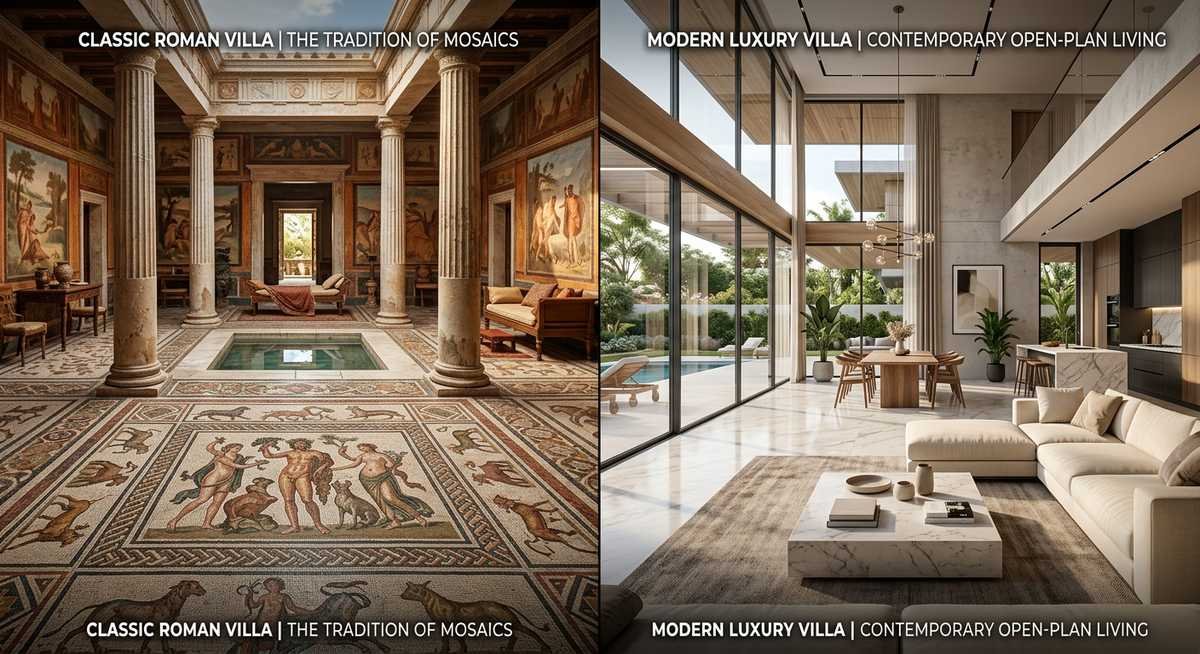
The original Roman villa organized life around an enclosed courtyard (the atrium or peristyle), with rooms radiating outward. Structures like the Villa of the Mysteries near Pompeii and Hadrian’s Villa at Tivoli set the template: colonnaded walkways, mosaic floors, integrated gardens, and a clear distinction between public reception areas and private family quarters. According to Wikipedia’s detailed entry on villas, Pliny the Younger’s letters, describing his own villas at Laurentum and Tuscany, remain among the most vivid primary sources on how Romans used these spaces.
Italian Renaissance Villas
The Medici family’s patronage in 15th-century Tuscany produced a wave of villas that blended humanist philosophy with agricultural productivity. Villa Medici at Fiesole and Palladio’s Villa La Rotonda near Vicenza became templates for European country houses for the next three centuries. The Palladian villa, with its symmetrical facade, central dome, and four identical porticos, directly influenced English Baroque architecture and later American plantation houses.
Mediterranean Villa Style
The Mediterranean villa is probably the most commercially imitated style today: white or ochre stucco walls, terracotta roof tiles, arched doorways, and a strong emphasis on shaded outdoor terraces and courtyards. This style is native to Spain, southern France, Italy, and Greece, and has been exported wholesale to Florida, California, and coastal resort developments globally. The defining logic is climate: thick walls retain cool air, shaded loggias extend living outdoors, and gardens provide both beauty and produce.
Contemporary and Modernist Villas
Since the mid-20th century, architects have stripped the villa back to its spatial principles, privacy, outlook, connection to surrounding terrain, while discarding historical ornament. Contemporary luxury villas in Bali, the Maldives, and southern Spain frequently feature floor-to-ceiling glass, cantilevered roof planes, and infinity pools that blur the line between interior and exterior. The materials shift (concrete, glass, steel) but the spatial logic remains: controlled separation from the outside world, commanding views, and generous private grounds.
Luxury Villa Amenities: What to Expect
Luxury villas consistently include a private pool, multiple en-suite bedrooms, outdoor kitchen and dining areas, and landscaped gardens. Above the $2M threshold, smart home automation, spa facilities, and staff quarters become standard. Below that tier, the pool and outdoor dining area remain the baseline across Mediterranean, Caribbean, and Southeast Asian rental markets.
The amenity profile varies by tier, location, and whether it’s a private residence or a managed rental property, but certain features appear consistently across market segments.
- Private pool or infinity pool: The single most expected amenity in villa rentals. Heated pools, lap pools, and plunge pools are common in higher-end properties.
- Outdoor kitchen and dining: Alfresco cooking areas with built-in grills, pizza ovens, and covered pergolas are standard in Mediterranean and Caribbean villas.
- Multiple bedroom suites with en-suite bathrooms: Typically ranging from 3 to 10+ bedrooms in rental villas, each with private bathrooms and often private terraces.
- Staff quarters: Many larger villas include accommodation for a housekeeper, groundskeeper, or chef, particularly in European and Southeast Asian markets.
- Smart home systems: Automated lighting, climate control, security cameras, and AV systems are increasingly standard in new-build villas above the $2M threshold.
- Spa and wellness facilities: Hot tubs, steam rooms, and dedicated yoga or gym spaces appear in 60-70% of premium villa rentals, according to Homes & Villas by Marriott Bonvoy‘s inventory data.
- Gardens and landscaping: Olive groves, citrus trees, rose gardens, and native plantings define the character of individual properties as much as the architecture does.
These aren’t ornamental additions. They’re the functional expression of what a villa is: a self-contained world where the boundary between inside and outside dissolves into daily life.
Villa vs. Mansion vs. Estate vs. Chateau: Clearing Up the Confusion
Villa, mansion, estate, and chateau each describe a different relationship between a building and its land, its occupants, and their social intentions. A villa prioritizes retreat and outdoor living; a mansion prioritizes status and interior display; an estate centers on land ownership; a chateau on winemaking heritage. Here’s how they differ:
| Property Type | Typical Size | Location | Primary Emphasis | Cultural Origin |
|---|---|---|---|---|
| Villa | 3,000–20,000 sq ft | Countryside, coast, resort | Outdoor living, leisure, privacy | Roman/Italian |
| Mansion | 5,000–25,000+ sq ft | Urban or suburban | Status display, interior grandeur | English/French |
| Estate | Varies widely | Rural, large land holdings | Land, agricultural or legacy purposes | English/American |
| Chateau | Large, highly variable | French countryside | Winemaking, aristocratic heritage | French |
The sharpest distinction between a villa and a mansion is orientation: a villa faces outward, toward gardens, views, and outdoor spaces, while a mansion faces inward, asserting its presence through facades, formal rooms, and interior grandeur. A Palladian villa in Veneto and a Gilded Age mansion on Fifth Avenue may cost the same and offer similar square footage, but they embody entirely different relationships with their surroundings. That distinction has persisted for 2,000 years.
Popular Villa Destinations: Where the World Rents and Buys
The top global villa rental markets are Tuscany, Bali, the Côte d’Azur, the Greek islands, Marbella, and the Caribbean. Rental prices range from $500 per week in Bali to $50,000+ per week in St. Barts. Each destination has a distinct architectural tradition and lifestyle offering that draws different buyer and traveler profiles.
The geography of villas tracks closely with luxury tourism and second-home investment. Certain regions have developed villa cultures deeply embedded in local architecture and economy.
| Destination | Dominant Style | Average Rental Range | Best For |
|---|---|---|---|
| Tuscany, Italy | Renaissance/rustic stone | $800–$5,000/week | Culture, wine, countryside |
| Côte d’Azur, France | Provencal/contemporary | $2,000–$20,000/week | Beaches, social scene, art |
| Bali, Indonesia | Balinese traditional/modern | $500–$3,000/week | Wellness, spirituality, affordability |
| Mykonos/Santorini, Greece | Cycladic white-cube | $1,500–$15,000/week | Island hopping, sunsets, luxury |
| Marbella, Spain | Andalusian/contemporary | $1,000–$8,000/week | Golf, beaches, nightlife |
| Caribbean (St. Barts, BVI) | Colonial/tropical modern | $3,000–$50,000+/week | Sailing, ultra-luxury, privacy |
Bali deserves particular attention. The island has developed a distinctive villa architecture that merges traditional Balinese compound design (open-air living pavilions, sacred garden corners, stone temple gates) with contemporary luxury expectations. A Seminyak villa for $800 a week often delivers what a $5,000-a-week Mediterranean property cannot match in terms of staffing and cultural immersion. The villa experience there isn’t just accommodation, it’s a sustained encounter with a living architectural tradition.
Frequently Asked Questions About Villas
What exactly is a villa?
A villa is a large private residence, typically freestanding, with significant outdoor living spaces including gardens, terraces, and often a private pool. The term originated in ancient Rome to describe wealthy country estates and now applies to luxury private homes, vacation rentals, and resort properties worldwide. The defining features are privacy, spacious grounds, and an emphasis on indoor-outdoor living.
What is the difference between a villa and a mansion?
A villa emphasizes outdoor spaces, privacy, and a connection to the natural setting around it, it’s oriented outward. A mansion emphasizes interior grandeur, formal rooms, and architectural display, it’s oriented inward. Villas tend to appear in countryside or coastal settings; mansions typically occupy urban or suburban lots. Both can be comparable in size and price, but their spatial logic differs fundamentally.
What are the main characteristics of a villa?
The main characteristics of a villa include: a freestanding structure with private grounds, strong emphasis on outdoor living spaces (terraces, courtyards, gardens), often a private pool or spa, architectural grandeur without the formal ostentation of a mansion, and a sense of seclusion from neighbors. Many villas are single-story, particularly in Mediterranean climates, though multi-story designs are common in Southeast Asia.
How much does it cost to rent a villa?
Villa rental costs range from around $500 per week for a modest Bali villa to $50,000+ per week for ultra-luxury Caribbean estates. Mid-range European villas in Tuscany or the Spanish Costa typically run $1,500–$5,000 per week for a 4-bedroom property with private pool. Prices vary significantly by season, location, property size, and included services such as housekeeping or chef.
Is buying a villa a good investment?
Villa investment potential depends heavily on location, rental market strength, and property management quality. Well-located villas in established markets like Tuscany, Bali, and the Côte d’Azur have historically offered strong rental yields (5–8% gross in peak rental markets) alongside capital appreciation. The cost of maintenance, staffing, and property management typically runs 15–25% of gross rental income, which should be factored into any ROI calculation.
What is the historical origin of villas?
Villas originated in ancient Rome, where wealthy citizens maintained rural estates outside cities. These Roman villas served dual purposes: agricultural production and leisured retreat from urban life. The concept was revived during the Italian Renaissance when the Medici family and other Florentine patrons commissioned grand country houses that blended humanist philosophy with agricultural use. Andrea Palladio’s 16th-century villa designs proved so influential that they shaped European and American country house architecture for centuries.
What amenities do luxury villas typically have?
Luxury villas typically feature a private pool, multiple en-suite bedrooms, outdoor kitchen and dining areas, smart home systems, dedicated gardens or landscaping, and often a hot tub or spa. Higher-end properties include staff quarters for housekeeping and groundskeeping, a gym or yoga pavilion, wine cellar, and advanced home automation. The specific amenity profile varies by region and tier.
The Villa as a Living Idea
The villa has outlasted empires, architectural movements, and economic cycles because it solves a persistent human problem: how to live well in relationship with land, light, and privacy. From Pliny the Younger describing his Laurentine villa’s sea views in 105 AD to a traveler booking a poolside pavilion in Ubud today, the underlying desire is the same. Different cultures, centuries, and price points have shaped the form in different directions, but the spatial logic, a private world that faces outward, has never really changed.
That continuity across 2,000 years is not accidental. It reflects something durable about what people want from the places they live.