




If a crossword clue led you here, the answer is OKINA. Five letters, one of the most frequently misidentified characters in any American state’s written language.
The ʻokina — that small curved mark in words like Hawaiʻi and aloha ʻoe — is not an apostrophe. Not a typo. Not decorative. It is a full consonant: one of eight in the Hawaiian alphabet, representing a glottal stop as phonemically real as any k or m. Drop it from a word and you can accidentally change the meaning — sometimes in embarrassing ways.
Below: how the glottal stop actually sounds, why the ʻokina is culturally irreplaceable, the colonial history that nearly erased it, and step-by-step instructions for typing the correct Unicode character on any device.
What Is the Hawaiian Letter That Looks Like an Apostrophe?
The ʻokina (ʻ) is one of eight consonants in the 13-letter Hawaiian alphabet — a full letter representing a glottal stop, not a punctuation mark or decorative flourish. Its Unicode value is U+02BB (modifier letter turned comma), a distinct character from the standard apostrophe at U+0027. Visually similar, functionally worlds apart.
The ʻOkina as a Consonant, Not Punctuation
The Hawaiian alphabet contains 13 letters: five vowels (a, e, i, o, u) and eight consonants (h, k, l, m, n, p, w, and the ʻokina). That last slot is the one people most often misunderstand. The ʻokina is not an accent mark, not an apostrophe standing in for a missing letter, and not optional styling.
Linguistically, the ʻokina signals a glottal stop — a momentary, complete closure of the vocal cords that functions as a genuine consonant sound. Omitting it from a word is the equivalent of dropping any other consonant from an English word. The meaning changes, or the word becomes unrecognizable.
According to the University of Hawaiʻi at Mānoa’s Hawaiian Language program, the ʻokina is encoded specifically as U+02BB in Unicode to distinguish it from punctuation — a technical acknowledgment that this character belongs to the alphabet, not to the keyboard’s punctuation row.
Visual Difference: ʻOkina vs. Apostrophe
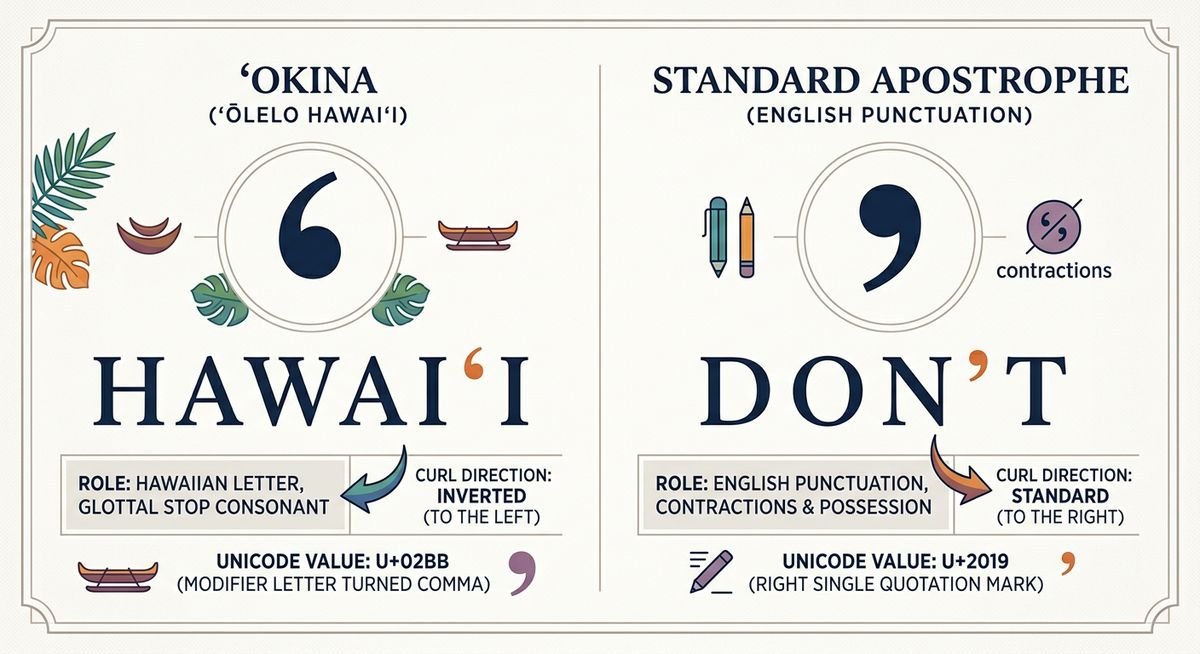
The two characters look nearly identical at small font sizes, which is why the confusion persists. Look closely: the ʻokina curls to the left (like a reversed comma), while the standard apostrophe curls to the right.
| Feature | ʻOkina (ʻ) | Standard Apostrophe (‘) |
|---|---|---|
| Character name | Modifier letter turned comma | Apostrophe |
| Unicode code point | U+02BB | U+0027 |
| Curl direction | Opens to the right (left-facing curve) | Opens to the left (right-facing curve) |
| Linguistic function | Consonant; glottal stop phoneme | Punctuation; marks possession or contraction |
| Correct usage context | Hawaiian words and proper nouns | English grammar and general punctuation |
Substituting a standard apostrophe for the ʻokina misrepresents the phonemic structure of the Hawaiian language. For a language that survived deliberate colonial suppression, using the wrong character is not a minor typographic quibble — it erases a linguistic distinction that Hawaiian speakers fought to preserve.
How to Pronounce the ʻOkina — The Glottal Stop
The ʻokina represents a glottal stop: a brief, complete closure of the vocal cords that produces a tiny catch in the throat. English speakers already make this sound instinctively in “uh-oh,” right at the hyphen. In Hawaiian, that same catch is a full consonant, as meaningful as any k or p.
What a Glottal Stop Sounds Like
Say “uh-oh” out loud. Notice the hard stop between the two syllables — your vocal cords snap shut momentarily, blocking airflow before the second vowel begins. That is a glottal stop. British English speakers from London produce the same sound when dropping the t in words like “butter” or “bottle” in Cockney speech, where the tt gets replaced entirely by that brief closure.
To produce it deliberately: start to say a vowel, then cut off the sound completely at the throat — not with your lips or tongue, but deep in the larynx. Hold for a fraction of a second, then release into the next vowel. With practice, it becomes automatic.
The University of Hawaiʻi at Mānoa’s Hawaiian language program classifies the ʻokina as one of eight consonants in the Hawaiian alphabet, carrying equal phonemic weight to any other letter.
Why the ʻOkina Changes Everything: Word-Pair Examples
The most direct proof that the ʻokina is phonemically essential — not cosmetic — comes from what happens to meaning when it disappears. Dropping the Hawaiian letter apostrophe from a word does not produce a slightly different spelling. It produces an entirely different word.
| With ʻOkina | Meaning | Without ʻOkina | Meaning |
|---|---|---|---|
| ʻai | to eat; food | ai | sexual intercourse |
| ʻō | to stab; to pierce | ō | a type of native bird (also spelled ʻōʻō) |
| ʻōlelo | language; to speak | ōlelo | not a standard Hawaiian word |
| Hawaiʻi | the island state, correctly spelled | Hawaii | common anglicized form; phonemically incomplete |
| ʻaʻā | a type of rough lava | aā | meaningless without the glottal stops |
The ʻai / ai pair is the most commonly cited example — and for good reason. Confusing “food” with “sexual intercourse” at a dinner table makes the case more memorably than any phonology textbook could.
How to Type the ʻOkina on Any Device
Typing the correct ʻokina character (U+02BB) requires a specific input method on each platform. A standard keyboard apostrophe (U+0027) or a smart quote will not produce the right character. Here are the most reliable methods for every major device and operating system.
Typing the ʻOkina on Mac, Windows, and Linux
| Platform | Method | Steps |
|---|---|---|
| Mac | Hawaiian keyboard layout | System Settings > Keyboard > Input Sources > add “Hawaiian.” The ʻokina key maps to the backtick (`) position. |
| Mac (alternative) | Character Viewer | Press Control + Command + Space, search “turned comma,” select U+02BB. |
| Windows | Unicode input | Type 02BB, then press Alt + X in Microsoft Word or compatible apps. |
| Windows (alternative) | Character Map | Open Character Map, search for U+02BB, copy and paste. |
| Linux | Unicode input | Press Ctrl + Shift + U, type 02bb, press Enter. |
| Google Docs | Special characters | Insert > Special characters > search “modifier letter turned comma.” |
Typing the ʻOkina on iPhone and Android
On iPhone and iPad, add the Hawaiian keyboard: Settings > General > Keyboard > Keyboards > Add New Keyboard > Hawaiian. Once enabled, the ʻokina appears as a dedicated key. Alternatively, long-press the apostrophe key on the standard keyboard — the ʻokina should appear as the second option.
On Android, the process varies by keyboard app. With Gboard (Google’s default keyboard), long-press the apostrophe key and look for the ʻokina among the options. If it does not appear, install a Hawaiian keyboard from the Google Play Store or use the Unicode character picker in your text app.
A quick copy-paste shortcut: save the ʻokina character (ʻ) in your phone’s text replacement or clipboard manager. On iPhone, go to Settings > General > Keyboard > Text Replacement, set a shortcut like “ok1” to output ʻ.
Cultural History and Significance of the ʻOkina
The ʻokina nearly vanished from written Hawaiian — not through natural language evolution, but through deliberate colonial policy that banned the Hawaiian language from public schools. Reclaiming this single character today represents linguistic repair, cultural identity, and resistance against a history of erasure.
Suppression and the Loss of Diacritical Marks
In 1896, the Republic of Hawaiʻi passed a law mandating English as the sole medium of instruction in public schools. Hawaiian-speaking children were punished for using their language in classrooms. Within two generations, fluent speakers dropped from the majority of the population to a few thousand elders.
Diacritical marks — the ʻokina and the macron-like kahakō — vanished from newspapers, government documents, and street signs as English-language printing conventions took over. The Hawaiian letter apostrophe was either replaced with a standard typewriter apostrophe or dropped altogether. Phonemic accuracy eroded quietly, word by word, decade by decade.
The Hawaiian Language Revival and Reclaiming the ʻOkina
The revitalization movement gained serious momentum in the 1970s and 1980s. The 1978 Hawaiʻi State Constitutional Convention recognized Hawaiian as an official state language alongside English — a landmark shift that gave the language legal standing for the first time in decades.
The ʻAha Pūnana Leo organization established Hawaiian-language immersion preschools beginning in 1984, and the University of Hawaiʻi at Hilo developed a comprehensive Hawaiian language degree program that formally standardized orthography, including consistent use of the ʻokina. According to the University of Hawaiʻi at Hilo’s Ka Haka ʻUla O Keʻelikōlani College of Hawaiian Language, enrollment in Hawaiian language courses has grown substantially since the 1980s.
Writing Hawaiʻi instead of Hawaii signals awareness that a living language — with its own phonemic rules and orthographic integrity — survived deliberate suppression and deserves accurate representation.
| Era | Key Event | Impact on the ʻOkina |
|---|---|---|
| 1896 | English-only instruction law enacted | Hawaiian language use in schools banned; diacritics dropped |
| 1978 | Hawaiian recognized as official state language | Legal foundation for language restoration established |
| 1984 | ʻAha Pūnana Leo immersion schools founded | Standardized orthography including ʻokina reintroduced formally |
| Present | Digital and institutional adoption ongoing | ʻOkina use in media, signage, and government documents expanding |
Frequently Asked Questions
What is the Hawaiian letter that resembles an apostrophe?
The ʻokina (ʻ) is the Hawaiian letter that looks like an apostrophe. It is the 13th letter of the Hawaiian alphabet, representing a glottal stop — a brief catch in the throat, like the pause in “uh-oh.” Its Unicode character is U+02BB, distinct from the standard apostrophe at U+0027.
Is the ʻokina a vowel or consonant?
The ʻokina is a consonant. It is one of eight consonants in the Hawaiian alphabet (alongside h, k, l, m, n, p, and w). It represents the glottal stop sound and functions identically to any other consonant in terms of its role in word formation and meaning.
What happens if you leave out the ʻokina?
Omitting the ʻokina can change a word’s meaning entirely. The most famous example: ʻai means “to eat” or “food,” while ai (without the ʻokina) means “sexual intercourse.” Similarly, Hawaiʻi with the ʻokina is the correct spelling of the state name; without it, the word is phonemically incomplete.
How do you type the ʻokina on iPhone?
Add the Hawaiian keyboard in Settings > General > Keyboard > Keyboards > Add New Keyboard > Hawaiian. Once enabled, the ʻokina appears as a dedicated key. You can also long-press the apostrophe key on the standard keyboard — the ʻokina is typically the second option in the popup menu.
Is OKINA the answer to “Hawaiian letter that resembles an apostrophe” in crosswords?
Yes. OKINA is the standard five-letter crossword answer for clues like “Hawaiian letter that resembles an apostrophe” or “Hawaiian apostrophe.” The clue has appeared in the LA Times Daily crossword and other major crossword publications.
Why does the ʻokina matter culturally?
The ʻokina was nearly erased from written Hawaiian during the colonial period when the Hawaiian language was banned in public schools after 1896. Using the correct character today — rather than a standard apostrophe or nothing at all — acknowledges the language’s survival and the ongoing revitalization effort led by organizations like ʻAha Pūnana Leo and the University of Hawaiʻi system.