




A cryptic alphanumeric code that borrows its prefix from an internet joke about teapots — and yet the 418dsg7 error keeps showing up in real application logs, crash reports, and system dashboards across Windows environments, cloud-connected apps, and web services. Its unusual appearance makes it look exotic. The causes behind it are almost always ordinary.
What Is the 418dsg7 Error?
The 418dsg7 error is a vendor-specific application code indicating a failed request or process. It has no universal standard definition — surfacing across web apps behind reverse proxies, desktop clients syncing with cloud services, and Windows-based software when file corruption, failed updates, or network disruptions block normal operations. The “418” prefix is cosmetic, not an HTTP relationship.
In practice, it means something in the application’s communication or process chain could not finish. The code bundles multiple failure types under one label, which is why it appears in such different contexts:
- Web applications running behind Nginx, Apache, or Envoy gateways when upstream services fail to respond
- Desktop productivity and communication tools that sync with cloud back-ends and hit authentication or rate-limit boundaries
- Windows-based software when system files, registry entries, or update processes are in an inconsistent state
- CI/CD pipelines relying on per-build caches or ephemeral credentials
The “418” prefix in the code name leads many users to look for RFC-7168 documentation — the “I’m a teapot” April Fool’s specification from 1998 — and find nothing actionable. That’s expected. The 418dsg7 designation is a product-level error label, not a protocol code. Treat it as a signal that something failed in the communication layer and work backward from context.
Common Symptoms of 418dsg7
The 418dsg7 error produces seven consistent symptoms: sudden application crashes, screen freezes lasting 30-90 seconds, repeated failure loops at startup or sync, and login succeeding while data fails to load. These signs appear in clusters, not as isolated glitches, which separates 418dsg7 from generic performance slowdowns.
Sudden app crashes, screen freezes, and sluggish system performance are the most consistent signs. The error typically appears at startup or when an app attempts server synchronization, often cycling through repeated failure prompts that don’t resolve on their own, a pattern distinct from one-off glitches.
The full symptom profile includes:
- Application crashes mid-task without warning
- Screen freeze or 30-90 second unresponsive window before a generic failure message
- Error appearing consistently at startup or on first connection attempt
- Background sync that pauses, loops, or stalls on the same request indefinitely
- Internet connectivity failures specifically during cloud sync operations
- Intermittent slowdowns followed by sudden termination
- Login succeeds but data fails to load or loads partially
Symptoms that appear exclusively under load, first launch, sync attempts, or resume from sleep, usually point to cache, token, or network causes rather than deep system file corruption.
Root Causes: What Triggers 418dsg7
Eight triggers account for most cases: corrupted system files, incomplete software updates, application conflicts, Windows Registry errors, unstable network connections, stale local cache, expired session tokens, and server-side rate limiting. The first four are system-level issues; the last four involve network and cloud communication layers.
System-Level Causes
Corrupted system files rank first. Essential application or OS files can become unreadable through unexpected shutdowns, failed disk writes, or storage hardware degradation. A single corrupted file in a core application directory can trigger the error on every subsequent launch.
Incomplete software updates leave applications partially upgraded, with old and new components running simultaneously. Power losses, forced restarts, or antivirus interference during installation are the most common causes of this state. The resulting version mismatch produces crashes that are difficult to trace to their source.
Application conflicts occur when two programs compete for the same system resources or registry keys. Security software and VPN clients generate these conflicts most frequently, particularly with applications using custom authentication handlers. Disabling conflicting software temporarily is often the fastest way to confirm this cause.
Windows Registry errors from outdated, duplicate, or broken entries disrupt how an application loads its configuration. This surfaces mainly after unclean uninstalls, failed system migrations, or significant Windows updates that leave orphaned keys.
Network and Cloud-Layer Causes
Unstable network connections during sync operations cause 418dsg7 in apps that require continuous connectivity for authentication handshakes. A dropped packet at the wrong moment can leave a session in an invalid state that prevents recovery without a full logout-login cycle.
Stale or corrupted local cache develops when an application stores response data or schema snapshots locally and those files drift out of sync with the server after a backend update. The client detects inconsistency and fails rather than proceeding with invalid data.
Expired session tokens, short-lived JWTs or OAuth tokens that expire mid-request, trigger the error when the refresh flow itself fails due to clock skew, a blocked refresh endpoint, or stored credentials that no longer match the server’s records.
Rate limiting from the server side surfaces as 418dsg7 when bursty requests trip server throttle limits. The client wraps the underlying HTTP 429 response under its own error label, obscuring the actual cause and making the problem look like a local failure rather than a server-side policy. The OAuth 2.0 token revocation specification details how expired or revoked tokens break the authentication chain in ways that produce exactly this class of composite error.
| Error | Type | What It Signals | Where It Appears |
|---|---|---|---|
| 418dsg7 | Vendor-specific | Application or process failed; multiple possible root causes | App logs, crash reports, observability dashboards |
| HTTP 418 | RFC 7168 (joke standard) | “I’m a teapot”, not used in production systems | Test environments, novelty responses |
| HTTP 500 | Standard HTTP | Internal server error, server-side failure | Browser responses, API clients |
| HTTP 503 | Standard HTTP | Service unavailable, server down or overloaded | Browser, load balancers, API clients |
That distinction between 418dsg7 and the standard HTTP 418 matters in practice. Users who confuse the two spend hours reviewing HTTP specifications before discovering the real problem was a temp folder holding stale cached files from three years ago.
How to Fix the 418dsg7 Error
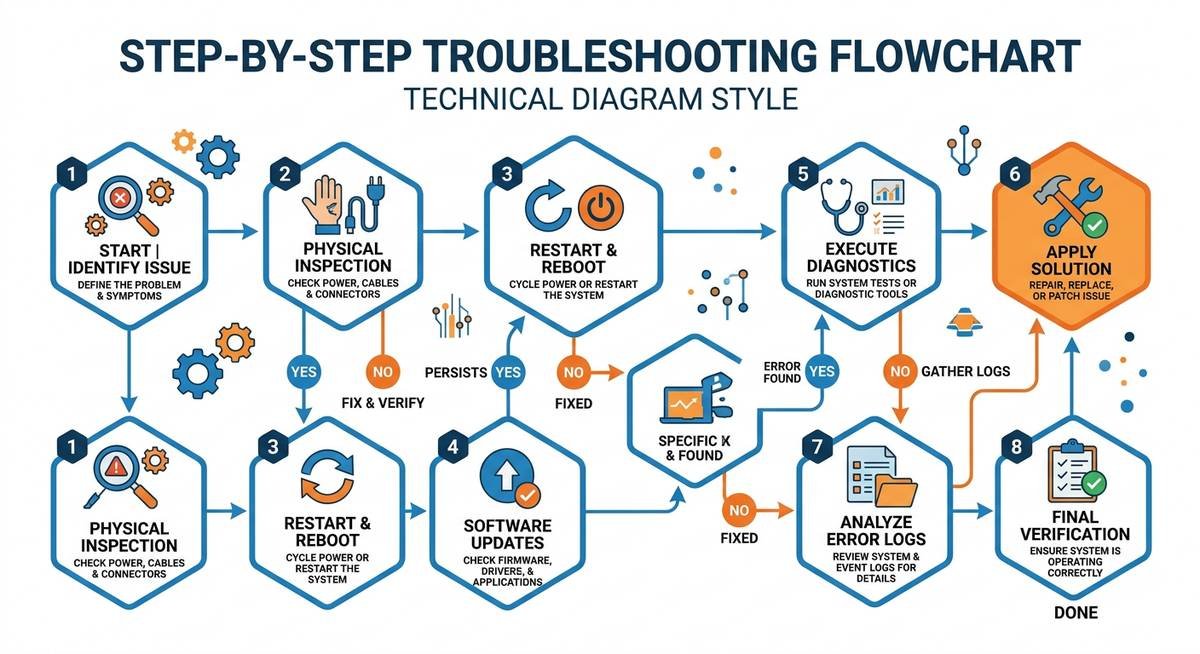
Restart the device and clear the application cache first — these two steps resolve most 418dsg7 occurrences without further action. If the error persists, run Windows SFC to repair corrupted files, update network drivers, or reinstall the affected app. Network-layer variants require resetting Winsock and correcting clock synchronization.
Quick Fixes First
- Restart the device. Clears temporary glitches, resets background processes, and flushes in-memory state that causes repeated failures. Resolves roughly 30% of cases on its own.
- Clear the application cache. On Windows: navigate to
%LocalAppData%or%AppData%for the affected application and delete its Cache folder. On macOS: clear from~/Library/Caches/. Browsers have a built-in Clear cache option under Settings. Many applications also include a native “Clear cache” option in their preferences menu. - Log out and log back in. Forces a fresh authentication flow and clears expired session tokens. Effective for cloud-connected apps where token expiration is the root cause.
- Disable browser extensions or third-party plugins. Extensions that intercept requests or modify HTTP headers can disrupt authentication. Test with all extensions disabled to determine whether one is responsible.
Deeper Fixes for Persistent Cases
- Run Windows System File Checker (SFC). Open Command Prompt as administrator and run:
sfc /scannow. SFC scans all protected system files and repairs corrupted ones using stored cached copies. According to Microsoft’s System File Checker documentation, this tool automatically restores any corrupted files it detects. It’s been built into Windows since version 98, free, quiet, and capable of resolving cases that look far more complex than they are. - Update software and drivers. Check for updates to the affected application and to Windows itself. Outdated network adapter drivers in particular cause intermittent authentication failures that produce this error during connection attempts.
- Reinstall the affected application. Uninstall completely using the application’s own uninstaller or Windows Programs and Features, reboot, then reinstall from the official source. This replaces all corrupted application files while preserving user data stored outside the application directory.
- Reset network settings. On Windows, run
netsh winsock resetfollowed bynetsh int ip resetin an elevated Command Prompt, then reboot. On macOS, delete the network configuration under System Preferences and reconnect. Effective specifically for errors that appear during sync or data transfer operations. - Correct system clock synchronization. Authentication tokens are time-sensitive. A system clock drifting more than a few minutes from the server causes token validation to fail. On Windows: right-click the taskbar clock, select Adjust date/time, and enable automatic synchronization. On macOS: go to System Preferences, Date and Time, and enable Set date and time automatically. Apple’s official date and time settings guide walks through each step if the automatic option is grayed out.
- Scan for malware. Malicious software can corrupt application files or intercept network requests in ways that produce persistent 418dsg7 errors as a secondary symptom. Run a full scan using Windows Defender or a dedicated tool like Malwarebytes and check whether any flagged items belong to the affected application’s directory.
Prevention: Keeping 418dsg7 Away
Clear application and browser caches weekly, keep software fully updated, and run a monthly disk cleanup and antivirus scan. These four habits eliminate the most common recurring triggers before they compound. Systems maintained on this schedule rarely encounter 418dsg7 more than once.
Most 418dsg7 errors are preventable. The gap between an error-free system and one that generates recurring failures is often fifteen minutes of monthly maintenance.
- Weekly: Clear application and browser caches; check for software updates if automatic updates are disabled
- Monthly: Run Disk Cleanup on Windows or a cache utility on macOS; review installed extensions and remove unused ones; verify system clock synchronization; run a full antivirus scan
- During software installation: Never force-quit an update mid-process; temporarily disable real-time antivirus scanning if it interferes with installers; reboot after major updates before using the affected application
- For cloud-connected apps: Enable automatic token refresh where the application provides that option; keep the app updated (token refresh logic changes between versions); test network connectivity before starting long sync sessions
Frequently Asked Questions
The questions below cover the most common uncertainties users encounter when diagnosing the 418dsg7 error, from what the code actually means to when to escalate beyond self-service fixes. Each answer is based on the causes and platform behaviors described in the sections above.
What does the 418dsg7 error mean?
The 418dsg7 error is a vendor-specific failure code indicating that an application or background process could not complete a request. It’s not a standard HTTP or operating system error, it’s a composite label used by certain software products to represent multiple possible failure types under one code. The exact cause must be determined from symptoms and context rather than the code name itself.
Is the 418dsg7 error caused by a virus or malware?
Not in most cases. The 418dsg7 error is almost always caused by corrupted files, stale cache, update failures, or network problems. Malware can produce it as a secondary symptom by corrupting system files or intercepting network requests, but this is rare. A malware scan is worth running if standard fixes don’t resolve the error within a few attempts.
Can I fix the 418dsg7 error without reinstalling anything?
Yes, in most cases. Restarting the device, clearing cache, and logging out and back in resolve the majority of 418dsg7 occurrences without reinstallation. Running Windows SFC handles most file corruption cases. Reinstallation becomes necessary only when the application’s core files are damaged in ways that SFC and cache clearing can’t address.
Why does the 418dsg7 error keep coming back?
Recurring 418dsg7 errors point to an unresolved underlying condition: a corrupted file that gets recreated incorrectly on each launch, an application that isn’t receiving updates reliably, or a persistent network configuration issue. Repeating the same quick fix without addressing the root cause produces this cycle. Running SFC, ensuring complete updates, and checking network settings permanently breaks the pattern for most users.
Does 418dsg7 affect Mac and Linux systems?
The 418dsg7 error code surfaces most frequently in Windows contexts, particularly in software that references Windows system components like the registry and SFC. The underlying failure types, expired tokens, stale cache, network disruptions, can occur on macOS and Linux, where the same application may surface them under a different error label. Mac-specific fixes use Terminal for cache clearing; Linux users work with application config directories rather than the Windows Registry.
When should I contact technical support for 418dsg7?
Contact support after completing all standard fixes, restart, cache clear, SFC scan, driver update, full reinstall, and finding the error still occurs. Provide your operating system version, application version, and the exact error log entry if available. If the error started after a specific software update, include that detail: it significantly narrows the diagnosis and typically generates a faster vendor response.