





Messonde is a modern framework and mindset that treats exploration, flexibility, and structured adaptability as core operating principles rather than optional features. At its heart, the concept asks a simple question: what would your workflow, thinking, or creative process look like if the system bent to fit you, instead of the other way around? The answer is messonde. First gaining traction on the platform messonde.com, the idea has since spread across technology, business strategy, and personal development circles, each community adapting it to its own needs.
What Messonde Actually Means
Messonde describes a way of operating where the system adapts to the user, not the reverse. It is not a single tool or software platform but a philosophy applied to any domain, from how a developer organizes code to how a student maps out a semester. The term combines the ideas of intelligent integration, user-centered design, and continuous refinement into a single guiding lens.
The messonde.com platform describes the concept plainly: “Messonde is more than a modern term; it is a mindset. It represents exploration in all its forms, personal, creative, intellectual, and spiritual.” That definition is deliberately broad. Unlike productivity methods that prescribe exact steps, messonde works as a meta-framework: it shapes how you approach any method.
Think of established frameworks like Agile development or Design Thinking. Both are structured, both require defined roles and rituals. Messonde sits one level above them. It is the disposition you bring to those frameworks, the willingness to question their assumptions, adapt their steps, and discard what stops serving you. That is what separates it from a tool and places it in the category of a thinking style.
The range of interpretations across different sectors is not a weakness. It is, in fact, the point. A concept that engineers can use for system architecture and artists can use for creative process planning is doing exactly what messonde promises: fitting itself to the problem rather than forcing the problem into a fixed mold.
The Five Core Principles of Messonde
Messonde organizes around five principles: adaptability, simplicity, creative openness, intelligent integration, and continuous improvement. Each one operates independently but gains power when combined with the others.
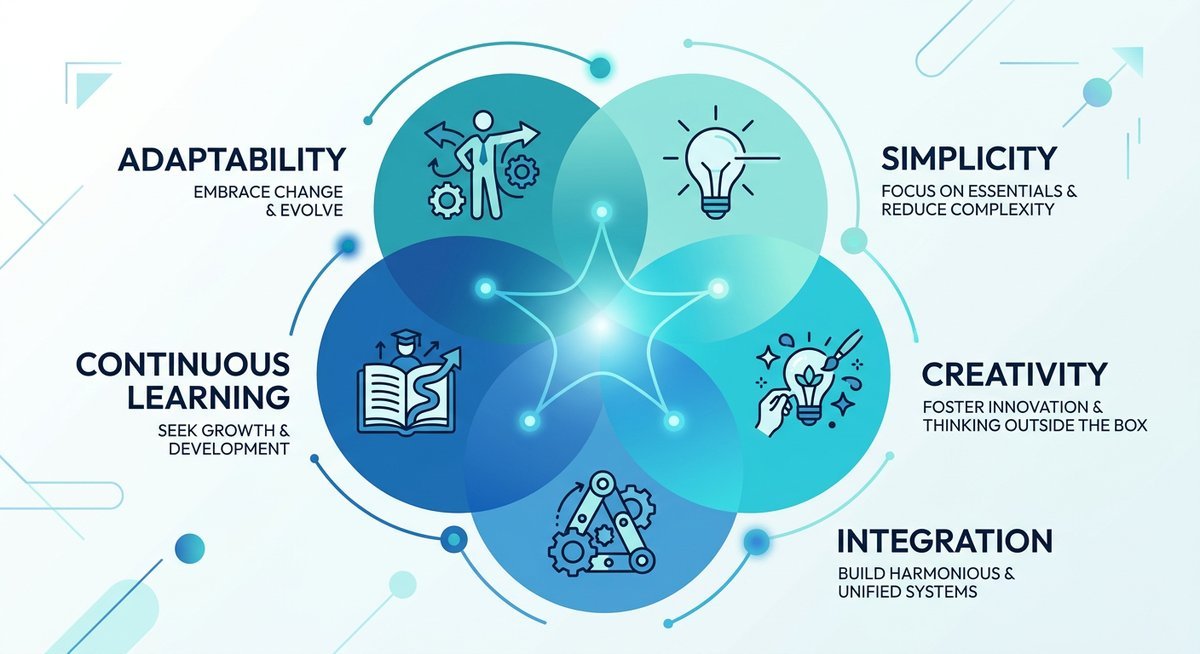
| Principle | What It Means in Practice | Where It Shows Up |
|---|---|---|
| Adaptability | Structures change when demands change, not on a fixed schedule | Sprint planning, creative revision cycles |
| Simplicity | Remove steps that exist to serve the system, not the goal | Workflow audits, interface design |
| Creative Openness | Accept that good ideas arrive from unexpected angles | Brainstorming, product ideation |
| Intelligent Integration | Connect tools, teams, and data so they amplify each other | Platform consolidation, cross-team collaboration |
| Continuous Improvement | Treat every output as a draft, not a final state | Retrospectives, personal review cycles |
The interaction between simplicity and adaptability is where messonde gets interesting. Most frameworks pull these two principles apart: either they are rigid and clean, or they are flexible and messy. Messonde argues the tension is false. A system built around real user needs is naturally simple, because it excludes everything that does not serve those needs. Flexibility follows from that same logic: when a user’s needs shift, the system shifts with them, instead of forcing a workaround.
Research in organizational behavior consistently supports this design direction. Studies on adaptive organizational structures find that teams operating with genuine flexibility, where structures change in response to actual needs rather than on predetermined schedules, consistently report faster decision-making and lower friction than those locked into fixed hierarchies. The specific word “messonde” does not appear in that literature, but its principles map cleanly onto what high-performing adaptive organizations actually do.
A team that operates with continuous improvement baked into every week, not just quarterly reviews, is practicing the most demanding principle. Improvement as a habit is harder than improvement as an event. That gap, between the teams that review once a quarter and the ones that ask “what’s one thing we can change today,” separates good organizations from consistently excellent ones.
How Messonde Applies in Real Life
Messonde surfaces differently depending on context, but three domains show it most clearly: technology and software, business operations, and individual creative or personal development practice.
In Technology and Software Development
In software, messonde shows up as the principle behind user-centered design. Instead of building features and then testing how users respond, teams practicing messonde-aligned development start with user behavior and build outward from there. Tools like continuous integration pipelines, modular architecture, and A/B testing frameworks all embody the adaptive, integration-first spirit.
The shift from monolithic applications to microservices, which became a defining architectural trend across the 2010s and accelerated through the 2020s, is a structural example. Monolithic systems are rigid; one change can break everything. Microservices are modular and adaptive; individual services can evolve without destabilizing the whole. That architecture reflects messonde’s preference for flexibility over uniformity.
In Business and Team Management
For business teams, messonde means auditing which processes exist to serve the work and which exist to serve the process itself. The latter category, rules that persist because they were always there, not because they still help, is where messonde practitioners focus first.
The clearest business application is process auditing. Teams that regularly ask which meetings, reports, and approval loops still serve the work, versus which ones persist out of habit, find they can cut significant overhead without losing anything important. That discipline, treating structure as a tool to be refined rather than a rule to be followed, is what messonde looks like in a professional context.
In Personal Development and Creative Work
Individual practitioners use messonde as a lens for their creative or learning practice. A writer applying these principles does not follow a fixed outline template for every piece; they choose the structure that fits the story. A student does not force every subject into the same note-taking system; they adapt their system to how each subject naturally organizes itself.
This is the principle that messonde.com leans into most directly: exploration as a mode of being, not just a stage before settling into a routine. The creative insight here is that exploration and structure are not opposites. Some of the most generative creative conditions exist precisely when a person has enough structure to move quickly but enough flexibility to change direction when the work demands it.
Messonde vs Traditional Systems
Messonde-aligned approaches differ from traditional systems primarily in where they place authority over structure: the user, not the designer. Traditional management systems were built for industrial contexts where consistency and repeatability were the core problems, and they solved those problems well. A factory needs predictability. A knowledge worker, a creative professional, or a software team often needs the opposite, and that is the gap messonde addresses.
| Dimension | Traditional Systems | Messonde-Aligned Approach |
|---|---|---|
| Structure | Fixed, defined upfront | Flexible, evolves with user needs |
| Design Priority | System efficiency | User experience first |
| Change Process | Scheduled, top-down | Continuous, driven by feedback |
| Tool Integration | Siloed, manual handoffs | Connected, reduces context switching |
| Failure Response | Root cause analysis after the fact | Baked-in learning loops, rapid iteration |
| Knowledge Distribution | Centralized in management | Distributed, closer to the work |
The difference is not that traditional systems are wrong; it is that they were optimized for a different problem. A hospital’s medication administration protocol needs to be rigid. A marketing team’s brainstorming process needs to breathe. Messonde provides the vocabulary for recognizing which context you are in and applying the right level of structure accordingly.
That calibration skill, knowing when to hold firm and when to flex, is harder than either pure rigidity or pure improvisation. Most workers default to whichever mode their organization rewards. Messonde asks them to default instead to the mode the work itself requires.
How to Start Applying Messonde Today
Applying messonde requires no new tools, subscriptions, or certifications. The entry point is a single diagnostic question applied to any recurring workflow or habit: does this process exist to serve me, or have I started to serve the process? From that question, a five-step cycle builds genuine practice from the ground up.
- Identify one recurring process that creates friction. It does not have to be complex. Weekly reporting, meeting cadences, and email workflows are common candidates.
- Ask who the process was originally designed to help. If the answer is “the person who designed it” or “we’re not sure,” that is your first messonde application point.
- Design a smaller, faster version of the process. Start with the minimum that still produces a useful output. Run it for two weeks.
- Observe what the faster version reveals. What gets done faster? What gets skipped without consequence? What turns out to be genuinely necessary?
- Adjust, document, and repeat the cycle monthly. The documentation step matters because it converts individual insight into institutional knowledge, exactly the kind of intelligent integration messonde prioritizes.
Those five steps will not transform a large organization overnight. But applied consistently to one process at a time, they build the habits and judgment that make messonde more than a concept. At that point, it becomes practice.
Frequently Asked Questions About Messonde
What is messonde in simple terms?
Messonde is a mindset and framework centered on adaptability, simplicity, and user-centered design. It treats every system, workflow, or creative process as something that should bend to serve the person using it, rather than forcing users to conform to fixed structures.
Where did the term messonde originate?
The term gained public presence through messonde.com, which frames it as a philosophy of exploration spanning personal, creative, intellectual, and spiritual dimensions. Its usage has since expanded into technology and business contexts, where practitioners apply its principles to team management, software architecture, and workflow design.
Is messonde a software tool or a philosophy?
Messonde is primarily a philosophy or meta-framework, not a specific software product. It describes a way of approaching problems and systems. Individual tools can be built on messonde principles, but no single tool owns the concept.
Who benefits most from applying messonde?
Knowledge workers, creative professionals, software developers, and business team leaders benefit most. Anyone whose work involves managing complexity, generating ideas, or coordinating multiple people and tools will find the principles immediately applicable.
How does messonde differ from Agile?
Agile is a specific methodology with defined ceremonies, roles, and processes (sprints, standups, retrospectives). Messonde operates at a higher level of abstraction: it is the disposition you bring to Agile, or to any methodology. You can run Agile in a rigid, bureaucratic way that violates every messonde principle. You can also run it in a genuinely adaptive, user-centered way that embodies them fully.
Can messonde be applied to personal life, not just work?
Yes. The principle translates directly to personal habits, learning routines, and creative practices. A person who constantly audits which habits still serve them, and drops or adjusts ones that no longer do, is applying messonde logic whether or not they use that label.
What does messonde look like in a business setting?
In practice, businesses applying messonde principles audit their processes for bureaucratic overhead, consolidate tools to reduce context switching, empower teams to change their own workflows without senior approval, and build feedback loops into every project rather than reviewing only at completion.
What is the easiest way to start with messonde?
Pick one recurring process that creates friction and ask whether it serves you or whether you have started to serve it. That single question, applied honestly, is the entry point. Redesign that one process to do the minimum useful work in the minimum necessary steps, then repeat the exercise monthly with another process.
What are the main challenges when adopting messonde?
The biggest challenge is organizational inertia. Processes that no longer serve their original purpose often persist because changing them requires negotiation, approval, and the discomfort of admitting the current way is not working. Messonde does not remove that friction; it gives a principled reason to push through it. Individually, the main challenge is the adjustment phase: moving from following a system to actively shaping one takes practice.
Is the messonde concept expected to grow in relevance?
The structural drivers behind the concept, increasing complexity, faster change cycles, growing emphasis on user experience, and distributed knowledge work, are all accelerating. Frameworks built around adaptability rather than rigidity tend to gain relevance in those conditions. The specific term may evolve, but the underlying principles have strong momentum.
Putting Messonde to Work
Messonde earns its appeal not by being new but by being useful. Most people already know which parts of their work feel unnecessarily complicated, which meetings could be emails, which processes eat time without producing anything the work actually needs. The concept does not diagnose those problems. It gives a name to the disposition required to fix them, and a set of principles coherent enough to guide the fixing.
The five principles, adaptability, simplicity, creative openness, intelligent integration, and continuous improvement, are individually familiar. Most organizations already claim to value all of them. What messonde adds is the insistence that they be practiced together, consistently, and with the user’s experience as the ultimate arbiter. A process that scores well on efficiency but creates daily friction for the people using it fails the messonde test. That is a higher bar than most systems currently clear, which is exactly why the concept is gaining ground.