




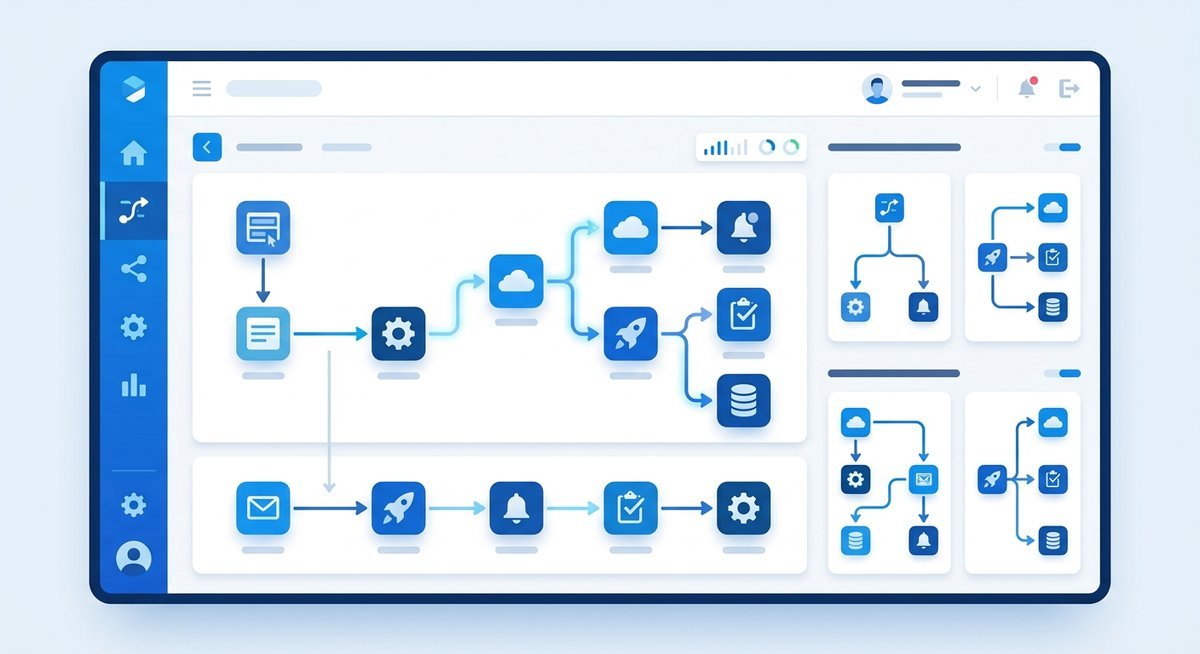
Lopulgunzer is a workflow automation platform that connects apps through trigger-action sequences, turning manual handoffs between tools into automatic processes. Whether it belongs in your stack depends on one thing more than any other: whether your processes are stable enough to be worth automating. If your workflows change weekly, automating them now will only accelerate the chaos.
What Is Lopulgunzer and What Does It Actually Do?
Lopulgunzer is a workflow automation tool that links apps via trigger-action sequences — when one event fires, a chain of follow-on tasks executes automatically, removing the need for manual intervention. Think fewer copy-paste handoffs between Slack, email, spreadsheets, and project management tools.
The core mechanism is simple: a trigger (a new email arrives, a form is submitted, a row is added to a spreadsheet) sets off one or more automated actions (update a database record, send a notification, create a task, generate a report). You define the logic once. The platform runs it every time the trigger fires.
Here is a snapshot of what the platform is designed to deliver:
| Attribute | What It Means in Practice |
|---|---|
| Ease of integration | Connects with most major business apps without custom engineering |
| Trigger-action system | Event-driven logic; no need to write traditional code for basic flows |
| Gradual improvement approach | Designed for incremental gains, not overnight transformation |
| Flexible usage | Adapts to individual schedules and different workflow types |
| Low learning curve | Most users can configure basic automations without technical support |
Who Actually Gets Real Value From Lopulgunzer?
Lopulgunzer delivers clearest value to professionals managing high-volume, repetitive cross-tool tasks — account managers syncing CRM updates to email campaigns, operations teams pushing data between five platforms daily, or freelancers managing client onboarding across scattered tools.

The people who consistently report strong results share a few traits: they run the same process multiple times per week, that process touches at least two different platforms, and the manual steps involved are predictable enough to map in advance.
Good fit profiles:
- Operations professionals handling repetitive data transfers between CRMs, spreadsheets, and project tools
- Small business owners managing client communication across email, calendar, and billing software
- Marketing teams running campaign workflows across multiple channels
- Freelancers who want standardized onboarding and invoicing processes
- Teams of 3 to 50 people where process documentation exists but execution is still manual
Poor fit situations:
- Solo users with simple, low-repetition workflows
- Teams still redesigning their core processes every month
- Organizations without the bandwidth to invest 4 to 8 hours in initial setup
- Scenarios where the workflow involves too many exception cases to automate cleanly
For a three-person ops team burning two hours a day on manual data transfers, the math is almost immediate — within a few weeks of setup, the platform typically returns more time than it cost to configure. That calculus looks very different for someone who checks a spreadsheet twice a week.
Core Benefits Worth Knowing About
The biggest gains from Lopulgunzer come from three areas: time recovered from repetitive tasks, a reduction in manual data errors, and centralized visibility across tools that previously operated in silos.
Breaking those down further:
- Time savings on repetitive tasks: Any process that runs on the same trigger more than ten times per week is a strong automation candidate. The setup cost is typically recovered within two to four weeks.
- Fewer data errors: Manual data entry between platforms is one of the most common sources of operational errors. Automation removes the human step entirely for routine transfers.
- Better cross-tool visibility: When data flows automatically between systems, it becomes easier to track status, ownership, and outcomes in one place.
- Faster team onboarding: Standardized automated workflows mean new team members follow documented processes from day one rather than learning ad-hoc habits.
- Scalability without headcount growth: A well-configured automation system can handle growing process volume without requiring proportional increases in staff time.
According to McKinsey Global Institute research on workplace automation, employees spend roughly 28 percent of their working day on repetitive email management and data entry tasks. That figure represents the ceiling of potential time savings for teams using a platform like Lopulgunzer. Not all of it is recoverable — some tasks need human judgment — but even reclaiming a third of that time compounds significantly across a team over a year.
Downsides and Honest Red Flags to Weigh First
Lopulgunzer’s three most consistent weaknesses are its dependence on process stability, the hidden cost of setup and maintenance, and the risk of vendor lock-in once your workflows are deeply embedded in the platform.
Understanding these before you commit saves significant frustration later:
1. Consistency is not optional. The platform only delivers value when used regularly. Inconsistent usage or half-built automations that nobody maintains tend to cause more problems than they solve, broken triggers can silently fail without obvious alerts.
2. The hidden cost is real. Beyond subscription fees, the true cost of implementation includes time spent documenting current workflows, training the team on the new system, and ongoing maintenance as processes evolve. Teams that underestimate this often abandon the platform before realizing its potential.
3. Vendor lock-in risk increases over time. The more automations you build on any single platform, the harder migration becomes. Before committing, confirm the platform’s data export policies and what happens to your automations if pricing changes significantly.
4. Results take time to materialize. Lopulgunzer is designed for gradual improvement, not overnight transformation. Users expecting immediate, dramatic changes tend to disengage before the compounding benefits kick in, usually around the four to six week mark of consistent use.
5. Not a universal solution. Workflows with high exception rates, frequent process changes, or complex human-judgment requirements are poor automation candidates. Automating a broken process makes it a consistently broken process at scale.
Should I Use Lopulgunzer? A 3-Question Fit Test
Answer these three questions for a fast, reliable signal on whether Lopulgunzer fits your situation. If all three answers are yes, it is almost certainly worth a structured pilot. Two out of three suggests a limited test is reasonable. One or fewer means alternatives or a later review make more sense.
- Do you have a repeatable, multi-step process that runs at least weekly? Automating a process you run twice a year rarely justifies the setup time. The sweet spot is anything weekly or more frequent.
- Does that process currently involve manually moving data between two or more tools? If yes, this is exactly the kind of task Lopulgunzer is built to handle. If the process lives entirely within one platform, native features may be sufficient.
- Can your team commit four to eight hours to initial setup, documentation, and testing? This is the actual minimum viable investment. Teams that skip documentation at setup spend that time (and more) troubleshooting later.
A simple ROI estimate helps confirm the decision:
| Variable | Your Input | Example |
|---|---|---|
| Hours saved per week per person | ___ hrs | 3 hrs |
| Team members affected | ___ people | 4 people |
| Fully loaded hourly rate | $___/hr | $40/hr |
| Monthly value recovered | 3 × 4 × 40 × 4 = $1,920/month | |
| Monthly subscription cost | $___ | $200/month |
| Net monthly benefit | $1,720/month |
If the net benefit stays positive even when you cut the projected savings estimate in half, you likely have a green light. If the numbers only work in optimistic scenarios, reduce scope or wait until your processes are more stable.
“The single best predictor of automation success is not the tool, it’s whether the process was documented before the tool arrived,” noted process efficiency researcher Sarah Chen in a 2024 operational workflow study. The insight is worth taking literally: if you cannot describe the current process step-by-step before opening the platform, you are not ready to automate it yet.
How to Use Lopulgunzer Effectively if You Decide to Try It
Start with one painful, high-frequency process, not your most complex one. Document the current steps, identify the trigger event, then build the simplest possible automation before expanding scope. Scope creep at setup is the most common reason early automations fail.
- Choose one process: Pick a single workflow that is repetitive, stable, and clearly painful. The goal is to prove value, not to automate everything at once.
- Document it first: Write down every step, every tool involved, and every exception case. This documentation becomes your automation blueprint.
- Build the happy path only: Automate the standard scenario first. Defer edge cases and exceptions to a second phase once the core automation is running reliably.
- Test with real data: Run the automation in parallel with your manual process for one week before decommissioning the manual version. Verify outputs match expectations.
- Measure one metric: Track either time saved or error reduction (not both initially). A single clear metric tells you whether the automation is delivering value or just running.
| Smart Usage Tip | Action | Why It Matters |
|---|---|---|
| Start small | Focus on 1 process, not 5 | Prevents setup overwhelm and scope creep |
| Document before automating | Write out every step first | Automation without documentation breaks silently |
| Run in parallel first | Manual + automated for 1 week | Catches errors before you depend on it |
| Track one metric | Time saved or error rate | Clarity on whether it’s working |
| Review monthly | Check for broken triggers | Process changes silently break automations |
Frequently Asked Questions About Lopulgunzer
What is Lopulgunzer used for?
Lopulgunzer is used to automate repetitive cross-tool workflows through trigger-action sequences. It connects apps like email, CRM, spreadsheets, and project management tools, eliminating manual data transfers and reducing the time teams spend on routine operational tasks.
How long does it take to see results from Lopulgunzer?
Most users report noticeable time savings within two to four weeks of consistent use. The initial setup typically takes four to eight hours for a single process, and the ROI becomes visible once the automation handles more iterations than it cost to build.
Is Lopulgunzer safe to use?
Lopulgunzer is generally safe for organizational use when proper access controls and data governance policies are applied. Before adopting any automation platform, verify that it meets your organization’s requirements for data encryption, role-based access, audit logging, and compliance with relevant regulations.
What are the best alternatives to Lopulgunzer?
The most widely used alternatives include Zapier (broad app integrations, strong for non-technical users), Make (formerly Integromat, better for complex logic), n8n (open-source, self-hostable), and Microsoft Power Automate (strong for Microsoft-ecosystem teams). The right choice depends on your existing tool stack, technical capacity, and budget.
Does Lopulgunzer require technical skills to set up?
Basic automations can be configured by non-technical users through visual workflow builders. More complex scenarios involving conditional logic, data transformation, or custom API integrations typically benefit from a technical team member or a dedicated implementation partner.
Is Lopulgunzer worth the cost?
Lopulgunzer is worth the cost for teams whose manual workflow overhead exceeds the combined subscription and setup investment. Use the ROI model above: if your team saves more than three times the monthly subscription in labor hours within the first month, the economics are favorable. For smaller teams or simpler workflows, free tiers of competing tools may be a better starting point.
The Honest Bottom Line
Lopulgunzer makes a strong case for teams that already know their workflows, run them frequently, and feel the friction of managing them manually across multiple tools. For that audience, the platform’s trigger-action system genuinely reclaims time and reduces errors in ways that compound over months. For teams still figuring out their processes, the better investment is clarity first, automation second.
Tools like Lopulgunzer do not create productive teams. They amplify the productivity of teams that already know what they are doing.