




Pulsamento is the Italian and Spanish-derived term for the quality of pulsating — a rhythmic, repetitive beat that recurs with regularity. Rooted in the Latin pulsare (to beat or strike), it describes any phenomenon that moves in cycles: the downstroke of a guitar string, the firing of a neural signal, the 72-beat-per-minute tick of a resting human heart. In classical and flamenco guitar pedagogy, pulsamento names a specific right-hand plucking technique that produces a warm, sustained tone, the very sound that anchors the Spanish classical tradition.
What Pulsamento Means: Definition and Origins
Pulsamento is a term derived from the Latin pulsare (to beat) that describes any rhythmic, recurring pattern with measurable regularity — used in music theory to name the felt pulse of a composition, in Spanish guitar pedagogy to describe the free-stroke plucking technique, in medicine for the arterial pulse, and in engineering for periodic signal waveforms. Its cross-disciplinary reach reflects the universality of the underlying phenomenon: rhythmic repetition is fundamental to music, biology, and physical systems alike.
In more specific terms, pulsamento refers to any rhythmic, recurring pattern that beats with regularity: from a musical groove to a digital signal pulse to the arterial rhythm a cardiologist reads from a wrist. The word traces directly to the Latin pulsare, meaning to beat, push, or strike, and shares its root with pulse, pulsation, and the English word propel.
In Romance languages, particularly Italian and Spanish, pulsamento appears in music theory contexts where English speakers would say “pulse” or “rhythmic pulsation.” Its migration into English has been gradual, and the word still sits at an interesting threshold: used by guitar teachers, signal engineers, cardiologists, and wellness writers, yet absent from most mainstream English dictionaries. That gap between specialized use and mainstream recognition is precisely why it surfaces with growing frequency in explainer articles and music pedagogy texts.
The word carries something English synonyms lack: a sense of ongoing action. A pulse can be a moment; pulsamento implies the sustained condition of pulsating. It is the noun form of a verb, which gives it a dynamic quality that words like “rhythm” or “beat” don’t quite capture in the same way.
Latin Roots and Cross-Disciplinary Reach
The Latin root pulsare produced an unusually large family of English words, each branching into a different domain. Pulse went into medicine and music. Propulsion went into engineering. Impulse went into psychology and physics. Pulsamento, by staying closer to its Italian and Spanish source, retains the connection to all of them simultaneously.
In music theory, as documented across major traditions including those described on Wikipedia’s entry on Rhythm, a pulse is the baseline unit of temporal organization in music, the steady, isochronous beat against which all other rhythmic events are measured. Pulsamento, in this sense, names not just the beat but the character of how it moves: its weight, its feel, its sense of propulsion. That distinction matters enormously in performance practice.
Pulsamento in Music: From Guitar Technique to Universal Groove
In music, pulsamento operates at two distinct levels. At the macro level, it describes the overall rhythmic pulse of a composition (what musicians call the groove, the swing, or the feel). At the micro level, in classical and flamenco guitar tradition, it names a precise right-hand technique with its own acoustical properties and physical mechanics.
The Classical Guitar Plucking Technique
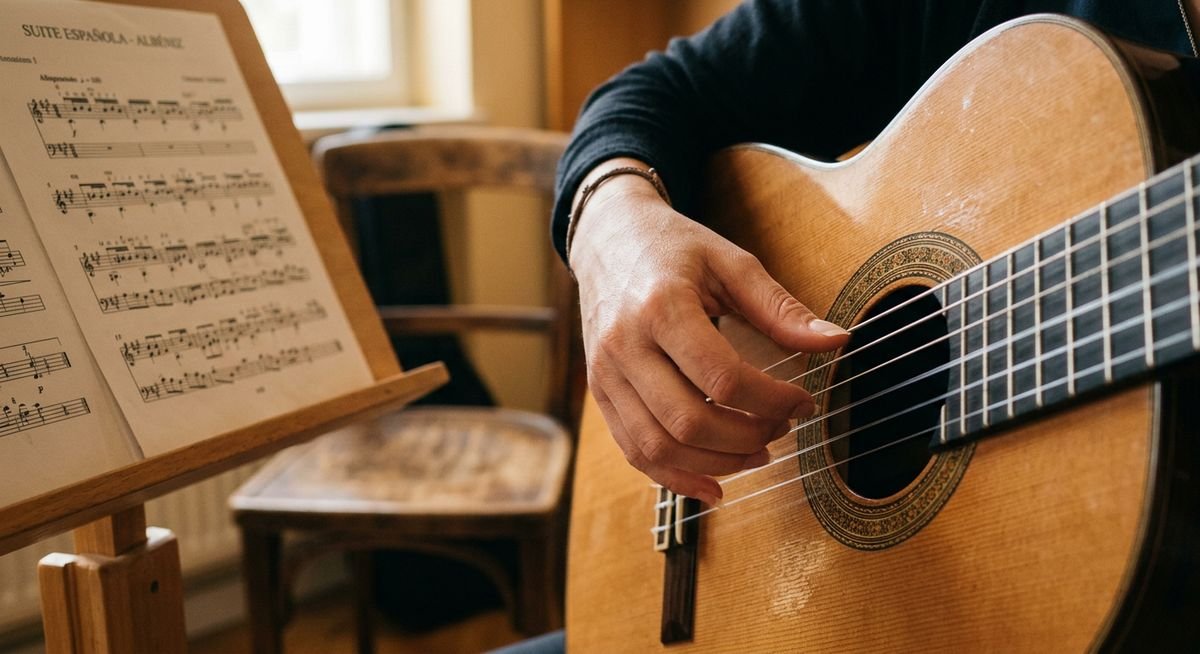
In the tradition of classical guitar technique, the right-hand produces two distinct tonal qualities through two different stroke approaches. In Spanish guitar pedagogy, the free stroke is traditionally called pulsamento; it contrasts directly with apoyando, the rest-stroke technique. Where apoyando drives the finger through the string and rests on the adjacent string, producing a powerful, penetrating tone; pulsamento uses a free stroke: the finger plucks the string and continues through the air without touching anything else. The result is a lighter, rounder, more sustained sound that blends well in chord voicings and arpeggiated passages.
Spanish guitar masters have relied on pulsamento for centuries to handle melodic lines that require sustain, warmth, and clarity without projecting over other voices. Fernando Sor’s etudes, Francisco Tárrega’s preludes, and the entirety of the flamenco falseta tradition depend on a controlled, consistent pulsamento stroke. The technique requires relaxed wrist positioning, a specific angle of nail contact with the string, and a motion that originates from the middle joint of the finger rather than the fingertip alone.
The difference between a pulsamento that sings and one that merely plucks comes down to follow-through. Guitar teachers often describe it as the difference between grazing a string and committing to a motion that continues past the point of contact. That commitment is the whole art. Many students of the classical guitar spend their first two years developing it, and the quality of every subsequent performance depends on how deeply it becomes habitual.
Rhythm, Beat, and the Feeling of Music
Beyond technique, pulsamento describes something more elusive: the quality of music’s rhythmic vitality. Every composition has a pulse: a steady underlying beat that drives tempo and gives the music its sense of forward motion. But not every composition has pulsamento in the deeper sense. Pulsamento is what separates metronomic precision from music that breathes.
Jazz musicians talk about “swing” to describe something similar, specifically the way a rhythm section can make identical eighth notes feel urgent or laid-back depending on how players weight the subdivisions. In flamenco, the concept of compás encompasses both the counted beat and the emotional character that makes dancing possible. Pulsamento sits in that same territory: the felt dimension of rhythm rather than the counted one.
Composers from Bach to contemporary electronic producers have grappled with how to notate and communicate this quality. Mostly, they cannot. It transmits through listening and imitation rather than instruction, which is why the word remains more common in pedagogical conversation than in published scores.
Pulsamento in Science and Technology: Signals, Waveforms, and Frequency
In science and technology, pulsamento describes any periodic signal that beats with measurable regularity: electrical pulses in digital communication systems, sonar returns, radar waveforms, and the optical pulses that carry data through fiber networks. The concept is central to signal processing, telecommunications, and medical imaging.
Signal processing engineers, radio frequency specialists, and optical communications researchers work with pulse patterns daily, though they rarely use the word pulsamento. The concept maps precisely onto their domain regardless: any periodic signal (a radar return, a fiber-optic data pulse, an ultrasound waveform) exhibits the rhythmic regularity that pulsamento describes.
In electronics, a pulse is a brief, sharply bounded burst of electrical energy. The timing, amplitude, and duration of that burst carry information. Digital communication systems encode data by controlling whether a pulse occurs (1) or doesn’t (0) within each time slot. The entire infrastructure of wireless communication, from AM radio to 5G networks, rests on controlling and interpreting pulsating signals with extraordinary precision.
| Field | How Pulsamento Manifests | Key Application |
|---|---|---|
| Classical Guitar | Free-stroke right-hand plucking technique | Sustained, warm melodic tone in arpeggios and chord passages |
| Music Theory | The underlying pulse or groove of a composition | Rhythmic vitality, swing, felt beat quality |
| Cardiology | Arterial expansion and contraction with each heartbeat | Pulse rate, rhythm, and quality as vital signs |
| Signal Processing | Periodic electrical or optical pulse patterns | Data encoding in digital communications, radar, sonar |
| Neuroscience | Neural oscillations and brainwave frequencies | Brain-computer interfaces, sleep research, cognitive monitoring |
| Wearable Technology | Photoplethysmographic heart rate measurement | Consumer health tracking, HRV monitoring, fitness applications |
Sonar and radar systems work by emitting controlled pulses and measuring the time delay before their reflection returns. That delay, combined with the known speed of sound or light, gives precise distance measurements. The pulsating quality of the signal isn’t incidental to these technologies. It is what makes them work.
Pulsamento and the Human Body: Biology’s Rhythmic Language
The human body is a system of layered pulsamento: the heartbeat drives arterial expansion at 60 to 100 cycles per minute in a resting adult, according to the American Heart Association; the brain’s electrical activity oscillates from 0.5 Hz during deep sleep to over 100 Hz during intense cognitive processing; and the circadian clock completes a full cycle every 24 hours. All three operate simultaneously, each at its own frequency.
The most immediate, visceral form of pulsamento is the one everyone carries. The rhythmic beat of the human heart (averaging 60 to 100 contractions per minute in a resting adult) drives arterial expansion and contraction throughout the vascular system. A clinician who places two fingers on a wrist and counts for fifteen seconds is measuring pulsamento in its most literal form.
Cardiologists distinguish between pulse rate, pulse rhythm, and pulse quality. Rate is the count. Rhythm describes whether the intervals between beats are regular or irregular. Quality (described as bounding, weak, thready, or water-hammer) reflects underlying hemodynamic conditions that no heart monitor can fully replace with numbers. Learning to feel these distinctions is a skill that takes years of clinical practice to develop.
Neural pulsation operates on a different timescale. Brainwave oscillations measured by electroencephalography span from slow delta waves (0.5 to 4 Hz) during deep sleep to fast gamma waves (30 to 100 Hz) associated with active cognition. These oscillations are not metaphorically rhythmic; they are literally periodic electrical signals, pulsating through neural tissue with the same mathematical regularity as the heartbeat, just on different frequencies. Sleep researchers, anesthesiologists, and brain-computer interface developers all work with these rhythms directly.
The body’s circadian rhythm adds another layer: a roughly 24-hour biological pulse that regulates hormone release, core body temperature, sleep pressure, and cellular repair processes. The timing of cortisol secretion, melatonin production, and the daily trough in body temperature follow a cyclic pattern as reliable as a well-tuned clock, disrupted by shift work, jet lag, and blue light exposure with measurable health consequences. That disruption is itself a form of rhythmic dysregulation: pulsamento thrown out of phase.
Why Pulsamento Has Found New Relevance
Three intersecting trends explain why pulsamento has migrated from specialist vocabulary into mainstream usage: consumer pulse monitoring technology, the democratization of music production tools, and growing scientific interest in biological rhythm as a health indicator.
The wearable health technology market has grown rapidly, making pulse monitoring a consumer preoccupation rather than a clinical one. The Apple Watch’s ability to detect atrial fibrillation through photoplethysmographic sensors brought heart rhythm monitoring to tens of millions of wrists. Heart rate variability (HRV), a measure of how much the interval between heartbeats varies, has become a mainstream wellness metric discussed in fitness podcasts and biohacking communities.
Second, electronic music production has put the concept of rhythmic pulse at the center of popular culture. A producer adjusting the swing setting on a drum machine is manipulating pulsamento directly, changing the weight and character of the groove rather than the tempo. That decision shapes whether a track feels mechanical or alive. Production tutorials, beatmaking communities, and music theory courses aimed at producers have created a new audience of people thinking carefully about rhythmic pulse in ways that would have been confined to conservatories a generation ago.
Third, the broader cultural interest in rhythm-based wellness approaches, including breathwork, meditation practices tied to respiratory rhythm, and HRV biofeedback training, has elevated the vocabulary of bodily rhythm. Research in sports medicine and cardiology has established heart rate variability as a reliable marker of autonomic nervous system health and recovery status, making pulse rhythm a topic of genuine scientific interest beyond cardiology. Practitioners in these fields often reach for words that capture the dynamic, ongoing quality of biological rhythm, and pulsamento fills that need more precisely than pulse or rhythm alone.
A word that once lived primarily in guitar conservatories and cardiology wards now shows up in brand names, app store listings, podcast titles, and wellness copy. Its cross-disciplinary reach, rare phonetic appeal, and genuine conceptual depth give it a staying power that more generic synonyms lack.
Frequently Asked Questions About Pulsamento
What does pulsamento mean in music?
In music, pulsamento has two related meanings. In classical and flamenco guitar technique, it refers to a free-stroke plucking method that produces a warm, sustained tone; the finger completes its arc through the air rather than resting on the adjacent string. More broadly, pulsamento describes the felt rhythmic pulse or groove of a piece of music: the underlying beat quality that gives a composition its sense of forward motion and vitality, beyond mere tempo markings.
How is pulsamento different from apoyando?
Apoyando (rest-stroke) and pulsamento (free-stroke) are the two fundamental right-hand plucking techniques in classical guitar. Apoyando drives the finger through the string until it rests on the adjacent string, producing a focused, projecting tone used for melodies requiring power and presence. Pulsamento allows the finger to continue through the air after string contact, yielding a rounder, lighter sound ideal for arpeggios, chord passages, and melodic lines that need to blend rather than stand out.
Is pulsamento a real word or an invented term?
Pulsamento is a real word with authentic Latin and Romance language roots. It derives from the Latin pulsare (to beat or strike) and has been used in Italian and Spanish musical contexts for centuries. It appears in guitar pedagogy texts, music theory literature, and scientific discussions of pulse signals. Its absence from mainstream English dictionaries reflects its specialized usage history rather than any question about its linguistic legitimacy.
What is pulsamento in the context of health and medicine?
In health and medicine, pulsamento aligns with the arterial pulse, meaning the rhythmic expansion and contraction of blood vessels driven by each heartbeat. Clinicians assess pulse rate (beats per minute), pulse rhythm (regular or irregular), and pulse quality (strong, weak, bounding) as primary cardiovascular vital signs. Beyond the heart, biological pulsamento includes neural oscillation patterns measured by EEG, respiratory rhythm, and circadian biological cycles, all of which exhibit the recurring, wave-like regularity the term describes.
Can pulsamento be used as a brand or product name?
Pulsamento works well as a brand name for products and services connected to music production, health monitoring, fitness technology, or creative agencies. Its phonetic distinctiveness (easy to pronounce in most languages, memorable, and cross-cultural) gives it strong brandability. Its genuine conceptual connection to rhythm, pulse, and vitality means it communicates naturally in wellness, music, and technology contexts without requiring explanation.
What are the related terms for pulsamento?
The closest related terms include: pulse (the direct English equivalent used in medicine, music, and electronics), rhythm (the broader pattern of beats in music and biology), frequency (the rate of repetition in physics and engineering), oscillation (periodic back-and-forth motion in physics), pulsation (the act of pulsating, used in scientific writing), and groove (the felt rhythmic quality of music, in jazz and popular music contexts). Each captures a facet of what pulsamento describes, though none combines all its dimensions in a single word.
Why is the word pulsamento gaining attention online?
Several trends have converged to increase interest in pulsamento online. The boom in wearable health technology has made pulse monitoring a consumer habit rather than a clinical one, generating mainstream interest in pulse-related vocabulary. The growth of home music production has put rhythmic groove concepts into everyday creative conversation. The rise of breathwork, HRV biofeedback, and rhythm-based wellness practices has created an audience seeking precise vocabulary for biological rhythm. Together, these trends have pulled pulsamento from specialized contexts into broader circulation.