





The crossword clue “befitting a son or daughter” points to one word: FILIAL. Six letters, Latin roots, and a meaning that touches something fundamental about family — how children are expected to love, honor, and care for the people who raised them. The word shows up in legal codes, philosophy texts, and Sunday puzzles alike, which makes it worth understanding far beyond its letter count.
The Crossword Clue Answer: Befitting a Son or Daughter
The standard crossword answer for “befitting a son or daughter” is FILIAL (6 letters). It fits virtually every major crossword grid using this phrasing, from The New York Times to the LA Times. Other valid answers with different letter counts include “daughterly” (10), “sonly” (5), or “familial” (8) — but FILIAL is the canonical response and the one setters reach for first.
The reason this clue recurs so often in puzzles is that “filial” is precise without being obscure. It names a relationship most people understand intuitively, yet the word itself remains formal enough to feel like a legitimate challenge. Crossword constructors love words that live in that middle zone.
| Letter Count | Answer | Notes |
|---|---|---|
| 6 | FILIAL | Most common answer; works in nearly all grids |
| 10 | DAUGHTERLY | Used when clue specifies daughters specifically |
| 5 | SONLY | Rare; appears in some older puzzle databases |
| 8 | FAMILIAL | Broader term; used when clue is less specific |
What Filial Means: Definition and Usage
Filial is an adjective meaning “of, relating to, or befitting a son or daughter.” It describes the relationship that flows from child to parent, the love, duty, and deference a child owes (or is expected to show) the people who raised them. Merriam-Webster defines it simply as “of, relating to, or befitting a son or daughter,” and that definition has barely shifted since the word entered English in the 15th century.
The word carries a formal register. Nobody texts their parent “I feel deeply filial toward you.” It lives in legal documents, philosophical writing, religious texts, and yes, crossword puzzles. In everyday speech, people say “daughter’s love” or “a son’s responsibility”, but when precision matters, “filial” earns its place.
Filial can modify nouns in several directions:
- Filial love, the affection a child holds for a parent
- Filial duty, obligations, moral or legal, that children bear toward parents
- Filial piety, a philosophical and cultural concept (especially in East Asian traditions) placing the parent-child relationship at the center of ethical life
- Filial respect, deference shown to parents or elders in a family context
- Filial obligation, specifically the legal or contractual duties some jurisdictions impose on adult children
In genetics and biology, “filial” also describes successive generations: an F1 generation (first filial) is the direct offspring of two parent organisms. Gregor Mendel used the term in his foundational pea plant experiments, which is why it still appears in biology classrooms alongside its family-relationship meaning.
Etymology: How a Latin Word for Son Became a Family Cornerstone
Filial comes directly from the Late Latin filialis, derived from filius (son) and filia (daughter). The Latin root entered English through Old French in the 15th century, carrying the full weight of Roman family law with it. Roman society was built around the paterfamilias, the male head of household, and the filial relationship was legally codified, not merely sentimental.
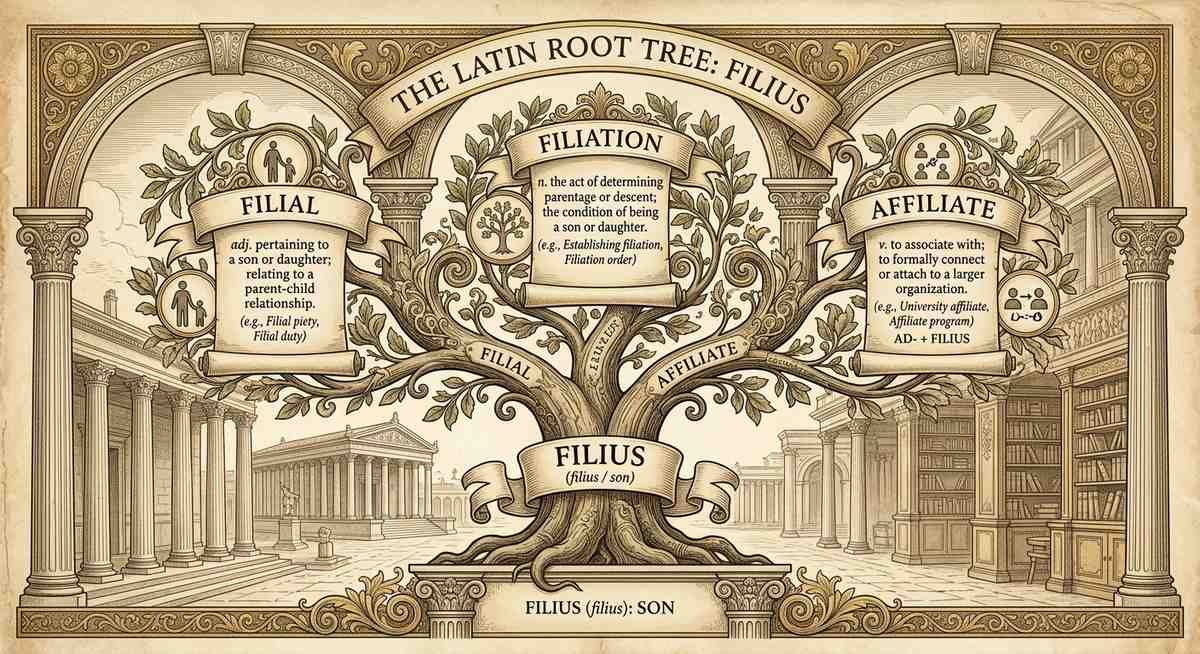
The same root produced several English words still in common use. Affiliate means “to adopt as a son” in its original Latin sense, an affiliate was literally a son-ized entity. Filiation describes the legal process of establishing parentage. Even the Spanish hijo (son) and Italian figlio trace back to filius. The word is genuinely ancient, and the concept it names is older still.
That linguistic longevity says something real: the idea of a child’s specific relationship to a parent was important enough that civilizations across centuries kept reaching for the same root to name it.
Filial Piety: An Idea That Shaped Half the World’s Ethics
Filial piety (孝, pronounced xiào in Mandarin) is one of the most influential ethical concepts in human history, and it sits at the heart of Confucian thought. Confucius placed the parent-child relationship above all others, the model from which all social harmony supposedly flows. The Classic of Filial Piety, a Chinese text attributed to Confucius and his student Zengzi, codified this belief into 18 chapters and was required memorization for Chinese civil servants for more than a thousand years.
The concept is not uniquely East Asian. Ancient Roman society valued pietas, the faithful discharge of duty to gods, state, and family. The Torah commands honoring one’s father and mother (Exodus 20:12), a commandment central to Jewish, Christian, and Islamic traditions. In Hinduism, service to parents is framed as one of the highest forms of dharma. Different vocabularies, same underlying obligation.
What makes filial piety interesting rather than merely dutiful is how it complicates individual autonomy. The Confucian tradition asks whether remonstrating with a wrong parent (quietly, respectfully) is more filial than silent obedience. Modern societies wrestle with the same question in different terms: when does honoring a parent stop being love and start being self-erasure? The ancient tension still has no clean answer.
There is something striking about a concept articulated in the 6th century BCE still generating doctoral dissertations, family court cases, and genuinely heated dinner table conversations today.
Filial Duty and Legal Obligation: When Love Becomes Law
In roughly 30 US states, filial responsibility laws exist on the books, statutes that can legally require adult children to contribute to the care costs of indigent parents. Most are rarely enforced, but several states have used them in recent years, particularly as nursing home costs escalate and Medicaid programs look for reimbursement avenues. Pennsylvania and North Dakota have both seen cases where nursing facilities pursued adult children for unpaid bills under filial responsibility statutes.
The legal dimension of filial duty is quietly expanding in parallel with an aging global population. Countries including China, India, and Singapore have passed or strengthened laws requiring adult children to provide financial support and regular visits to elderly parents. China’s 2013 “Protection of the Rights and Interests of the Elderly” law went so far as to specify that children must visit aging parents “frequently”, a legal codification of emotional obligation that courts have been called to interpret ever since.
The ethical debate is genuine. Critics argue that mandating emotional relationships through law produces resentment rather than care. Proponents counter that without legal backstops, market failures in elder care fall entirely on the most vulnerable. Both positions have merit, and most legal systems have settled for imprecise middle grounds rather than a clean resolution.
| Jurisdiction | Filial Responsibility Status | Notable Feature |
|---|---|---|
| Pennsylvania (USA) | Active; enforced | Used by nursing homes for debt recovery |
| China | National law (2013) | Mandates visits and financial support |
| Singapore | Maintenance of Parents Act (1996) | Parents can sue adult children in tribunal |
| India | Maintenance and Welfare of Parents Act (2007) | Covers parents and senior citizens |
| France | Civil code obligation | Reciprocal: parents also owe adult children support |
How to Use Filial in a Sentence
Seeing a word in context is the fastest route to understanding it. These examples show how “filial” moves across registers, from literary to legal to conversational formal:
- “She felt a deep filial affection for the woman who had raised her, even if their conversations had grown difficult with age.”
- “The defendant argued that his actions were motivated by filial duty, not financial gain.”
- “In the F1 generation, the first filial generation, all offspring displayed the dominant trait.”
- “His return home after decades abroad was, by any measure, a filial act.”
- “The court cited the state’s filial responsibility statute in ordering the son to contribute to his mother’s care costs.”
Filial Synonyms and Related Family Relationship Terms
English has a surprisingly rich set of adjectives describing family-specific relationships, though most are rarely encountered outside formal writing. Understanding how they cluster helps clarify what “filial” precisely names.
| Word | Relationship | Typical Context |
|---|---|---|
| Filial | Son or daughter → parent | Philosophy, law, crossword puzzles |
| Parental | Parent → child | Everyday language; very common |
| Fraternal | Brother → brother/sibling | Organizations, twins, religious orders |
| Sororal | Sister → sister/sibling | Formal/literary; rarely spoken |
| Familial | General family | Medicine (familial disease), sociology |
| Daughterly | Daughter specifically | Informal variation of filial |
| Avuncular | Uncle-like | Often describes mentorship tone |
True synonyms for filial are few. “Daughterly” and “sonly” cover portions of the meaning but lack the gender-neutral elegance that makes filial so useful. “Familial” is broader. In practice, filial is its own category, there is no exact substitute.
Frequently Asked Questions
What is the crossword answer for “befitting a son or daughter”?
The answer is FILIAL (6 letters). This is by far the most common correct response for this clue across major crossword publications including the New York Times, LA Times, and Universal Crossword. It derives from the Latin filius (son) and has been used in English since the 15th century.
What does filial mean in plain English?
Filial means relating to or appropriate for a son or daughter. When someone shows filial devotion, they are honoring their parents the way a child is expected to. The word can describe emotions (filial love), obligations (filial duty), or inherited characteristics in biology (filial generation).
What is filial piety and where does it come from?
Filial piety (孝) is a Confucian ethical concept placing the parent-child relationship at the foundation of all social virtue. Originating in ancient China and codified in the Classic of Filial Piety (attributed to Confucius, approximately 4th-5th century BCE), it shaped Chinese, Japanese, Korean, and Vietnamese social structures for millennia. Similar concepts exist in most major world religions and ethical traditions, though the Confucian version is the most systematically developed.
Is filial duty legally enforceable?
In many jurisdictions, yes. Approximately 30 US states have filial responsibility laws on the books that can require adult children to contribute to parents’ care costs. Countries including China, Singapore, and India have national statutes mandating financial support and regular contact. Enforcement varies widely, but cases where nursing homes or government agencies have successfully pursued adult children under these laws are on record in Pennsylvania, North Dakota, and several other states.
What does filial mean in biology or genetics?
In genetics, filial refers to successive generations of offspring. The F1 generation is the first filial generation, the direct offspring of two parent organisms in a cross. F2 is the second filial generation, produced by crossing F1 individuals. Gregor Mendel used this terminology in his landmark 19th-century experiments on pea plant inheritance, and it remains standard in biology education today.
What are the best synonyms for filial?
The closest synonyms are “daughterly,” “sonly,” and “familial,” though none fully replaces filial. Daughterly and sonly are gender-specific, while familial applies more broadly to family relationships in general. In practice, filial is often its own category with no precise substitute, which is part of why it endures in formal writing, legal texts, and crossword puzzles.
What is the Latin root of filial?
Filial derives from the Late Latin filialis, from filius (son) and filia (daughter). This root also produced affiliate (to adopt as a son), filiation (the legal establishment of parentage), and related words in Spanish (hijo), Italian (figlio), and French (fils). The root entered English through Old French in the 15th century.
The Word That Sums Up What Children Owe Parents
Filial is one of those words that carries more weight than its three syllables suggest. It names the relationship between children and parents, their love, their obligations, their debts, their duty, with a precision that everyday language struggles to match. Whether you encountered it in a crossword grid (FILIAL, 6 letters), a philosophy seminar, or a nursing home billing dispute, the word points at something real and enduring about how families work and what they ask of each other.
The crossword answer is simple. What the word means, that takes rather longer to unpack.