




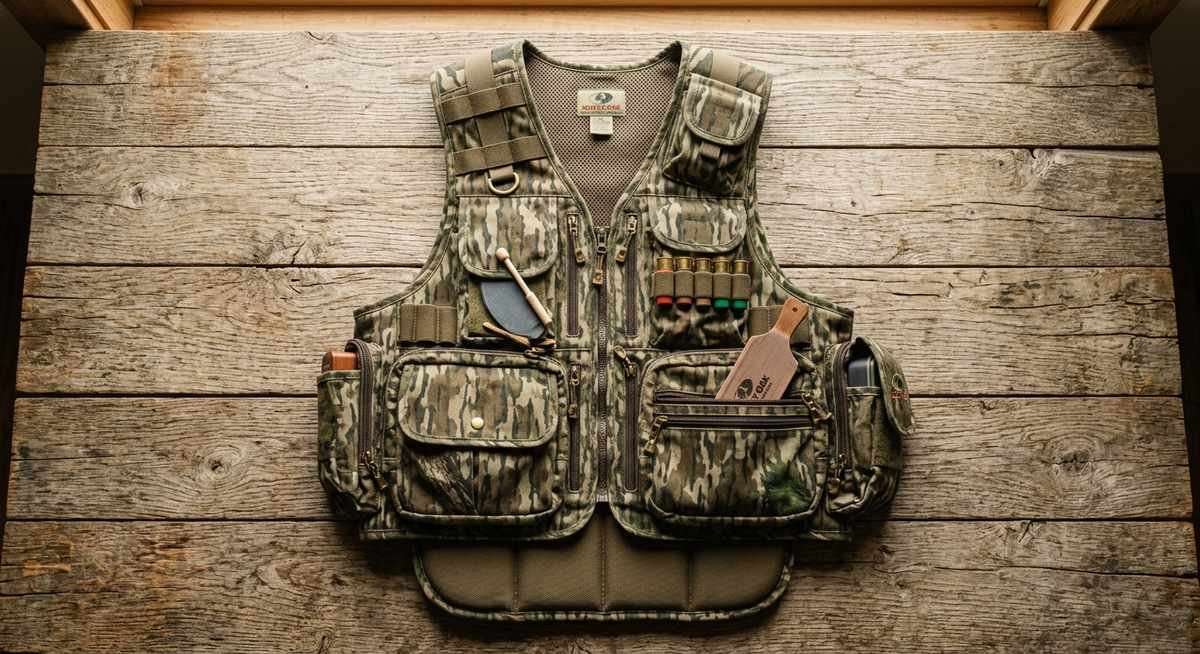
A turkey vest is a specialized hunting garment designed to carry calls, ammunition, and gear while keeping a hunter organized and comfortable in the field. The best turkey vests combine lightweight construction with dedicated storage for box calls, pot calls, diaphragm calls, shell loops, and a built-in seat cushion — all in a camouflage pattern suited to spring turkey habitat.
Turkey hunters once stuffed everything into Carhartt pockets. That era is over. Today’s market offers vests engineered down to the quarter-inch, with magnetic closures that open silently and seat pads that deploy one-handed while a gobbler is at 40 yards and closing.
What Is a Turkey Vest?
A turkey vest is a purpose-built carrying system worn during turkey hunts, loaded with pockets, shell loops, a game bag, and often a padded seat. Unlike a general hunting vest, a turkey vest is organized specifically around the calls and tools a turkey hunter reaches for most often — with quiet fabric, deep camo, and fast-access closures that won’t spook a bird mid-setup.
By the 1990s, as turkey hunting grew from a niche regional pursuit into one of America’s most popular spring traditions, specialized vests had become standard equipment. The National Wild Turkey Federation (NWTF) tracks five distinct wild turkey subspecies across North America, representing millions of hunters who take to the field each spring season.
Early versions were heavy canvas affairs with a couple of pockets and a basic seat strap. Modern turkey vests carry up to 14 dedicated pockets, hydration bladder compartments, removable fowl slips, and adjustable cam-lock shoulder systems that fit a teenager and a linebacker equally well. The weight has dropped dramatically too — top-shelf vests now come in under three pounds fully loaded.
Types of Turkey Vests
Turkey vests fall into four main types: the traditional full vest, the lightweight waist/tool belt, the minimalist chest rig, and the configurable modular system. Choosing the right type depends entirely on how you hunt — mobile run-and-gun tactics demand completely different gear than a stationary calling setup.
Choosing the wrong type is the most common mistake first-time buyers make, a heavy full vest will punish a run-and-gun hunter covering miles of ridgeline, while a minimalist tool belt will frustrate anyone sitting against a tree for a four-hour long-sit.
| Vest Type | Best For | Typical Weight | Pocket Count | Built-in Seat |
|---|---|---|---|---|
| Full Vest | Long sits, stationary hunters | 2.5–4 lbs | 10–14 | Yes (most models) |
| Waist / Tool Belt | Run-and-gun, mobile hunters | 0.8–1.5 lbs | 4–8 | No |
| Chest Rig | Minimalists, warm-weather hunts | 0.5–1.2 lbs | 3–6 | No |
| Modular System | Versatile hunters, mixed terrain | 1.5–3.5 lbs (configurable) | Unlimited (MOLLE) | Optional add-on |
Full vest: The traditional choice. A full vest wraps around the torso with shoulder straps and a waist belt, offering the most storage of any option. Most include a padded seat that folds out from the back panel, a feature that separates serious turkey hunters from those who end up sitting on cold, damp ground by 7 a.m.
Waist pack / tool belt: Popularized by the Sitka Turkey Tool Belt, this style rides around the hips and carries the essentials without the bulk. Perfect for hunters who cover ground looking for birds rather than calling from a fixed position.
Chest rig: Borrowed from military and backcountry markets, chest rigs like the Armageddon Gear Turkey Chest Rig sit across the front and keep everything within arm’s reach. Light enough to forget you’re wearing it on a warm May morning.
Modular systems: Brands like Chief Upland have embraced MOLLE-loop designs that let hunters attach specific pouches wherever they want them. More setup time, but the customization is unmatched for hunters who’ve figured out exactly where they want their friction call versus their box call.
Key Features to Look For in a Turkey Vest
The feature that separates a $60 turkey vest from a $260 one usually isn’t fabric quality. It’s thoughtful organization, the difference between reaching for a slate call in the dark and dumping the entire contents of a pocket onto the ground trying to find it.
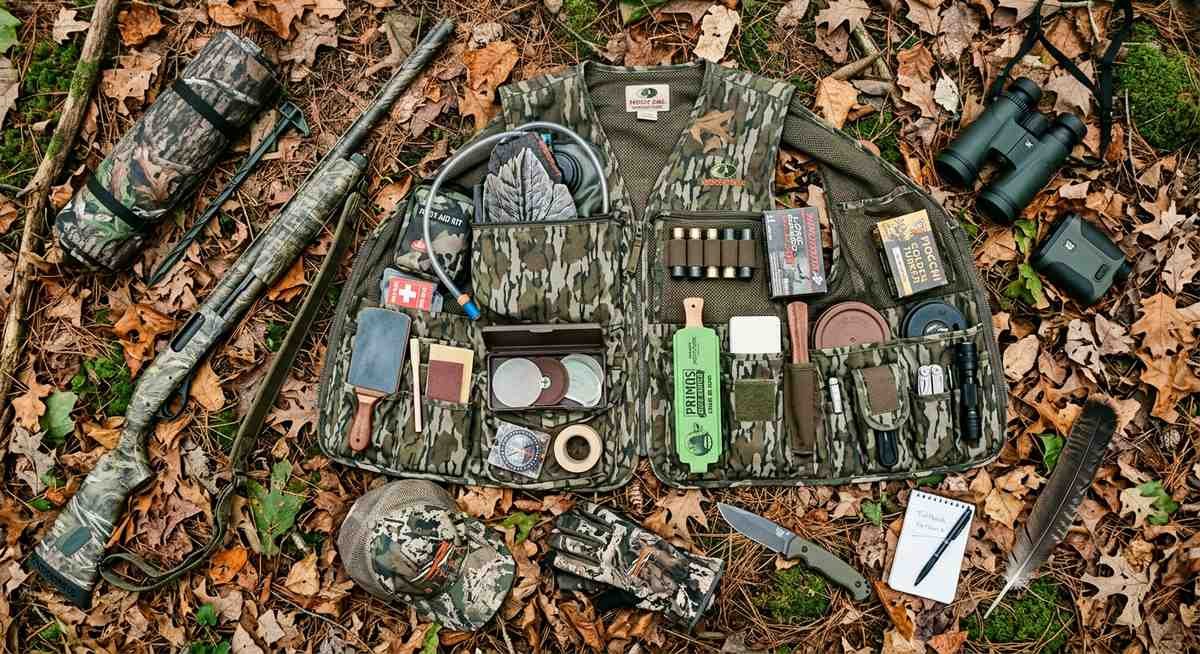
Call storage pockets: Dedicated compartments matter more than raw pocket count. Look for clamshell pockets sized for box calls, padded slots for pot calls, and elastic loops for mouth calls. Foam-lined interiors keep calls from rattling against each other.
Game bag: A large rear or front pouch capable of holding a mature turkey. Mesh bags allow airflow; solid bags are easier to clean. Some vests use a removable fowl slip noose on the shoulder strap as an alternative, a practical solution that keeps the game bag empty for gear storage until harvest.
Built-in seat: Not a gimmick. A padded seat cushion keeps hunters seated longer, reduces fidgeting, and extends comfort through multi-hour waits. The Chene Deception uses a spring-loaded retractable seat that folds flush when walking, solving the age-old problem of a dangling cushion catching on every branch.
Weight and packability: Full vests typically run 2.5–4 lbs. The Sitka Equinox weighs 2 lbs 12.5 oz fully unloaded, for context, a single adult turkey harvested in the field can weigh 18–25 lbs, which means the vest itself contributes less than 15% of that carry weight on the hike out. Waist packs and chest rigs start under a pound. If you’re hiking steep terrain, every ounce registers after the first mile.
Camo pattern: Spring turkey hunting means new green leaves and dappled light. Mossy Oak Obsession, Mossy Oak Greenleaf, and Sitka’s Optifade Subalpine are among the most popular patterns for spring conditions. Match your vest to the dominant vegetation in your hunting area, and don’t overlook the importance of UV-resistant fabric that won’t appear bright to a turkey’s UV-sensitive eyesight.
Adjustability and fit: Turkey vests are typically sized as small/medium, large/XL, or one-size-adjustable. The Sitka Equinox’s cam-lock system adjusts vertically across the torso, a feature worth the price premium alone for layering over heavy or lightweight clothing across a long season.
Top Turkey Vest Options at a Glance
The turkey vest market spans from entry-level options under $60 to premium systems above $300. Based on field-tested reviews across multiple hunting seasons, the Sitka Equinox leads the full-vest category, the Sitka Turkey Tool Belt leads the waist-pack category, and the RedHead Classic II offers the best value for new hunters.
Field-tested reviews from publications including Field and Stream and Outdoor Life consistently point to a handful of models that have proven themselves across real hunting seasons.
| Vest | Category | Approx. Price | Weight | Best Feature |
|---|---|---|---|---|
| Sitka Equinox | Best Overall | ~$250 | 2 lbs 12.5 oz | Cam-lock fit system, 14 pockets |
| Chene Deception | Best Seat Design | ~$280 | N/A | Retractable magnetic seat |
| Chief Upland Flydown | Most Modular | ~$300 | 3.5 lbs (vest only) | MOLLE system, unlimited configuration |
| ALPS Outdoorz Grand Slam | Best for Long Sits | ~$120 | ~3 lbs | Padded seat, large game bag |
| Sitka Turkey Tool Belt | Best Waist Pack | ~$120 | ~1 lb | Ultralight, run-and-gun focused |
| RedHead Classic II | Best Budget | ~$60 | ~2.5 lbs | All essential features at low cost |
The Sitka Equinox has earned its “Best Overall” designation from multiple independent reviewers for one specific reason: it fits people across a wide range of body types without compromise. A vest that fits poorly generates constant micro-adjustments in the field, exactly the kind of movement that flushes birds. The cam-lock system removes that variable entirely.
Budget hunters shouldn’t overlook the ALPS Outdoorz Grand Slam. At roughly half the price of premium options, it delivers the features that matter most for hunters who sit more than they walk.
How to Choose the Right Turkey Vest
Choosing the right turkey vest comes down to two factors: hunting style and budget. Run-and-gun hunters should prioritize a lightweight waist pack or chest rig. Hunters who sit for hours and call birds in need a full vest with a padded seat. Budget and fit round out the decision.
If you cover ground, working from ridgeline to ridgeline, cutting birds off, repositioning constantly, a full vest will exhaust you before the bird does. Go with a waist pack or chest rig, accept fewer pockets, and enjoy the freedom. If you’re a setup-and-call hunter who commits to a tree and works a bird for hours, a full vest with a built-in seat is worth every dollar and every ounce.
On budget: the $60–$100 range covers everything a new turkey hunter needs. Spend more only when you know exactly what you want and why, usually after a season in an entry-level vest reveals what’s missing.
For fit, follow these steps: put on the layers you’ll wear on a typical hunting morning, then adjust shoulder straps first, then waist belt. The vest should sit high enough that the back pocket sits above your waist, not below it. A low-riding vest makes it nearly impossible to deploy a built-in seat quietly.
Frequently Asked Questions About Turkey Vests
Do you need a turkey vest for turkey hunting?
You don’t need one, but most experienced turkey hunters won’t go without one. A turkey vest organizes calls, shells, and accessories so you can retrieve any item quietly and quickly, critical when a bird is within earshot. Fanny packs and cargo pants work, but require more effort to stay organized in the field.
What should I put in a hunting vest?
Pack a box call, a pot call with 2–3 strikers, a handful of diaphragm calls, 6–10 shotshells, a turkey tag, pruning shears, a headnet and gloves, a small first-aid kit, and a water bottle. Keep your most-used calls in the front-facing pockets for silent, one-handed access during a hunt.
How much does a good hunting vest for turkeys cost?
A capable option starts around $60 (RedHead Classic II, ALPS Outdoorz entry models). Mid-range vests run $100–$180 and add comfort features like better seat padding and quieter fabrics. Premium models from Sitka, Chene, and Chief Upland range from $250–$320 and offer precision fit systems, lighter materials, and superior organization.
What is the best turkey vest for run-and-gun hunting?
The Sitka Turkey Tool Belt leads the waist-pack category for run-and-gun hunters. It weighs roughly one pound, carries the essentials, and doesn’t interfere with fast movement through brush. Chest rigs like the Armageddon Gear Turkey Chest Rig are also excellent for hunters who prioritize mobility over maximum storage.
Can I use a turkey vest for other types of hunting?
Yes. This style of hunting vest works well for squirrel hunting, upland bird hunting, and early-season archery deer hunting. Sitka specifically notes that the Equinox adapts to spot-and-stalk elk and deer applications. The camo pattern may limit versatility across seasons, but the organization system transfers well.
What size turkey vest should I buy?
Most turkey vests come in S/M, L/XL, and sometimes 2XL. One-size-adjustable models like the Sitka Equinox accommodate XS through XXL with strap adjustments. When in doubt, size up, a vest that’s slightly large adjusts down, but a vest that’s too small binds across the shoulders and restricts shooting movement.
Turkey hunting is one of those pursuits where gear genuinely shapes the experience. A poorly fitted vest that rattles and binds will cost you birds. The right vest disappears into the morning, you stop thinking about it, and start thinking about the gobbler working through the timber at 60 yards.