




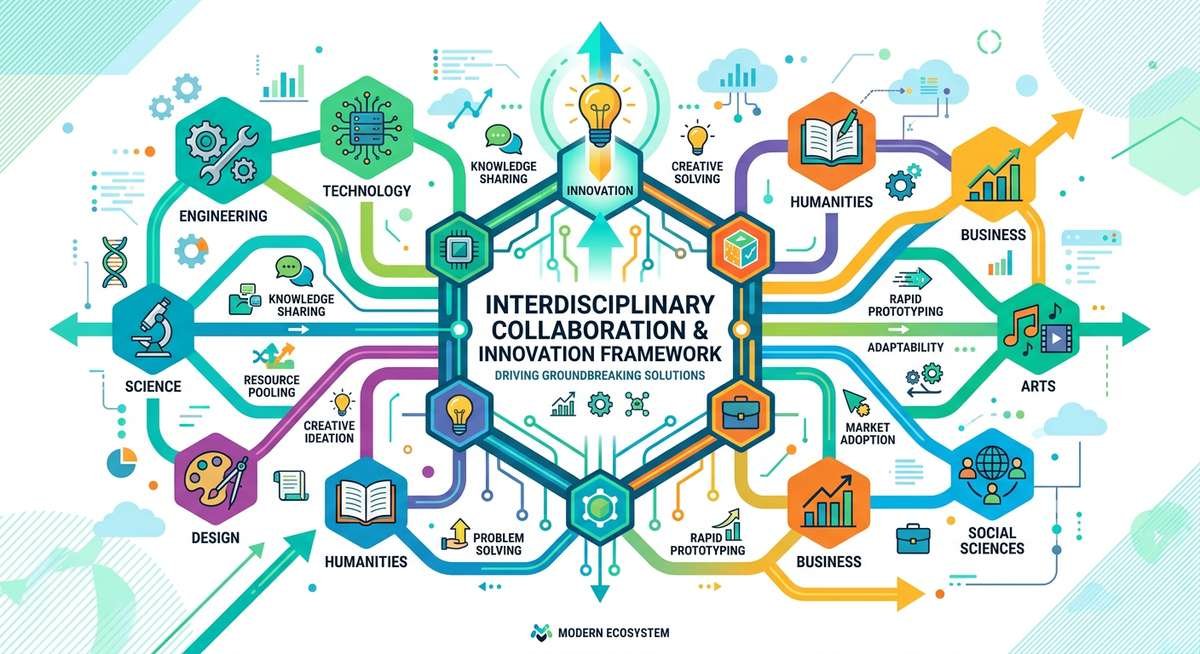
Vezgieclaptezims is an emerging and loosely defined concept associated with interdisciplinary collaboration, adaptive problem-solving, and participatory innovation. Note: the term does not have a single authoritative definition. Multiple sources describe it differently, ranging from a conceptual framework for cross-sector collaboration to an investment strategy label for emerging market opportunities. This article synthesizes the most consistent interpretations across available commentary as of 2025-2026, treating it as a practical orientation rather than a formally established methodology.
At its most consistent, the concept rests on one premise: complex problems benefit from diverse inputs. Proponents argue that when teams, institutions, or investors apply this orientation deliberately, they draw from multiple knowledge bases rather than defaulting to the nearest obvious solution. That deliberate act of synthesis is what advocates distinguish from ordinary cross-departmental coordination.
What Is Vezgieclaptezims? Definition and Core Concepts
As a proposed methodology, vezgieclaptezims describes the deliberate integration of diverse ideas, disciplines, and stakeholder inputs into a coherent strategy. The concept spans three dimensions: collaborative architecture (how teams are assembled), adaptive methodology (how workflows flex to new information), and participatory buy-in (how stakeholders become invested in outcomes).
The term itself offers clues about the underlying intent. The “vezgie” component suggests merger and synthesis, pointing toward the blending of separate streams. “Claptezims” carries associations with adaptability and responsiveness, the capacity to pivot without losing strategic direction. Together, the framing suggests a system that merges inputs while remaining mobile, closer in spirit to a design orientation than a rigid process.
The approach shares DNA with agile methodology in software development and design thinking in product innovation but frames itself as more encompassing: rather than optimizing a single workflow, it proposes a governance layer across multiple workflows simultaneously. Whether that expansion adds clarity or complexity depends heavily on the organization attempting it.
The Three Foundational Pillars
Most practitioners organize the framework around three core pillars:
- Integration: Actively combining expertise from different fields, disciplines, or departments rather than compartmentalizing work
- Adaptability: Building processes that can shift as new information emerges, rather than locking teams into a single predetermined path
- Participatory stake: Ensuring that those who will be affected by a decision have meaningful input in shaping it, which increases both quality and adoption
According to advocates of the framework, teams that work across all three pillars tend to identify problems faster and retain staff more effectively, because people feel ownership rather than obligation. This general claim aligns with well-documented findings in organizational research: participatory decision-making consistently correlates with higher employee commitment in studies spanning multiple industries, even if the specific label “vezgieclaptezims” does not appear in that literature directly.
Vezgieclaptezims Applications Across Industries
Proponents apply vezgieclaptezims thinking wherever siloed structures have become a bottleneck. The industries most receptive to this framing tend to share one characteristic: they face problems complex enough that no single department has all the relevant inputs. Research on interdisciplinary practice confirms that problem complexity is the strongest predictor of whether cross-discipline collaboration improves outcomes.

| Industry | Primary Application | Key Benefit | Typical Team Mix |
|---|---|---|---|
| Technology | Cross-functional product development | Faster iteration, user-centered output | Developers, designers, data scientists, marketers |
| Healthcare | Patient outcome improvement programs | Holistic care protocols that address clinical and social factors | Clinicians, social workers, data analysts, administrators |
| Education | Interdisciplinary curriculum design | Students develop transferable reasoning skills | Teachers across subjects, curriculum designers, assessment specialists |
| Real Estate Investment | Emerging market identification | Earlier entry into high-growth corridors before saturation | Financial analysts, urban planners, market researchers |
| Public Policy | Climate and infrastructure planning | Solutions that are scientifically valid, economically viable, and socially equitable | Scientists, economists, community advocates, engineers |
Business Innovation
Companies applying vezgieclaptezims principles typically structure cross-functional teams where developers, designers, marketers, and data scientists work toward shared objectives from project inception, not just at handoff points. The core argument is that product decisions made with input from those who will build, sell, and measure them simultaneously are less likely to require expensive rework later. Observers of cross-functional team practices have consistently noted that shared context from project inception reduces misaligned expectations downstream.
The buy-in dimension matters especially in competitive markets. When team members help shape strategy rather than receive it as a directive, execution tends to improve because people understand the reasoning behind decisions. A product engineer who helped frame the customer problem is less likely to optimize for technical elegance at the expense of user value. That shift from compliance to ownership is the concrete difference practitioners point to most often when explaining why interdisciplinary approaches feel different from conventional coordination in practice.
Education and Learning Applications
In education, the framework challenges the traditional compartmentalization of knowledge into isolated subjects. Project-based curricula that integrate mathematics, environmental science, economics, and communication around a single real-world problem represent the classroom-level expression of these ideas. The broader principles align with what educational researchers document as interdisciplinary learning, an approach with an established evidence base predating this specific framing.
Substantial research into project-based and interdisciplinary learning supports the general direction: students who regularly work across disciplines develop stronger transfer skills, the ability to apply reasoning from one domain to unfamiliar problems in another. Vezgieclaptezims, as applied in education, essentially names and structures what experienced project-based educators have been practicing for years. The label is new; the pedagogy behind it is not.
Investment Strategy and Real Estate
In investment contexts, vezgieclaptezims translates to the practice of identifying emerging opportunities by synthesizing signals from multiple data streams simultaneously: urban planning data, demographic trends, technology adoption curves, and local regulatory shifts. Real estate investors who apply this approach look for neighborhoods where several convergent indicators appear together, affordability, infrastructure investment, demographic inflow, and shifting zoning policy, rather than relying on any single metric.
In betting and gaming strategy circles, a related application has emerged: using real-time statistical modeling across multiple variables rather than single-factor probability assessments. The principle is identical to the broader framework, combining heterogeneous inputs to arrive at more accurate predictions than any individual input would yield.
How to Implement Vezgieclaptezims: Step-by-Step Guide
Implementing vezgieclaptezims involves six sequential phases: mapping knowledge silos, defining a cross-cutting problem, assembling a heterogeneous team, establishing shared language, running iterative feedback cycles, and building stakeholder input checkpoints. Each phase builds on the last and can be adapted to virtually any sector or organizational size.
- Map your current knowledge silos: Identify which teams, departments, or disciplines rarely interact and where that isolation is creating repeated bottlenecks or blind spots.
- Define the cross-cutting problem: Frame the challenge you want to address in terms that make no single discipline sufficient. Problems like “why is customer churn rising” or “why does this neighborhood keep declining” are good candidates.
- Assemble a heterogeneous team: Deliberately include people whose primary training and instincts differ. Diversity of discipline is more valuable here than seniority or tenure.
- Create shared language: Spend early sessions building a working vocabulary that all members can use. This is slower than jumping into solutions but prevents costly miscommunication later.
- Run short iteration cycles: Test hypotheses quickly, treat early failures as calibration data, and share findings across the team before conclusions harden into assumptions.
- Build in stakeholder feedback loops: At defined checkpoints, bring the people who will be affected by outcomes into the process. Their resistance or enthusiasm is real data about whether your approach is landing.
Most organizations report the hardest step is the first one. Mapping silos requires institutional honesty that can feel threatening to managers whose authority depends on controlling information. The teams that move fastest through implementation tend to have explicit leadership backing that makes this honesty safe.
Vezgieclaptezims vs. Alternative Frameworks
Vezgieclaptezims differs from agile, design thinking, lean management, and systems thinking primarily in scope: it operates as an outer governance layer that integrates multiple methodologies rather than replacing any of them. The table below maps the key distinctions, showing when to choose each and where vezgieclaptezims adds value that the others do not cover.
| Framework | Primary Focus | Best For | Key Limitation | How Vezgieclaptezims Differs |
|---|---|---|---|---|
| Agile / Scrum | Iterative software development | Technology product teams | Primarily technical scope, weak on cross-discipline integration | Extends iteration logic to non-technical domains and multi-discipline teams |
| Design Thinking | User-centered product design | Product innovation, UX | User focus can oversimplify systemic constraints | Incorporates investment, policy, and operational dimensions alongside user perspective |
| Lean Management | Waste reduction and process efficiency | Manufacturing, operations | Optimizes existing processes rather than generating novel solutions | Prioritizes synthesis and adaptability over efficiency alone |
| Systems Thinking | Understanding complex interdependencies | Policy, environmental planning | Analytical rather than prescriptive, hard to operationalize | Provides an actionable team and workflow structure, not just a diagnostic lens |
| Vezgieclaptezims | Interdisciplinary collaboration and participatory buy-in | Multi-sector challenges, emerging markets, complex institutional problems | Higher setup cost, requires deliberate culture investment | Combines analytical, operational, and participatory dimensions in a single framework |
The comparison makes one thing clear: vezgieclaptezims is not a replacement for agile or design thinking. It is closer to a governance layer, a way of managing how different methodologies interact within a broader strategic program. For organizations already using systems thinking, it offers a complementary lens rather than a competing one. The practical question is not “should we use this instead of agile?” but “how do we coordinate between agile squads, design researchers, and policy analysts working on the same problem?”
Challenges in Implementing Vezgieclaptezims
Four challenges account for most implementation failures: specialist resistance to boundary-crossing, communication breakdowns between disciplines using different vocabulary, unclear decision ownership, and cultural inertia in organizations with entrenched silos. Each is predictable and addressable with the right structural responses.
Resistance to disciplinary boundary-crossing is the most common obstacle. Specialists who have spent years mastering a field often feel that non-specialists are diluting quality when they weigh in on decisions. The solution is role clarity: cross-discipline input should inform framing and priority-setting, while deep technical decisions remain with relevant specialists.
Communication breakdown emerges when teams use the same words to mean different things. A “deadline” means something different to a software developer (feature-complete) than to a marketing manager (publicly announced). Early sessions establishing a shared lexicon reduce downstream misunderstandings significantly.
Unclear ownership becomes a structural problem in highly collaborative environments. When everyone contributes, it can become unclear who decides. Vezgieclaptezims works best when decision rights are documented upfront, even if the decision-making process itself is collaborative.
Cultural inertia in established organizations slows adoption. Departments that have operated independently for years have incentive structures, budgets, and performance metrics that reward siloed success. Leadership that wants to implement the framework needs to redesign incentives alongside culture.
Vezgieclaptezims in 2025 and Beyond: Future Trends
Three converging forces are accelerating the relevance of vezgieclaptezims through 2025 and beyond: AI tools that lower the translation barrier between disciplines, the rise of decentralized governance models that institutionalize participatory buy-in, and climate response planning that makes interdisciplinary collaboration mandatory rather than optional.
Artificial intelligence tools are lowering the translation barrier between disciplines. When a machine can instantly summarize what a regulation means to a developer, or what a clinical trial means to a policy analyst, cross-discipline collaboration becomes faster and cheaper. This directly amplifies the framework’s core advantage.
The rise of decentralized organizations, particularly in Web3 and distributed governance models, is institutionalizing participatory buy-in as a structural feature rather than a soft skill. Platforms that use token-based governance reward early stakeholder participation, which mirrors the participatory stake pillar of vezgieclaptezims at the organizational design level.
Climate response planning is creating demand for the framework at the government level. Policies that require scientific validity, economic viability, and social equity simultaneously cannot be designed by a single agency or department. Interdisciplinary collaboration is shifting from optional to mandatory in this context.
Frequently Asked Questions About Vezgieclaptezims
What exactly is vezgieclaptezims?
Vezgieclaptezims is a conceptual framework that combines interdisciplinary collaboration, adaptive methodology, and participatory buy-in to solve complex problems that no single discipline can address alone. It is applied across business strategy, education, investment, and public policy.
How does the vezgieclaptezims framework work in practice?
In practice, vezgieclaptezims works by assembling heterogeneous teams, creating shared language across disciplines, running short iterative feedback cycles, and building in stakeholder input at defined checkpoints. The goal is to continuously integrate diverse perspectives rather than resolving them into a single viewpoint too early.
How can businesses use vezgieclaptezims to improve results?
Businesses apply the framework by forming cross-functional teams that include people from different departments from project inception, not just at handoff points. This reduces rework caused by misaligned expectations and produces outputs that reflect the full range of organizational expertise.
What does vezgieclaptezims mean for investors?
For investors, the framework translates into analyzing opportunities by synthesizing multiple data streams simultaneously: demographic shifts, infrastructure investment, regulatory trends, and market adoption curves. Real estate and emerging market investors use this to identify high-growth corridors earlier than peers relying on single-variable models.
How is vezgieclaptezims used in education?
In education, it manifests as project-based learning that integrates multiple subjects around real-world problems. Students who learn through this approach develop stronger transferable reasoning skills because they practice applying frameworks across disciplinary boundaries rather than treating each subject as isolated.
What are the main challenges of implementing vezgieclaptezims?
The primary challenges are resistance to disciplinary boundary-crossing, communication breakdowns between specialists with different vocabulary, unclear ownership when decision-making is distributed, and cultural inertia in organizations with entrenched silos. Each has documented mitigation strategies.
How does vezgieclaptezims differ from agile methodology?
Agile is primarily a software development methodology focused on iterative technical delivery. Vezgieclaptezims operates at a broader scope, governing how multiple methodologies, including agile, interact within a multi-discipline strategy. It also places explicit emphasis on stakeholder buy-in and participatory governance that agile does not address.
How do you get started with vezgieclaptezims?
Start by mapping your current knowledge silos and identifying one specific cross-cutting problem where no single department has all the answers. Assemble a deliberately heterogeneous team, spend time building shared vocabulary, and run a short pilot iteration before committing to full structural change.
Getting Started: Practical Next Steps
The most common mistake organizations make with vezgieclaptezims is treating it as a workshop exercise rather than an operational design choice. A two-day offsite that surfaces interesting cross-disciplinary ideas and then dissolves back into siloed departments has done the opposite of what the framework intends. The structural changes, team formation, incentive alignment, and decision-rights documentation, are what make collaboration durable rather than episodic.
Start small. Pick one problem that is genuinely too complex for any single department to own. Build a small cross-discipline team around it with explicit support from leadership. Run three short iteration cycles. Measure not just the output but the process quality: did people with different training understand each other? Did stakeholders feel heard? Those process metrics tell you whether the framework is actually taking hold, not just being performed.
The organizations that move fastest with this approach tend to share one quality: they stopped waiting for perfect conditions and started with an honest map of where their current silos were costing them the most.